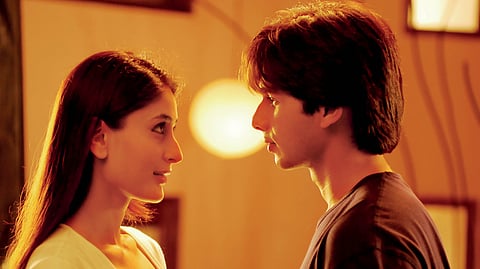


I studied in a cool college whose tagline — “it’s not a college, it’s a way of life” — sounded worse as I grew older. Jab We Met (2007) hit theatres not too long after I graduated and, overcome by a surge of incoherent emotion, I remember describing it to friends as: it’s not a film, it’s a way of life. An embarrassing choice of words (with a theatrical pause), perhaps, but the essence mattered.
For Jab We Met quickly became an inextricable part of the Hindi film lexicon. The rom-com went word-of-mouth viral, back when social media was barely a thing. It acquired the loyalty and cultdom of a generation looking for their own Dilwale Dulhaniya Le Jayenge. Moments became memes in a pre-meme era, and Pritam’s music found that sweet spot between breezy Shankar-Ehsaan-Loy and balmy Salim-Sulaiman.
Most of all, it started new trends, tropes and a whole mainstream language. Hinglish titles and sufi-flavoured Himalayan dashes aside, I’ve often cursed the film for triggering an endless wave of manic-pixie dream girl imitations (on and off screen) over the years. The ‘bubbly’ and indefatigable Punjabi heroine that Kareena Kapoor Khan immortalised was a solo female lead of sorts — and her name, Geet, became shorthand for next-gen writers to make viewers love and invest in a character without quite earning it.
Post-Geet Bollywood has been haunted by the ghost of toxically happy and chatty extroverts.
The main-apni-favourite-hu (I am my own favourite) vibe has defined characters and people across genres: where golden retriever energy meets born-yesterday idealism. Sometimes I even imagine that Tamasha’s Ved modelled himself on Geet but got so carried away that he remained stranded on the fence between performance and truth. Sometimes I wish that Rockstar’s Heer had never watched Jab We Met in her spare time. Sometimes I wonder if gems like Meri Pyaari Bindu would’ve existed if Geet hadn’t. But would Geet have existed if not for Sholay’s Basanti? That’s the burden of legacy. That’s also the collateral damage of greatness.
For those familiar with Imtiaz Ali’s charming directorial debut, Socha Na Tha (2004), Jab We Met felt like natural continuity. A film about accidental soulmates straddled multiple genres (and future Imtiaz Ali movies) at once: a road-trip movie, an elopement thriller, an interclass comedy, a coming-of-age drama for not one but two characters, a love triangle, a meet-the-family saga, a romantic musical. It’s Aditya’s story about how love cured his heartbreak, but it’s equally Geet’s story about how heartbreak cured her ability to love. It’s a poor-little-rich-boy narrative and a smiley-little-country-girl fairytale. It’s also a mistaken-identity version of the Raj-and-Simran lore, where her family trusts him so hard that they almost gaslight Shahid Kapoor into acting like Shah Rukh Khan and Aditya into falling for her.
The film opens where most tragedies close: with an 11-minute stretch of silence from a brooder whose life has fallen apart. He’s at odds with his estranged mother, an ex-girlfriend whose wedding he wordlessly attends, and a company his father has left behind. He takes a train — a space otherwise synonymous with the cinema of chance meetings and happy endings — to end it all. Only he has boarded a parallel film already in motion: this stranger, Geet, is so alive that he’s the one who eventually feels like he’s gatecrashed someone else’s compartment. His depression softens over an adventure of shady hotels, missed trains, fake homecomings, loud families and midnight escapes. Her altruism softens over a journey of shady hotels, missed trains, performative returns, venting-as-therapy phone calls and public rejections. If he is a noun in search of purpose, she is an adjective seeking a noun.
The cultural metamorphosis of Jab We Met can be traced back to the mid-2000s landscape it arrived in. Several filmmakers and auteurs arrived with distinct voices and were starting to alter the lens of the Bombay film industry: Dibakar Banerjee, Anurag Kashyap, Sriram Raghavan, Zoya Akhtar, Navdeep Singh, Shaad Ali, and Imtiaz Ali himself. Ali was perhaps the most accessible in terms of commercial Hindi film — his interest seemed to lie in renovating familiar templates rather than manufacturing new ones. In doing so, however, he did upgrade the grammar of the new-age romantic comedy. Jab We Met, like many others from the time, staged Geet as more of a male fantasy: chirpy and carefree when she’s fine, reclusive and lost when she’s not. She flits between an average man’s imagination of “bindaas girlfriend” and “subdued wife.”
But the film altered the concept of a male saviour, a staple of 2000s’ popular entertainment. The act of rescuing a woman in need of emotional support was directly linked to a hero’s nature and benevolence. He often saved others to amplify the prevailing idea of patriarchy and strength; he helped because it disguised the conventional notion of control and masculinity. His compassion would be his cape. Ali’s film equalised the stakes — it reframed Aditya’s search and rescue of a post-breakup Geet as an act of gratitude and love. He consciously revives her because she subconsciously revives him.
In the first half, Geet subverts the pattern of a happy girl fixing a tortured boy; she’s not in service of him but herself, and his transformation is incidental. He grows feelings for her because of who she is, not because of how she might have affected him. In the second half, he brings her back so that she can learn to love herself again. There’s no self-righteous desire to prove how sorted he is. He almost trusts that if she can rediscover her own spirit, she can choose the right things — including acceptance into an orthodox Sikh family that refused to disown her. One might argue that this is another brand of the male-saviour complex, where the woman needs the man to find herself. But the give-and-take rhythm makes it more of a budding companionship story than a love story. This selfless urge to return the favour and want the best for the other person — regardless of circumstances — unfolds as more of a reckoning than a sacrifice.
That’s what Jab We Met excelled at in an age where Hindi cinema was still bound by its romanticisation of the damsel-in-distress syndrome. The decade’s classics — like Veer-Zaara and even Kal Ho Naa Ho — won within the constraints of traditionalism but Jab We Met painted a proactive portrait of female agency laced with human fragility. Geet isolated herself because she felt like she had to pay the price for her ‘wrong’ judgement of original lover Anshuman; that’s how she was wired to think about sinning and redemption. But the return of Aditya gives her the confidence to follow her instincts again without worrying about societal consequences.
In many ways, this film introduced the promise of a headlining female protagonist — one who rectified the male gaze without succumbing to it. Geet sparkled so that her spiritual descendants could explode — or not — on their own terms. Ali’s subsequent movies lurked in the shadows of Geet, but the pressure showed. Most of them were technically superior and ambitious, yet it was Jab We Met that bled into new-age Bollywood’s emerging relationship with complex women characters. For better or worse, it continues to shape our everyday reality — the manic pixie boldness of social media identities and small-town slang — and not just the fictions we engage with.
After all, not all good films are remembered as films. Some of them just become a way of life.
To read more exclusive stories from The Hollywood Reporter India's October 2025 print issue, pick up a copy of the magazine from your nearest book store or newspaper stand.
To buy the digital issue of the magazine, please click here.