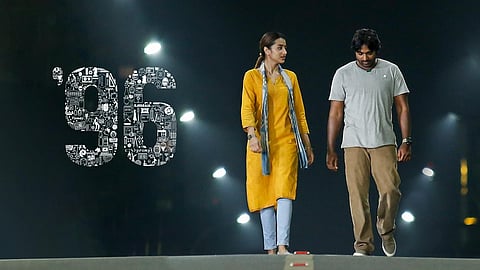


Two childhood sweethearts meet at a school reunion. He’s single, she’s married. They can’t take their eyes off each other. Once the class of ‘96 disperses, they spend the night together: in her hotel room, at his apartment. She cooks for him, sings his favourite song, shares a bed, wakes up in his shirt. They don’t want the sun to rise. But it does. He drives her to the airport. She cannot afford to miss her flight home. The yearning is complete.
It all sounds very intense, but the essence of C. Prem Kumar’s ‘96 is that it relies on the interiority of nostalgia rather than the physicality of desire. The night is actually quite platonic. Here’s how it really plays out. In her hotel room, they talk, discuss their missed connections, and recall incidents from the past. At his apartment, she (Trisha Krishnan) changes into his shirt after getting drenched in the rain. In between, he (Vijay Sethupathi) drives her around; they go for a walk, a metro ride, a barber shop and a coffee. The transience of an adult tryst is reframed as the belated end credits of puppy love. They were 15 when they last met; they’re 15 going on 37 again. When they finally touch, too, they do it through the illusion of an ‘accident’; she places her hand on the car gear that he keeps shifting. It’s like they’re trying to love without disrupting the continuity of living. They supply moments that already exist so as to uphold the illusion of unrequited feeling. They’re so used to stealing glances in school corridors that, even now, they connect like everyone’s watching.
‘96 is a remarkable film on many levels. I could say things like “they don’t make ‘em like these anymore” or fixate on the offbeat tenderness of the romance. I could praise it for humanising the trope of an obsessive man — at one point, he reveals that he had been following and stalking her for years — by letting them stew in the inertia of lost time. I could admire it in terms of the popular one-night-only template. Here are two soulmates who realise that this life of being apart might be their alternate reality; the togetherness they dreamt of is probably their truth. I could also appreciate it for just how immersive its sense of place and time is. Ram’s affection for his childhood spaces in Thanjavur bleeds into our relationship with the story. I’ve never been there, but I found myself missing those pastel-coloured school walls, the hopeful classrooms and the friendly security guard, as if it were my own little town.
It extends to their present-day scenes. When Ram and Jaanu spend the night in Chennai after the reunion, the city feels haunted by the memories they’re making. I felt the stress of her imminent departure, the pressure of limited time, and the fact that the meaning of these areas will forever be altered for him. I feared the heartache he would feel as a resident of the city, when he passes by these spots in the future. It’s a bittersweet stroll through both catharsis and grief at once; the film evokes the intimacy of experiencing and contextualising a place without needing to know it. There’s the textual tension of Chennai suspended between day and night, reality and dreams, beginnings and endings — a version of a couple reuniting mid-air between time zones, in hours that do not technically exist
The reason it feels this way is because, spiritually, the film itself isn’t supposed to exist. And I don’t mean that because it’s “different” for the genre it adopts. Let me explain. 99 times out of 100, childhood sweethearts do not cross paths again and tell themselves tales about what could have been. They placate themselves with the potential of an incomplete myth. They romanticise the what-if-ness of first love, and continue to long for the idea of the people they once knew. It’s easier to buy the lofty hypotheticals that pop culture sells rather than confront the dry incompatibilities of living. In a normal world, both of them would have skipped the reunion and held onto the dated fictions and misconceptions of each other. It’s the only way to keep loving one another: to exist in the shapeless time-zone between what is and what might have been.
By choosing to meet the way they do, however, Ram and Jaanu liberate themselves from the warm delusions of storytelling. They aren’t built to meet again, so it’s like watching two characters go rogue and rupture the canon. They dare to confront the possibility of upending their memories of each other — and puncturing the fantasy that sustained, and imprisoned, them for 22 years. Think a grounded Veer-Zaara (2004) of sorts, where the hero and heroine preserve projections of each other through an endless wait. This night isn’t supposed to happen, and therefore it almost unfolds as an act of courage here: risking the truth of uncovering whether they were ever meant to be. In a way, they’re like dreamers who force themselves to wake up and smell the (filter) coffee. It’s subconsciously why Ram fashions a trip to his hometown, activates a reunion plan, all so that they could maybe come face to face and stop hiding behind the cozy curtains of fate.
At some level, it’s also as if Ram and Jaanu meet in the hope of getting disappointed by their adult selves. It’s the only way their tragedy would be validated. It’s the only way they would feel better about missing that shot all those years ago. But the enduring charm of ‘96 is that he is still that tall, dark boy in an ink-splattered shirt; she is still that girl with a silken voice and neat plaits. There is no escaping that, even in 2018, they are hopelessly drawn to each other. Not much has changed; the scraggly beard and dignified eyes are merely disguises to protect themselves from the heritage of their chemistry. As a result it’s even braver that, by spending this night of knowing everything and nothing, Ram frees himself from the confines of a still photograph; Jaanu frees herself from the heady idealism of knowing that she will always be cherished from afar.
Suddenly, he has no choice but to move on and start living a little; she has no choice but to live on and start moving a little. She spent years under the impression that he didn’t remember her enough to pursue her; he spent ages under the impression that she resented him enough to reject him. Once they discover that the feelings were mutual all along, they are no longer tethered to the shackles of one-sided love. Just like that, their Before Sunrise and Before Sunset are catapulted in the direction of a Before Midnight. The night will become a flashback — his new-old look; her alt-ending story to his students; the melancholic hug — when they perhaps meet as pensioners in the distant future. Until then, they will remain past lives and mirror images of each other: united by design, divided by timing. After all, once the rose-tinted glasses come off, one soulmate’s 9 is revealed to be another’s 6.