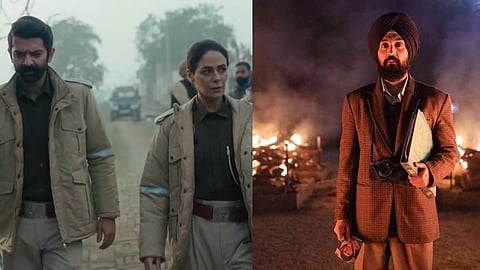


Open-hearted virility, phulkari in shades of rainbow riot, parandas and pehelwans, swaying fields of mustard and wheat, bhangra—these were the images of Punjab sold by Hindi cinema. Bonded labour, closeted homosexuality, abusive households, drug addiction, infertility, infidelity—these are the images from a new crop of Hindi films and shows set in Punjab, circling around the thriller genre, to make sense of a state in turmoil, and a collective conscience in rot.
The second season of Kohrra, set in the fictional Punjabi town of Dalerpura, is the latest among burgeoning stories that began with Maachis (1996), and more recently with Punjab 1984 (2014) and Udta Punjab (2016), which got a renewed momentum on streaming—a format that prefers stark realism in a metallic wash—with shows like Paatal Lok (2020), Tabbar (2021), Masoom (2022), Cat (2022), Chamak (2023), and the first season of Kohrra (2023), set in the fictional Punjabi town of Jagrana. Even Imtiaz Ali, the director who kept returning to Punjab as a land of emotional and cultural largesse, made Amar Singh Chamkila (2024), which infected it with a quiet sense of doom.
Independent cinema, too, twisted the dagger, with films like Kabir Singh Chowdhry’s Mehsampur (2018), Anmol Sidhu’s Jaggi (2021), and Gurvinder Singh’s Anhe Ghore Da Daan (2011), Chauthi Koot (2015), and Adh Chanani Raat (2022). If the desire to return animated much of the older films set in Punjab—the NRI in Aditya Chopra’s Dilwale Dulhania Le Jayenge (1995); both Yash Chopra’s Veer-Zaara (2004) and Ali’s Jab We Met (2007) ending with an arcing back to the agrarian homelands—it is the desire to escape that powers much of the newer Punjabi films and stories.
It is not a coincidence that in both seasons of Kohrra, the murder that sets the snowball rolling, is that of an NRI. If you return, inevitably, you die. “To have the NRI die in both seasons wasn’t by design. If an NRI dies, though, you have a bigger case, for if the embassy gets involved, we are screwed,” Gunjit Chopra, the writer of Kohrra, tells THR India.
Even, Lohri, the harvest festival of joy, that DDLJ and Veer-Zaara used to stage not just a carnival of colour, but courtship, too, in the hands of Kohrra’s creator-director Sudip Sharma becomes a site of family rupture—incest and infertility coming to the surface of the fragile festivities. Punjab is being re-written in the cultural imagination. Punjab noir is the feted genre.
Noir is a strange, shapeless genre, for unlike, say “comedy” or “musical” or “Western”, it isn’t immediately apparent what aspect of the film is being referred to—it is more tied to atmosphere than narrative. The French critic Nino Frank who coined the term ‘noir’ in 1946 referred to something beyond plot and action in the films around and after the Second World War, a psychological scaffolding that unmasks something sinister in contemporary society. These stories—decidedly political—borrow their bleakness from a place in poisonous churn. Historical residue is, thus, essential to Punjabi noir.
Yash Chopra was a Punjabi Khatri, displaced by the Partition. While Chopra’s elder brother, BR Chopra, left Lahore and eventually settled in Bombay, there were also other artists—the Anand brothers and Balraj Sahni—who despite working in Bombay, were hoping to return ‘home’ i.e. Pakistan, a return made impossible by the cleaving of the countries. Post-partition, there was an increasing ‘Punjabification’ of Hindi cinema, with the influx of Punjabi directors, actors, and lyricists, and the pan-Indianisation of Punjabi rituals—Karwa Chaut and the glitz-governed Punjabi wedding with mehendi and a reception, for example. As Vijay Sharma writes in Bollywood Cinema: Temples of Desire, “Punjabi ethos (Sikh and Hindu) is displacing the old North Indian Hindi ethos of Bombay Cinema.”
In Chopra’s films, Punjab takes on a halcyon-like glow, as though erupted from a mind that can only make sense of a place through nostalgia. The iconic embrace between Raj (Shah Rukh Khan) and Simran (Kajol) in the sarson ke kheth (mustard fields)—which later becomes the comical ganne ke kheth (sugarcane fields) in Jab We Met—is emblematic of love itself.
Gunjit Chopra, however, notes, “These are not romantic places, these were made romantic. These are normal spaces where anything can happen—romance can happen, murder can happen. Besides, we imagine there is always sarson ke kheth in Punjab. Do mahine hoti hai, yaar. (It is only there for two months) DDLJ was not even shot in Punjab; it was shot in Haryana. We are so used to seeing Punjab from one lens.”
A new generation of storytellers came to the fore, some of whom lived through the post-Green Revolution Punjab, the “Dehshat” period, with the Khalistani movement in simmer and sputter, and Operation Bluestar in 1984, with the subsequent political fallout and large-scale disappearances of civilians in the 1990s by the Punjab Police, all the way to the drug crisis in the aughts from increased youth unemployment and being a border state, not to mention the land poisoned by increased pesticides and fertilizers, leading to rising indebtedness, crop failure, poisoned groundwater, and cities evacuated of their productive youth, leaving behind a ghostly impression.
These filmmakers are reframing the charged meaning of spaces. In the first season of Kohrra, for example, the dead body was found in the same fields that a decade ago would house lovers in embrace. In the second season, the dead body was found in the animal shed—once a site of son-of-the-soil machismo drinking milk directly from the udder in Namastey London (2007).
“Humein sirf sarson ke kheth dimaagh mein nahin aate, sarson ke phoolon mein khoon dikhayi deta hai (We don’t see the mustard fields, but see the blood on the mustard flower)," Honey Trehan, director of the unreleased Punjab 95, tells THR India, “Our Punjab is different.”
In some sense, this shift began with Udta Punjab, a film on the drug crisis and the abuse of migrant labour. “We were young and wanted to make a fancy, cool film about drugs. Then we went to Punjab—the rehab centers, spoke to addicts and doctors—and the situation was bleak. It unnerved [co-writer] Sudip [Sharma] and I. At that time, we just thought we should make a film on this issue and make it count, no matter what. Nobody was talking about it," writer-director Abhishek Chaubey says.
While Udta Punjab lit the fire, both Sudeep Sharma and Honey Trehan—who also worked on the film—would go onto chart their respective stories of Punjab that have a far bleaker visual and narrative tone, a “hyper-real” storytelling, the equivalent of focusing a microscope on the pores of place. Even aspiration, the thing that Udta Punjab ends with—the migrant labourer’s dream of a Goa vacation—is putrefying in Kohrra. There is no space for dreams, because there is no future.
There is something absurd about the fake bust of the Statue of Liberty in Kohrra, or the fake landscaped garden with a pond and pelican statues in Masoom. They even make the good life seem grotesquely derivative. “I have seen weird things in Punjab—statues of planes on top of houses, caravans in their courtyards, using it to just sleep in. Half of the cars have a Canada flag. You will see huge buildings with the Canadian Parliament or Niagara Falls. In marriage halls, there are signs saying, “No spitting, no smoking, no guns”. You don’t see that anywhere else. People are really okay with this culture,” Gunjit Chopra tells THR India.
Sharma, however, was clear that he did not want to force-fit the cultural and political issues into his story. “We wanted to focus on the private trauma, and find organic ways to inform the character’s lives through a peek into their past, making the character fuller. How do you talk about a place without a past, without going the other way around? We did not want to put the cart before the horse.” In a poignant moment, a character confesses her past, referring to the disappearances of the 1990s, which haunt the decisions made today.
Punjabi cinema was itself in shambles by the decades of dehshat to respond to any of the turmoil. The subsequent resurgence of Punjabi cinema in the late 2000s was unable and unwilling to tell its own stories. Director Anurag Singh, who made the foray from Punjabi to Hindi, balancing Punjab 1984 with other blaring Punjabi rom-coms, tells THR India, “Even these films were largely rom-coms with an eye at a hefty box-office return. There is hardly any serious dissection of Punjabi society."
Gurvinder Singh notes, “The popular mainstream Punjabi cinema is caste dominated by the Jatts—made by the Jatts, about Jatts, aiming at a Jatt audience here and also overseas.” Popular music that came from Punjab, but was often being made in Canada, too, preferred “reinforcing stereotypes of a certain lifestyle, with gendered aspiration—what men should be like, how men should be looking at women, etc.”
An essential aspect of Punjab noir’s aesthetic is a lingering loneliness. Gurmeet Singh, the creator of Masoom (2022), an adaptation of the Irish drama series Blood, decided to transplant the thriller from Dublin to a small town in Punjab, because “the original setting was also moody—the distance between one place and another, the feeling of isolation and cold.”
Despite its grim narrative, Singh was clear that the visuals for the series should not be dark or depressing. “Overall, because Masoom dealt with the theme of loss, we were hoping to keep the sense of hope and a better tomorrow alive. We didn’t want to take that away from the viewer. While the isolation was something we wanted to keep in the story, we didn’t want the viewer to feel that sense of depression or despair.”
On the other hand, Chaubey decided to desaturate his images in Udta Punjab and the cold tones in Kohrra replicate the light of harsh winters with soft fog, with high-contrast lighting and deep shadows. For Tabbar, Ajitpal Singh decided to use bleach bypass (to reduce saturation) and silver nitrate (to enhance the wrinkles and the texture of the skin of its older protagonists), though Singh confesses that it was a decision borne out of budgetary constraints. “There was no way I could control the colour palette during the shoot. I didn’t want that in the final image—somewhere it is yellow, somewhere it is blue.”
For a culture known for verbose cheer, Kohrra is filled with moments of ennui, the camera lingering on characters’ mute faces, speech as though uncomfortable with the shape of their feelings, and so avoiding it altogether. That is trauma. This haunting is made more apparent in Ajitpal Singh’s Tabbar, which ends with an almost Shakespearean exorcism of the soul.
The choice of locations, too, is important. Chaubey did not want to use any grand mansions. Even for the film’s concert scenes, “we wanted to keep it a little tacky, because that is what you would expect. We deliberately called concert lighting guys from Chandigarh who do this kind of thing. We avoided the grand, saturated look. The moment you walk into the film, you should realise this is a different Punjab film.”
Filmmakers had to be careful, though, for their muscular desire to tell new stories got quickly deflated by the state’s censorship. Udta Punjab was given 89 cuts by the Central Board of Film Certification (CBFC), which the Bombay High Court eventually struck down. In the years since, the CBFC’s noose and unchecked power has tightened. Honey Trehan’s Punjab 95 is still unreleased, with the CBFC demanding over 120 cuts—including absurd directions like removing the word “Punjab” or “State” or “System”. Sharma set both seasons of Kohrra in fictional towns. “We are not shining a bad light on these places. It is just that conversations tend to go in this absurd direction — ‘Oh you are showing this place as that, and it is an insult’ — which we never intended. We wanted the conversation to be about values, not places.”
Even as these films and shows tap into the gloomy contemporary, they infuse it with ideals of culture. The use of Gurbani—composed by Baba Farid, a 12th-century Punjabi Muslim mystic—in Tabbar, Shiv Kumar Batalvi’s poetry in Udta Punjab, the colourful language, and even the playful re-working of popular chartbusters ‘Tare Gin Gin’ and ‘Baajre Ka Sikka’ in Kohrra makes it clear that these are not portrayals that emerge out of distaste, but despair. There is neither revelry nor pity in this rot.
The sant-sipahi (saint-soldier) culture of Punjab, framed by the British as a “martial race”, and stereotyped later by Indians as large-hearted and pea-brained, deserves a reckoning. Nostalgia has expired. It is important, though, that this reckoning is not reactionary or complacent—and even as it contends with the state’s brutal reality, doesn’t collapse into a performative pessimism where the bleakness becomes less political and more of an easy, replicable aesthetic.
When asked about the possible fetishization of this gloominess, Gurvinder Singh responds, “It might be already happening. I don’t know why the gloominess of Punjab has to revolve around just crime. There is gloominess beyond crime, too. Are the stories tackling that?”