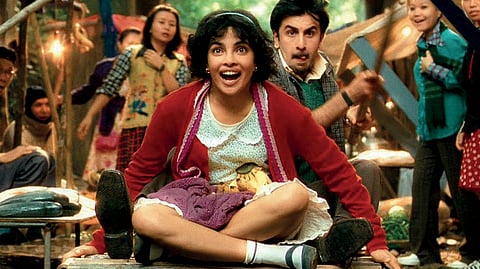


When I chose to write about Barfi! (2012) for this column, I followed the usual ‘flashback’ routine: rewatch the film, think about it for a few days, recall my first theatrical experience, then write. But this time around, I never got past the rewatching stage. I kept replaying the visual gags, musical interludes, vibrant set pieces and playful vignettes of Anurag Basu’s film. What’s funny is this is a monthly ritual; it needs no special occasion. Whenever I feel deflated after reviewing a string of mediocre titles, I switch on Barfi! for a bit. I start with a glimpse, but get carried away. Being under its spell becomes a booster shot — a timely and timeless reminder of why we love the movies to begin with.
It’s the cinematic equivalent of meeting your favourite person after a tough week. Even if they’re familiar, they feel new. Even if their life is inherently dark, they are impossibly light-footed. And it’s not like they’re in denial; this is just who they are. The legacy of Barfi! lies in its courage and ingenuity to give traditionally “sad” movie themes a dreamy, peppy and fable-coded makeover. We have a deaf-and-mute hero (Ranbir Kapoor, as Barfi), an autistic heroine (Priyanka Chopra Jonas, as Jhilmil), a tragic third wheel (Ileana D’Cruz, as Shruti), subplots of kidnapping, loss and heartache.
It’s why one of the film’s many inspirations, Jean-Pierre Jeunet’s Amélie (2001), was such a milestone — the adventures of an introvert who inherited the idiosyncratic energy of her own imagination. The framing device of Barfi! might look odd at first. When an old Barfi falls sick, we hear of his history from an assortment of documentary-style talking heads: aged characters who look back on his bittersweet journey across 1970s’ Darjeeling and Calcutta. It’s the medium used to celebrate an extraordinary man who strived to be ordinary. The primary narrator is Shruti Ghosh Sengupta, the woman who longed for him after breaking his heart.
What this format accomplishes is twofold. It not only justifies the chaos of a non-linear narrative, but it also allows the film to look and sound the way it does. The story seems to unfold in pronounced shades, pop-cultural influences and designed memories. It’s as if the interviewees are subconsciously remembering the couple as characters from a silent film navigating a talkies’ era. You can sense that their pitch is heightened to estimate how the world might look to Barfi; the film itself spoofs their perspective. As Bengalis, their inherent passion for film and literature (literally) paints the way they visualise things; the Chaplin-and-Keaton-meet-Amélie treatment marries their past and present. It’s also to atone for the black-and-white palette that one often attributes to characters who do not speak — a style that stems from guilt and hindsight. Every scene is a little more cinematic because they’re trying to comprehend the couple through the limitlessness of art.
In other words, Basu’s storytelling and Pritam’s background score are not derivative. The homages are integral to its grammar. The reason it feels like borrowed shards of previous films is because the characters have no other references — we simply see the graphics they are wired to imagine. Their gaze is written into our relationship with the film. It’s not a love letter to the movies; it’s a letter that normalises movies in love. When the “Picture Shuru” song begins as the pre-film disclaimer, it’s the kind of pure thing that Barfi or Jhilmil would interpret a disclaimer as; their perception of everyday life remains untarnished by the burdens of optics and adulthood. The “live band” in every other shot lends context to Basu’s Life… in a Metro (2007) gimmick — it’s likely how the protagonists construe the source of music when they hear it. It reminds me of how, as a child enamoured by cinema halls, I was convinced that a transparent screen separated viewers from live actors and orchestras performing behind.
There’s also the symmetry of the love triangle. When Shruti slowly falls for Barfi, the problem isn’t her marital or social status so much as her ableist instinct to love as an extension of sympathy. She thinks she is charmed by how smooth he is, but she’s actually fascinated by how different he is. Her compassion is shaped by a desire to ‘accept’ him; it’s a distance that can’t be bridged. But when Barfi’s love for Jhilmil emerges from the space of caregiving (everyone chases Barfi, but she follows him), it reclaims romance as a tenor of companionship. His primal feelings — being protective, indulgent, paternal even — evoke a custodial bond of sorts. She doesn’t fix him, he doesn’t rescue her; instead, they complete each other the way delayed reactions complete shy gestures. It takes Shruti a while to realise that they yearn in a language she can’t understand.
Barfi! is Kapoor’s most intuitive performance, but every time I rewatch parts, I see a fresh dimension. My latest takeaway is how Kapoor plays the deaf-and-mute man not as a victim, and not as an exception to the norm. Conversely, he plays Barfi as someone who is amused by the fact that others can talk and hear. He sees them as the exception to his norm — as humans who are handicapped by the gulf between thoughts and voices. Much has been written about Chopra Jonas’s turn as Jhilmil, but I still believe that she finds the sweet spot between creative excess and emotional truth. It’s a difficult role in a shapeless genre, not least because Jhilmil’s sense of attachment is coming of age; she is discovering her capacity to need while mitigating her ability to want.
It’s easy to overlook D’Cruz in the bargain, but some of the most soulful passages feature Shruti’s mute glances in a trinity where unsaid feelings outweigh unexpressed ones. When Shruti’s eyes betray her and reveal Jhilmil’s cries from afar during the famous climax, Barfi’s actions encapsulate the essence of her character. He pauses, smiles, takes a breath and combs his hair, almost as though Shruti’s face is a mirror in which he can see the reflection of his soulmate.
Barfi! is also when Basu became an oeuvre — he is to whimsy what Sanjay Leela Bhansali is to beauty and Anurag Kashyap is to life. If his filmography were a day, Barfi! would be the magic hour: that warm dance of colour before the stillness of sunrise or after the spectacle of sunset. It’s Basu’s finest film, because it’s the most aligned distillation of his unstructured talent. As a result, it’s also a shadow that has loomed over all he’s made since. Jagga Jasoos, Ludo and Metro… In Dino have suffered by comparison; it’s like seeing a slew of risky half-centuries from a batsman whose triple century is still revered. But I suspect that time is his ally. Perhaps these movies entertain in a language we haven’t understood yet. Perhaps our reaction is destined to be delayed. And perhaps in my next rewatch, Basu’s actors and Pritam’s band will jump out from behind the television to prove that the screen was a window — not a canvas — all along. After all, Barfi! vindicates the child in us without alienating the adult.
To read more exclusive stories from The Hollywood Reporter India's September 2025 print issue, pick up a copy of the magazine from your nearest book store or newspaper stand.
To buy the digital issue of the magazine, please click here.