

Revisiting older Hindi films for a flashback column is an interesting exercise. One tends to map out memories of bygone theatrical experiences through the lasting impact of specific emotions, scenes, or incidents. For instance, I could remember the feeling of Kahaani (2012) through its nervy interval buzz, the euphoric and rainy silence of exiting the mall after Udaan (2010), or the happy high of chuckling with strangers during Piku (2015). With several Salman Khan-starrers from that era, the rewatch is more visceral. The background score of an introductory scene or explosive set piece is mentally accompanied by whistles and claps and celebratory hoots. Most visuals are still accompanied by the sensory chaos of stray limbs and dancing bodies blocking the screen. Reactions in a cinema hall become an inextricable part of cinema itself; the passionate parasocial relationship shapes the soundscape and visual language of such stories.
Rarely has this ‘stadium spectacle’ been more pronounced than in Kabir Khan’s Ek Tha Tiger (2012). In hindsight, the stylish spy actioner went on to become many things: the first title under the YRF Spy Universe franchise; the highest grosser of a banner year for Hindi cinema; the first of three ambitious collaborations between two Khans — one a talented mainstream creator, the other a popular icon with a cult following — that peaked with Bajrangi Bhaijaan (2015); the hit that catapulted Katrina Kaif to the peak of a male-dominated industry in a year where an item song (‘Chikni Chameli’ from Agneepath, 2012) and a love triangle with Jesus Christ (Jab Tak Hai Jaan, 2012) became viral sensations.
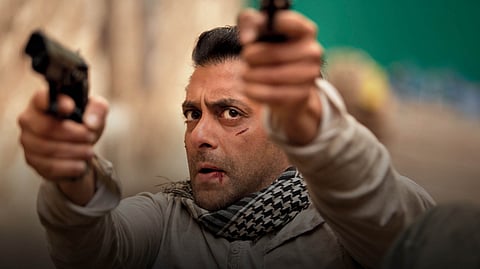
But in that moment, Ek Tha Tiger became a movie of incomparable moments. The triple-threat hero-entry shot is the best in Salman Khan’s career: first the title appearing over the silhouette of a familiar figure looking over a Middle-Eastern town, then the reflection of a face in a rearview mirror, and finally, a full-blown reveal of Tiger (and his famous chequered scarf) against a slow-mo foreground of falling cigarette butts. The massiness is written on the wall: if you’re a baddie, ‘Bhai’ is as injurious to health as smoking is.
Good directors don’t worship the superstars they work with, they weaponise this reverence into something sharper. They don’t cater to die-hard fans by giving them what they want, they expand the idea of fandom by showing them what’s possible. Kabir Khan does this skilfully in Ek Tha Tiger, fusing the mythical legend of the actor with the slick machinations of the genre. Much of the plot — particularly the characterisation of RAW operative Avinash “Tiger” Singh Rathore — mines and meme-fies Salman Khan’s off-screen image. After the slick entry shot, for example, the larger-than-life frame of a grinning Tiger sauntering away from the violence transitions to his humble “real-world” cover: that of a modest government servant stepping out of his middle-class Delhi colony door for the milkman every morning. His dashing looks, mysterious profession, and bruises are the subject of neighbourhood gossip. Needless to mention, the ‘housewives’ can’t take their eyes off him.
Avinash is perennially single, his apartment is frugal, a colleague always offers him a lift, and his veteran boss, RAW chief Chenoy (portrayed by Girish Karnad), wonders why he lives such an ordinary life. His job prevents him from forging romantic attachments; its high-profile anonymity turns love into a luxury he cannot afford. It’s a character that cleverly excavates Salman Khan’s perceived reality and the fictions he inhabits. As if to say: behind the busy, invincible celebrity is a simple man with simple dreams. In fact, this interplay of identity defines the film’s central conflict. He thinks that Avinash is the mask designed to conceal the jet-setting madness of Tiger, but he slowly realises that Tiger was perhaps the ruse all along — Avinash Singh Rathore is who he really is. The existentialism of a spy extends to the predicament of a dreamy bachelor torn between heart and mind.
When the film begins, Tiger is already flirting with the fantasy of crossing over. He asks his boss if he ever loved anyone — he is essentially a human trapped in the body of a patriotic machine. The fatigue is real, and his only interactions with the opposite sex have been lethal face-offs on the job; the rest of the film uses the spy template to become a wish-fulfillment narrative for its fabled hero. It’s a version of watching the superstar escape the very spotlight that created him: on the run, after daring to put himself before the hero that everyone wants him to be. Despite the personal parallels, it speaks volumes that the protagonist starts to question the desensitisation of national allegiances: are his sacrifices worth the world he’s fighting for? The reason he ‘errs’ and goes rogue — a theme explored in subsequent installments of the franchise (War, 2019; Pathaan, 2023) — is linked to his sudden disenchantment with a system that treats borders as faultlines.
It also says something about his transformation — that it is brought on by interrogating the diplomatic and non-diplomatic tensions of the India-Pakistan rift. (Bajrangi Bhaijaan is a spiritual successor in terms of the 2010 ‘Aman ki Asha’ subtext.) The against-all-odds love story between undercover RAW agent Tiger and undercover ISI agent Zoya (Kaif) is almost presented as a tale of Romeo-and-Juliet-coded lovers eloping from their warring and historically charged households. Except here, the star-crossed romance is replaced by a dance of survival by two individuals who defy their destiny of being hunted down by their ‘families’. The scene of Tiger seeking Zoya out and dancing with her at a conference in Istanbul in front of their respective contingents cuts across genres. The age-old formula is refined within the physicality of an espionage thriller. They are trained to deceive, but they succumb to the truth.
To the enduring credit of Ek Tha Tiger, the movie resists the lazy devices of today’s hyper-nationalistic action sagas. No side is demonised, the bosses don’t become bellowing patriarchs, and the act of betraying a country (for money) is introduced early on so that Tiger’s future decision is viewed in context of the humanity he proposes rather than the democracy he deposes. He tries to quit the spy world to mind his own business, but the baggage of defending an Indianness haunts his ability to be Indian; he is required to keep proving his credentials till the day he dies. They may be Avinash and Zoya, but the scale of the stakes and accusations they face — of ‘selling out’ their respective countries and reneging on their cultures — are not very different from any other interfaith couple. They, too, are hounded by their governments. The musicality and manhunts amplify the everydayness of such situations.
The “there are more than 200 countries and you had to find a Pakistani girl” punchline is funny because it exposes the wariness of a people whose life choices and outlooks are dictated by unsaid laws and inherited biases. It’s not that they are morally opposed to the couple; they just don’t want the headache of offending cross-border sensibilities and dealing with the consequences. The epilogue states how Avinash and Zoya ironically forced the rival agencies to unite in their hunt for them — an ode to the social coalitions of love, but also one of the film’s many implications that any two modern nations are more similar than they’d like to admit, especially in their flawed understanding of bureaucracy and betrayal.
More importantly, former documentary maker Kabir Khan’s politics mesh well with the legacy studio’s vintage depictions of secularism. Pre-partition nostalgia and religious harmony have been recurring motifs in Yash Raj Films’ (YRF) productions over the years. As have exotic locales and international shoots. The two find cohesion in this film. One might argue that, unlike the sepia-tinted and sweaty swag of Wanted (2009) and Dabangg (2010), Khan’s antics in Ek Tha Tiger aren’t homegrown enough, that the look and action pieces are too ‘Western’ in their treatment. The big chases unfold in Iraq, Dublin, Istanbul, and Havana. They’re neatly conceived and choreographed, yet without the masala timing and disorder of an Indian spectacle.
But tell that to the single-screen and multiplex audiences who cheered without prejudice in 2012. This is because all the globe-trotting serves a critical purpose, one that elevates the spy franchise above expensive standalone movies like Kick (2014). Just as YRF songs stage love as an imaginary emotion in foreign lands, Ek Tha Tiger stages peace as an imaginary quest in foreign lands. Both are idealistic, aspirational, and ‘controversial’ concepts that are allowed to blossom in all their glory — with chiffon saris and curated mayhem — away from domestic scrutiny. The film closes with footage of Avinash and Zoya being spotted at random places abroad. In a not-so-parallel universe, they’d be dancing around trees or frolicking on beaches. But in Ek Tha Tiger, the rebellion is in their being. The resistance is in the mundanity of their travels. They are willing to belong nowhere — to belong together.
To read more exclusive stories from The Hollywood Reporter India's August 2025 print issue, pick up a copy of the magazine from your nearest book store or newspaper stand.
To buy the digital issue of the magazine, please click here.