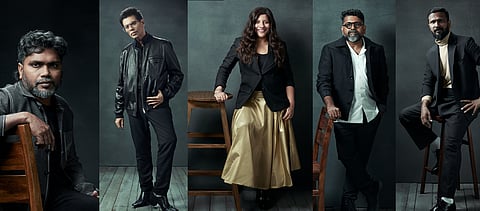


It’s easy to assume that filmmakers, who pour their heart and soul into bringing stories to life, would be entirely enamoured by the process. Yet, like in any profession, there are highs and lows. During a recent roundtable with The Hollywood Reporter India, directors Zoya Akhtar, Karan Johar, Pa. Ranjith, Vetrimaaran, and Mahesh Narayanan opened up about the aspects of filmmaking they love – and those they could do without.
The conversation has been edited for clarity.
Mahesh Narayanan: I started as an editor. So the thing is, I always write for my edit. Writing is the toughest part. That is where the cinema lies. For example, C U Soon (2020) was written in two weeks. It's not about whether something is written in two weeks, but it's about writing something out, which is conceptualised in terms of an edit. Sometimes, you have to take time. Your mind goes bizarre in that process, but I like it.
What I like the least is the wait. In Bollywood, you have to wait for green lighting. In the Malayalam film industry, the green lighting happens in three days. But when you wait, your story expires. After you write something, if you start shooting it three years later, it has already expired. By that time, you have to fetch new ideas. The entire screenplay is gone. You have to rewrite it. That is the biggest challenge.
Karan Johar: When he [Narayanan] said writing, I just looked at Zoya [Akhtar] because I know how much she loves writing. To me, it's the most lonely process. I can't say I hate it because there's so much gorgeousness about creating characters, writing narratives, stories. But it's very daunting. It's very scary.
You know, those days when nothing comes out of your head? Those are such awful, scary days. And then, suddenly, a great scene is written. Writing to me is daunting. I can't say I hate any part of filmmaking because it's in my core, it's in my DNA. But daunting, yes.
What I love the most, I have to say, is the process of scoring the background music. I love, love, love it. I just love how a symphony, or an orchestra, can elevate a moment. In the good old days, when I did Kuch Kuch Hota Hai (1998) and Kabhi Khushi Kabhie Gham…(2001), I had the massive good fortune of actually seeing a score with an absolutely large live orchestra.
There used to be a chorus — there were the 40 violinists, there were flutes. The Empire studio in Andheri has this huge space where I saw Babloo (Chakravorty) da, who was the music arranger, with the live orchestra. And Lata Mangeshkar ji standing there in her console, singing the alaap for Kabhi Khushi… and the violins along with her. There was Manohari (Singh) da on the flute. To me, that was cinema, and I don't have the privilege anymore of doing that. I'm a big believer in the old-school background score. My favourite part of the pre- or -post of a film is really the background score.
Zoya Akhtar: I absolutely love writing. And I love shooting. I like the energy of a shoot. When you come out of the writing process, which is quiet and nine-to-five, that's the only nine-to-five part of my life. But shooting has got energy, it's got adrenaline. I love the alchemy of the actors, the costumes, the people, the camera, everything together.
I don't like editing. I see all my mistakes. It's like sunset. Writing is sunrise and editing is sunset. There's all this possibility in writing, and then you're saving in editing. I don't like that. And I hate dubbing. I just don't enjoy it.
Karan Johar: I have to just tell everybody that because I hate dubbing so much — and I should have said this earlier — that I've never attended a single dub. I don't go to a dub, because I'm like, it's never going to be the same. I'm going to be annoyed.
Zoya Akhtar: I go to the dub and I don’t like it. I have had a meltdown and I have cried at every edit. I have done this once in every film. I just feel like this film is over. I'm done. What have I done? Then my editor will be like, “It's fine. This is called a first cut.”
Karan Johar: The other thing that I hate is research screenings. When you're showing people [the film] — it's like when somebody dies and they line up at the end. When you're standing outside the editing room, that’s what the filmmaker feels. They walk out in a line and give you that look. You can tell from the body language if somebody's liked it, not liked it, or hated it. Then everybody sits and answers those questions — you have to ask them what they thought, and then you're just worried about what they're going to say.
They're so ruthless! They say, “I'll not recommend this movie. I'll not watch this.” And you feel so bad because it’s three years of work! Why do I have to put myself through this? And yet you're told, you must.
Vetrimaaran: I like everything about filmmaking — editing, the most. I edit for a year. One thing I don't like is wrapping up a film. I don't want to finish a film. I would like to have a few more months. Like another 10 days of shooting. That's me.
Pa. Ranjith: I really love writing. It is too personal. There is no one to enter my space. I just enjoy the process. But what I hate is when I have to give my story to another person to read. They will say, “No, you have to edit this.” I hate that. Art is very personal. We connect with something and we need to explore it. When I write, I get involved in the world and I don’t want to come out of that world.
But the shooting…I hate being a director. A lot of people come into your world and they try to convey your words — it’s a big process. You have to have a lot of patience. I am not an angry person, but you have to wait for your good take. Sometimes, I just want to throw it all away and I don’t want to direct. I want to just get out of the set (laughs).