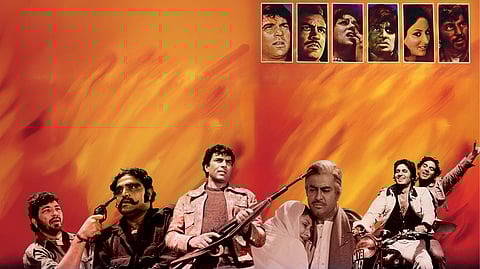


When Sholay was released in 1975, Shivendra Singh Dungarpur was all of six years old. The buzz about the Amitabh Bachchan and Dharmendra starrer had reached his school in Bhopal, and there was chatter about it at home too. And yet, his mother did not allow him to watch it in the theatre. “I was a huge fan of Bachchan, and I had watched his films like Abhimaan and Mili. My memories of the day (of wanting to go to the theatre to watch the film) are so vivid that I even remember the maroon-ish shorts I wore, along with a floral shirt. I remember constantly crying for not being allowed to go. Everyone was talking about Gabbar (Amjad Khan) and I wasn’t allowed to go because of how violent my mother thought the film was,” recalls Dungarpur, filmmaker, founder and director of the Mumbai-based Film Heritage Foundation that has been entrusted with the restoration of the iconic film, including its original ending and deleted scenes in 4K resolution, as it is slated to make a comeback in theatres in its 50th year.
Originally released on Independence Day that followed hard on the heels of the nationwide Emergency declared in June, Sholay poignantly reflected the social angst of the nation in an era of political discord. “In that context, it was a very violent film,” says Dungarpur. The original ending of the blockbuster showed former police officer Thakur Baldev Singh (Sanjeev Kumar) taking his much-anticipated revenge by killing Gabbar with his spiked shoes — a rather graphic visual that the Central Board of Film Certification (CBFC) wanted changed. At their behest, director Ramesh Sippy reshot the ending to one where Gabbar gets arrested by the police after being thrashed by Thakur. In 2025, however, Thakur and Gabbar are dealt with their original fates in the restored version.
“When Ramesh Sippy and (his son, filmmaker) Rohan Sippy first spoke to me during the COVID-19 pandemic, they said they couldn’t tell where the original negative is. They were also upset with what had happened with (the 3D re-release of) Sholay earlier (in 2014),” Dungarpur says. With the original tracks of the film by R. D. Burman being removed in the 2014 version, it was now up to Dungarpur to salvage the original negatives that had gone missing. He was introduced to Shehzad Sippy, son of Ramesh’s brother Suresh, who then helped locate the 35mm negatives in an old storage facility in Mumbai, in the most dramatic way befitting Sholay — inside a gunny bag — in 2022. Some additional material was also found in London, which the British Film Institute (BFI) took responsibility of. “Because of their relationship with the FHF, the BFI was very kind to actually go to the facility and bring all the material to BFI in London and inspect it at no cost,” Dungarpur says.
Everything had to be assessed in mindful detail, and the moment Ramesh and Rohan Sippy saw the original negatives — all in a state of decay — they were overcome with emotions. “The sound had completely gone, and it was in bad shape. I have known Rohan and Ramesh ji for years, but to see them look at those negatives was something else,” Dungarpur recalls.
What made this serendipity even more extraordinary, however, was discovering the original ending that Ramesh Sippy wanted. “We know of Om Shivpuri’s character coming in the last two scenes to arrest Gabbar, but the right ending is the one where Thakur has his moment and kills Gabbar at the place where his hands were cut off,” Dungarpur says. It’s the kind of poetic justice that offsets the atrocities committed by Gabbar on Thakur, which remain invisible in the existing version, and includes the severing of Thakur’s hands and his grandchild being murdered by Gabbar. Sholay put very little blood on display, resorting to merely a few bullet wounds.
The surprises, however, didn’t end with the climax sequence. Another one of the two deleted scenes that have now been unearthed and have made their way back to the revived version originally showed Sachin Pilgaonkar’s character of the young village boy Ahmed being captured by Gabbar’s men. He is then taken to his hideout, where the dacoit is resting. In the background, pieces of meat are skewered and roasting over a fire. Gabbar’s cronies inform him that the boy is from Ramgarh and that they nabbed him on his way to the station. Gabbar takes a moment’s pause to watch a fly crawl on his forearm. He then smirks and mauls it with a slap in the CBFC-approved version of the film, in which the following scene shows Ahmed’s horse carrying his dead body back to Ramgarh.
In the uncensored version, however, after squashing the fly, Gabbar tells his men that the people of Ramgarh have begun fleeing the village. Ahmed pleads for him to be let go, but Gabbar says that since he is the “father” of Ramgarh, Ahmed should pay him respect by rubbing his nose on the ground at his feet, which the boy refuses to do. It infuriates Gabbar, and he orders him to step forward. Ahmed attempts to attack him, but Gabbar takes him out with a single blow. As his men prepare to shoot Ahmed, Gabbar stops them and says that a man feels no pain when killed by a bullet. Instead, he promises Ahmed a slow and excruciating death. He then takes a heated iron rod from the fire, pulls Ahmed by the hair, and brings the rod close to his eye. The following image is of Ahmed’s horse returning to the village, carrying his corpse.
Ramesh Sippy has, over the years, said in several interviews that he was unhappy with the cuts demanded by the Certification Board back in the day, and had to comply to have the film released during the Emergency, an era of stringent censorship. But even after the censored version of the film was released, it sparked debates in the media, as critics argued that its portrayal of harsh violence and cruelty warranted an ‘Adults Only’ certification.
In the present day, however, the job of restoring the film to its original glory was riddled with bigger challenges as the audio of the deleted scenes had gone completely missing. “All the kids, like Rohan and the rest, who were there when the film was being made, remembered the dialogues because they had heard them, but I hadn’t,” says Dungarpur. Luckily, they found the magnetic tracks that had the original sounds of Thakur’s footsteps, the sharp bullets being fired, and even the Burman soundtrack. “You think you’ve heard all of it, but they may not always be there, like in the version on Prime Video, or any other that’s available. I was very clear that we must bring it back to the original version the best way we can, and that proved to be the most difficult part of the endeavour,” he adds.
According to Dungarpur, the original sound design is the most decisive element, but missing camera negatives without their dupes made it tougher to achieve their goals. They, however, had interpositives — or a positive image created from a negative, serving as an intermediate step to produce duplicate negatives — to work with. But that meant determining the correct aspect ratio for what was a 70mm film — without its 70mm original print — now meant for digital projection. It led Dungarpur to veteran cinematographer Kamalakar Rao, who had worked on Sholay. It was Rao who ultimately helped him find the technical solution for this missing piece of the restoration puzzle.
With the entire process carried out at the L’Immagine Ritrovata restoration facility in Bologna, Italy, it was only fitting, then, that the restored version has its premiere in the city of its rebirth. So, in June this year, Sholay was screened at the Piazza Maggiore in Bologna, as part of the Il Cinema Ritrovato Festival, to a packed audience in an open-air theatre that can accommodate over 4,000 people. “It was the film’s biggest test — to screen it in Bologna — and it started sometime around 10 pm. No one got up till 1.20 am for a three-hour, 24-minute-long film, and there were more than 2,000 people in the audience,” Dungarpur says.
He recalls reciting dialogues from the film while restoring it in Italy, and his Italian colleagues watching him, fascinated. “Sholay is one such film that makes people recite its dialogues,” — and what could be a better testament to how a work of art has stood the test of time?
Dungarpur is certain that the re-release of Sholay will trigger introspection about the kind of cinema India has left behind. The film — which is now on its way to the Toronto Film Festival in September — is likely to tap into nostalgia, and also a sense of rediscovered novelty for a newer and younger audience. “It’s got such cool names, cool dialogues, and Amjad Khan’s performance as Gabbar in what people will see as an action film, a dacoit film, shot in such a contemporary manner,” says Dungarpur, asking one to mark his words that Sholay, once again, will shift the paradigms of storytelling, in an encore of what it achieved half a century ago.
To read more exclusive stories from The Hollywood Reporter India's August 2025 print issue, pick up a copy of the magazine from your nearest book store or newspaper stand.
To buy the digital issue of the magazine, please click here.