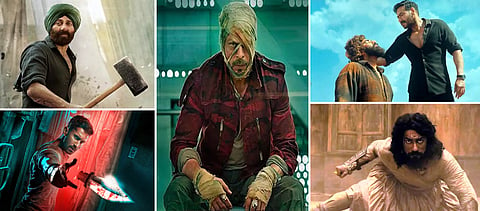


There’s a saying that India’s action directors hear every day: “Dekhlo sir, jo bhi possible ho…” (“See how you can manage...”). For decades, most of them have believed that with enough jugaad (or inventive problem-solving with limited resources), anything is possible. And even if the nature of the job hasn’t changed for Bollywood's erstwhile “fight masters” or “action masters”, who are now referred to as “action directors”, Indian action cinema has seen a renaissance of sorts, with films like RRR (2022), Jawan (2023) and Kill (2024) setting benchmarks for spectacle and scale. Yet, behind every slow-motion explosion or gravity-defying jump lies a story of tight budgets, and tighter clothes.
The Hindi film industry has always loved high-octane action, but in over the last couple of years, the focus has shifted to loud, brash, testosterone-fuelled spectacles. With blockbuster hits drawing massive crowds, producers are now eager to back more of the same.
Good action requires time, and every extra second costs money. “Every time a director comes to me with a grand vision, my first question is, ‘How many days are you giving me?’ They want Mission Impossible and John Wick, but their budget barely covers what those films spend on catering,” says Parvez Shaikh, who’s helmed action for films like Brahmastra Part One: Shiva (2022), Fighter (2024), and Chhaava (2025).
Action directors in India are often asked to work miracles within small budgets, and as a result, they have to be innovative. Action director Sunil Rodrigues, who has worked on Jawan, Pathaan (2023) and Singham Again (2024), says, “In India, very honestly, you don’t get a lot of time. We are ‘jugaadus’, and people in India don’t want to have original ideas; they want to replicate whatever is happening in Hollywood. But Hollywood takes a lot of time, a lot of research and a lot of resources. We don’t have that many resources in India.”
While jugaad isn’t always a bad thing, it’s a hack for survival, not a recipe for spectacle. “When you cut corners, the audience knows it,” says Shaikh. “Why do you think everyone applauded Kill for its action?” The action sequences in Kill grab the audience by their collar and don’t let go. They’re sharp, brutal, and slick. The film is almost animalistic in its pursuit of action, which matches the rhythm of the moving train it’s set on. Action directors Shaikh and Se-Yeong Oh use the train’s cramped interiors and the actors’ physicality in a way that makes you feel every punch and kick. With 42 unique deaths, Kill’s gore and style have been lauded for bringing innovation to the action genre. “We didn’t have a big star cast, but we spent over four months preparing for the action and training with the whole crew. When you give something its due care, it blossoms — that’s why it looks so good, and that’s why it looks different,” Shaikh adds.
To invest in creating an action spectacle is to take a risk bigger than sitting in one of Rohit Shetty’s cars mid-chase. Producers have to think about the returns on their investment. “Hollywood spends a lot of money but the release range is very big, and they are able to make that money back. But for us, we are divided even by region…which means the scope for recovering money is also limited,” says Rodrigues. Uncertainty looms large: “The story is very important for a film to work,” says Rodrigues — and hits like Jawan and Kill would support that claim. Yet, the industry often proves that even wafer-thin plots and blatant misogyny can turn a profit. In truth, no one really knows what will land. A good story remains the safest bet.
What is also true is that if the narrative doesn’t resonate, no amount of action can save it. “The first thing is the story. Then, as an action director, I have to think holistically. Think about the handpump sequence in Gadar 2, the 2023 sequel to 2001’s period drama Gadar: Ek Prem Katha. You have to direct the whole sequence. It’s not just kicks and punches, you have to create drama. Action is created with drama; you have to tell a story,” says veteran action director Sham Kaushal who has been in the business for over four decades. Films like RRR and Gadar 2 succeed because the action is an extension of the story — not a distraction from it. Contrast this with the countless flops (like Bade Miyan Chote Miyan in 2024) where action sequences feel shoehorned in, and the difference is clear.
The desire to approach Hollywood standards is almost a mantra in Indian action filmmaking. “Many times, we get videos of Hollywood films to reference. They want us to replicate what has already been done. It’s no secret that originality is not high up on the list of things commercial Hindi cinema wants to achieve, but as Rodrigues puts it, “Nakal ke liye bhi akal ki zarurat hoti hai” (Even imitation demands intelligence). Replicating an action sequence isn’t just about copying the stunts, you have to replicate all the variables, including the time and money spent. “They say two days for the shoot and one day for prep. Now, what will you prep in one day?” Rodrigues asks.
Other crucial factors include how much time you actually get to shoot in a day. “That depends on the director of photography (DOP). If the DOP takes a lot of time to set up the lighting and the shot, that eats into my process too, right? I can’t just pick up the camera and shoot however I want. We’re given very limited time and expected to deliver Hollywood standards,” he adds.
As Kaushal points out, action direction is an extension of storytelling, and one of the most crucial parts of that is the treatment of the shot. The build-up of the hero, the build-up of the villain — all of these factors come together to make a compelling action scene. “Only when you give it good treatment will the action work. It takes a lot of time to do the treatment. You have to take 50 different shots for one small moment — a close-up of a bicep, a slo-mo of the dust — can’t do that in two days,” Rodrigues says.
However, not only does the industry lack the necessary budgets, but the films also have to cater to a vastly different cultural context and a diverse demographic. Indian cinema thrives on its emotional core, and an overreliance on aping Western aesthetics often strips Indian action of its uniqueness. Look no further than the stark difference between Baahubali’s grandeur and the Hollywood mimicry of Bang Bang (2014), a scene-by-scene recreation of the action comedy Knight and Day (2010), to see how authenticity trumps imitation.
“The story tells you what kind of action it demands. A Gangs of Wasseypur demands a different kind of action, and a James Bond demands a different kind of action,” says Kaushal. Why does the over-the-top action of RRR or KGF work? Why do audiences cheer for Shah Rukh Khan’s entry, even without spectacular stunts? The answer, perhaps, lies in different cultural sensibilities. “In the West, they are telling their stories; we should be honest to our stories, our people, our culture,” adds Kaushal.
Today, a lot of inspired and culturally relevant action is coming from the South film industries. “Nowadays, they are not just showing us Hollywood references but also South references for our projects,” says Shaikh. A streak of unique action direction and stunt choreography is coming from the duo Anbariv — brothers Anbumani and Arivumani — known for Kaithi (2019), Vikram (2022) and the KGF films, which even got them a national award. “We set clear boundaries from the start. If they show us a reference like a James Bond chase scene, we’ll tell them honestly, ‘If you want that, we need more time. Otherwise, we’ll create something within our own style, but it won’t be identical’,” say Anbariv.
At the end of the day, filmmaking is a collaborative process; the more you work together, the better the outcome will be. “We all get together to decide how much time and money we can afford to spend on action sequences. We have to stand together, we have to stand with the producers; it’s teamwork,” says Kaushal. On the other hand, Anbariv have found a way to get on a project as early as possible, “We consider the entire movie, from start to finish, not just the action scenes. We create action sequences that serve the story, not just the spectacle,” they say.
An audience member might not fully understand the emotional intelligence required to pull off an action sequence that keeps viewers on the edge of their seats. For all the flashy, brawny spectacles, the true gut punch comes when the hero, just inches away from saving the world, is knocked out cold. “There’s a whole other screenplay for action…you have to think about the narrative, you have to take the audience on an emotional journey. It’s not just bombs and bullets — you are a storyteller,” says Kaushal.
There’s reason for optimism. The gap between global and Indian standards is steadily narrowing. “We are lagging behind, but it’s nothing to worry about. It will get better; it always does,” says Kaushal. Anbariv agree: “In big-budget films, the planning is improving, and we’re starting to see more attention to detail.” Rodrigues points to the investments fuelling this progress: “Yash Raj Films is spending money, Shah Rukh Khan is spending money, Rohit Shetty is spending money. Spiro Razatos (known for Captain America: Civil War) met me recently and said, ‘When I first came here, you guys were nothing, but now you’re matching me.’ That’s a huge leap forward for us.”
At the start of every showdown, it feels like the hero is outmatched, the villain comfortably ahead, the gap impossible to close. But if Indian action heroes have taught the audience anything, it is that with a little imagination and a healthy dose of recklessness, one can punch above their weight.