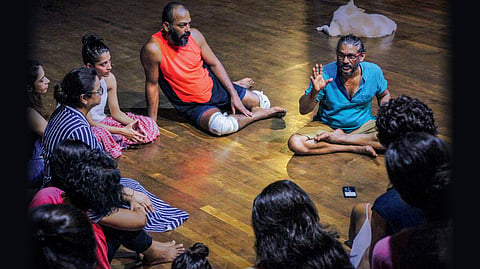

Far from Mumbai’s smog, screen tests, and horn-blared hustle, a red mud path winds through the lush greenery on the fringes of Pondicherry and lands you at a theatre sanctuary that has become Bollywood’s most unexpected training ground. At the Adishakti Laboratory for Theatre Arts, a new generation of actors are learning how to move, breathe, and break down on cue by plunging deep into their bodies and souls. Spread over three acres, the campus feels more forest than facility: thatched roof rooms tucked under canopy neem trees, rehearsal spaces open to the sky, birdsong replacing ringtones. It’s part acting school, part spiritual rest — and entirely unlike anything else in India.
It’s this promise of reinvention that has pulled the likes of Richa Chadha, Swara Bhasker, Ali Fazal, Adarsh Gourav, Fatima Sana Shaikh, Kalki Koechlin, Naga Chaitanya, Kani Kusruti, Divya Prabha, and Zahan Kapoor to Adishakti time and again. Over 10 days here, actors immerse themselves in a rigorous 12-hour daily schedule that blends breathwork, rhythmic movement, voice training, meditative practices, and even underwater exercises — each designed to awaken what the school calls the “source of performance energy.”

That Adishakti taps into something elemental is evident: Kapoor, Kusruti, and Bhaskar have each returned more than once. Fazal, meanwhile, is so invested that he now sits on the board. And at the Waves Summit this May, Adishakti received its starriest stamp of approval yet: Aamir Khan not only recommended the lab to aspiring performers but also expressed his own desire to attend it someday.
Founded in 1981 by the late Veenapani Chawla — one of the pioneers of experimental theatre in contemporary India — Adishakti began as a theatre company in Mumbai driven by performance and inquiry. In 1993, this vision found a more permanent home in Pondicherry, where Adishakti deepened its commitment to building a new language for contemporary performance. And in 2008, after years of staging experimental plays, the ensemble formalised its method into a residential training course. It was an attempt to share — not gatekeep — the techniques Chawla’s ensemble had honed through decades of performance.
For Kapoor — last seen in Black Warrant — Chawla’s name had familiar origins. The theatre stalwart was a key figure in the early days of Prithvi Theatre and his father even starred in Oedipus, Chawla’s debut play alongside Naseeruddin Shah. “When you’re part of a touring company, your body has to last. Your breath has to last. That’s where technique becomes survival.”
Kalki Koechlin was part of Adishakti’s inaugural batch in 2008.
Zahan Kapoor has been to Adishakti twice — first in 2013 and then in 2016. He has since returned to the space multiple times.
Kani Kusruti trained at Adishakti while founder Veenapani Chawla was still alive and returned for a second stint with Vinay Kumar and Nimmy Raphael.
Adarsh Gourav enrolled in June 2023 after wrapping Superboys of Malegaon.
Ali Fazal keeps returning to Adishakti and now serves on Adishakti’s board.
Swara Bhasker, Richa Chadha, Shweta Tripathi, Chaitanya Sharma, Fatima Sana Shaikh, Divya Prabha, and Naga Chaitanya are other attendees.
Chawla’s methodology drew from ancient Indian performing lineages: Koodiyattam’s emotive codes, the musical math of Dhrupad singing, the muscular logic of Kalaripayattu, the breath cycles of Vedic chanting. But it also leaned into global influences — the physical rigour of Denmark’s Odin Theatre and the voice coaching of the United Kingdom’s Royal Shakespeare Company. Run today by Artistic Directors Vinay Kumar and Nimmy Raphael, Adishakti reimagines emotion not as something remembered but as something embodied.
Kapoor breaks down the workshop like a musician would describe riyaz. “They dive into folk traditions and texts — be it Sanskrit or Shakespeare — and try to understand the roots of how those lines are meant to be spoken, how the breath moves through them. But the approach is entirely physical: purely from the body, purely from breath, purely from movement.”
What sets Adishakti apart isn’t just the physical rigour — it is also the understanding that an actor’s body is their first and most expressive instrument. And it requires tuning.
Back in June 2023, right after he wrapped Superboys of Malegaon (2024), Gourav enrolled himself in the course. For the actor — who had trained at Drama School Mumbai and attended workshops under actor Neeraj Kabi and theatremaker Sara Matchett — Adishakti had long been on the radar. Even then, Gourav wasn’t prepared for the intensity of the two weeks once he arrived on the premises.
“We’d wake at six, have breakfast, and start with two hours of Kalaripayattu,” says Gourav. “Then we’d split into batches and spend the day in sessions led by Vinay and Nimmy, learning to master breath, modulate rhythms, and summon tears by activating specific muscles.” One of the ideas that resonated with him was that an effective performance doesn’t always demand total emotional investment — it can come from technique too. “Your job as an actor is to make the audience feel an emotion even if you don’t feel it yourself.”
Over 10 days at Adishakti, Gourav discovered tools that allowed him to reshape his approach to performance. He brings up the odd and even rhythm exercise that Kumar encouraged the participants to practice. “In a nutshell, human beings are hardwired to move on even beats every time they do any action,” the actor explains. But training yourself to move on odd beats — something that takes conscious effort — introduces an element of unpredictability. “A lot of great actors, say, Nawazuddin Siddiqui, Irrfan Khan, Joaquin Phoenix, combine odd and even rhythms in their performances, perhaps subconsciously.”
Every time an actor picks up a new technique, it is one more addition to the weaponry that they already carry as a trained performer. But as Gourav points out, their real worth often reveals itself during moments of crisis. “Imagine you’re stuck in a scene and don’t know how to get there emotionally, especially after exhausting yourself with 15 or 20 retakes. Every word you’re saying starts to feel rehearsed because you know exactly what’s coming next. That’s when you tap into this understanding that there are things that can be achieved mechanically and technically.”
Both Kumar and Raphael believe that it is an actor’s breath that fuels the emotional machinery of performance. “Your breath changes with every situation, as does your rhythm. We just don’t realise it,” Kumar posits.
If that sounds more like therapy than theatre, that’s because, as Kumar puts it, Adishakti’s actor-training pedagogy lives at the intersection of both — rooted in rasas and rhythm but cross-pollinated with mathematics, number theory, Ayurveda and neuroscience. “It is the culmination of over 30 years of research to build an alternative methodology that is not dependent on Western ideas. Something as fragile as memories and recalling — that’s not the foundation here.”
Kusruti first arrived at Adishakti when Chawla was still alive, giving her the rare chance to train under the founder herself — alongside Kumar and Raphael during her second visit. The actor notes that the original framework that Chawla devised was never meant to be static. “She channelled everything she learned — voice, diction, rhythm, physicality — into a form that’s still growing.” That growth continues, Kusruti says, through Kumar and Raphael. “Adishakti doesn’t replicate old forms. It contemporises them. That’s what keeps it relevant.”
And then there’s the energy of the lab itself. “Some exercises adapt. But the demand on your body, your voice, your presence — that’s constant,” says Kusruti.
Almost every actor exposed to Adishakti speaks of the experience in reverent tones. Many call it transformative. But as Kusruti is quick to point out, it’s not a magic fix. “You can’t learn a methodology in 10 days,” she says. “What you get is a light — a glimpse — of what’s possible. After that, it’s on you. Are you going to practise it? Or will it just be a beautiful experience you had?”
Both Gourav and Kapoor underline the space as a great equaliser — where veterans and newcomers train shoulder to shoulder, sharing rooms, meals, and the alarm clock of the rising sun. “You feel your body in a way you haven’t in years,” says Gourav. “Everyone glows by day ten.”
To Kapoor, the growing pull of Adishakti signals a larger reckoning in Hindi cinema, where the spotlight is drifting — slowly, steadily — from stardom to craft. “There was a time when being called a theatre actor was a pejorative term. Today, name one casting director who doesn’t advise younger actors to do theatre, learn the craft,” he adds. Now, Adishakti’s name comes up alongside that recommendation almost automatically.
Says Kapoor, “Suddenly, casting directors are saying: Adishakti jaoge toh khul jaoge.”
Held six times a year, the SOPE (Source of Performance Energy) programme invites 30 participants per batch for an intensive 12-hour-a-day residential training on Adishakti’s Pondicherry campus.
Participants live on site in tiled-roof dormitories, sharing non-AC rooms and simple meals.
Training kicks off at 7 am and can stretch on till 10 pm.
Mornings begin with exercises that train gaze and awaken body centres, followed by sessions in Kalaripayattu, the ancient martial art used to build strength, flexibility, and focus.
Participants learn to map classical rasas through eight codified breath patterns drawn from Koodiyattam and the Natya Shastra.
Voice sessions explore how sound originates in the body using breathwork to open up range, pitch, and resonance.
Underwater exercises deepen awareness of internal movement and vocal vibration.
Drumming and rhythm training enhance timing and sync emotional intent with gesture and voice.