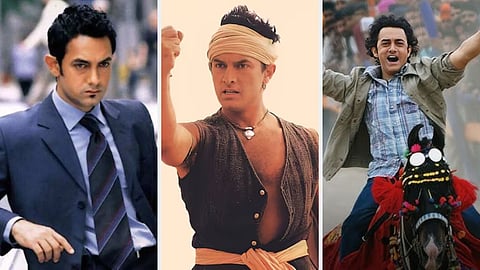


If Salman Khan is revered and Shah Rukh Khan is desired, Aamir Khan is needed. For more than 35 years, the actor has expanded the language — the job profile — of stardom. With him, it’s not about capturing the imagination of a nation; it’s about reimagining the way a nation is entertained. Khan’s legacy can’t be measured in box-office numbers, staggering as they’ve been; he’s changed the manner those numbers are perceived. Every success of his has paved a new path, broken new ground, started a new trend, invented a new economic and narrative model. In other words, he has been the poster child of possibility. You don’t have to love Aamir Khan to be his fan; you only have to love the movies.
Khan’s obsession with the craft of storytelling — as performer, producer, director, thinker, doer — defines the versatility of his stardom. His fame is, in itself, an artform. Instead of giving the audience what they want, he’s given them the agency to want more. He played unprepared parents and husbands when others were falling in love; he played humans when others were heroes and villains; he played fathers, mentors, raw patriots and college boys in the same breath. This journey hasn’t been without conflict, especially in the last 8 years. Yet, he remains a genre unto himself — searching for sensibility rather than sensationalism, relevance over records. He has this rare trait of being visible when he falters, but invisible when he delivers.
His acting career is at once bereft of ego (all those ensembles) and prone to vanity (all those saviour roles). The originality of being ‘Aamir’ on screen, though, is still a sight to behold. Even a Dream11 ad campaign can stir up a vintage Indian-ness, a cultural identity, that he’s worked hard to uphold. On the eve of Sitaare Zameen Par, here are 10 of my favourite Aamir Khan performances which, mind you, is a category markedly different from ‘best Aamir Khan films’ (which would include the tragic Laal Singh Chaddha — a hill I’m prepared to die on):
You either love Khan’s take of a Bhojpuri-speaking alien or you hate it. There’s no in between: it’s that much of an acquired taste. By now, Khan was already a shape-shifting superstar that could turn anything (including Dhoom 3) into gold. But the ambition didn’t waver. He swung for the fences in the sort of nostalgic, pre-intolerance satire that — like Rang De Basanti, Sarfarosh and other edgy efforts — is almost extinct today. They don’t make ‘em like they used to because they can’t make ‘em like they used to. The funny part about Khan’s wide-eyed, floppy-eared performance is that it teetered on the brink of backfiring. A similar tone in Forrest Gump remake Laal Singh Chaddha — to depict human disability — had the opposite effect. But because PK was an alien with no reference point, Khan’s excesses wove the fabric of the teacherly melodrama. He became a fresh set of eyes to see an India that had long been a country of contradictions. The simplistic approach worked because of his live-action-cartoon-coded pitch; a little deviation might have pushed it into Tubelight territory. After all these years, it’s hard not to miss PK and his naive, paan-stained commentary.
It’s a bit surreal to see the early, unadorned performances of actors who go on to become superstars with tics and patterns. It’s like watching black-and-white flashback montages in massy blockbusters. The brooding and bleak Raakh (“ash”) might qualify as an arthouse or experimental film — Khan’s second lead role after the sensation that was Qayamat Se Qayamat Tak. Fittingly, he played a character called Aamir, a name yet to morph into an identity. The Aditya Bhattacharya-directed, Santosh-Sivan-lensed film tells the story of a young and privileged man who spirals into a noirish void after the sexual assault of the older woman (Supriya Pathak) he likes. The woman recovers but the man doesn’t — if anything, her trauma becomes his crutch to break bad. Aamir is the narrator, but the puppeteer is an India he was once sheltered from. In a post-riots and communally sensitive state, he becomes an instrument of revenge for a policeman (Pankaj Kapur) who mentors him for his own motives. Even the training montage feels like an unfiltered version of the one in Jo Jeeta Wohi Sikandar. Khan’s feral turn is striking — his breakdowns contain sounds we never heard again, and his ‘transformation’ is untethered to musical or narrative cues. His risk-taking endured, but the Aamir from Raakh was the ashes before the (sanitised) fire.
Aamir Khan was no stranger to unofficial remakes at a time when every second movie legitimised the art of copying. Vikram Bhatt’s Ghulam — heavily based on On The Waterfront — followed in the borrowed footsteps of Dil Hai Ke Manta Nahi (It Happened One Night), Jo Jeeta Wohi Sikandar (Breaking Away), Akele Hum Akele Tum (Kramer vs Kramer), Baazi (Die Hard) and Mann (An Affair To Remember). The ethical aspect is easy to judge today, but Khan’s baby-faced grit raised the bar in a post-liberalisation industry that was still figuring out how to express its cinephilia. Ghulam felt like Peak Adaptation, a pulpy Mumbai thriller about a working-class hero who develops a spine. In terms of characterisation, Khan’s Siddharth “Siddhu” Marathe was a successor of Rangeela’s Munna: streetwise, rugged, gauche. The actor deftly weaves between boxing champ, brother, lover, citizen — doing his own stunts (the train sprint), singing his own songs (the rest of India discovered “Khandala”), carving out a grammar of inspiration that felt wholly original. Rajit Kapur’s nerves, Rani Mukerji’s dubbed allure, Mita Vashishta’s ferocity, Deepak Tijori’s leather jacket, and Siddhu’s brawl with Sharat Saxena’s biceps — featuring a busted face and defiant finger-wag — is etched in the annals of ‘90s Hindi film history.
Khan’s 2001 odyssey meant more after a spate of flops (Mann, Mela). As the Bombay brat going through a first-world transition from adolescence to adulthood, Aamir Khan’s Akash is one of those iconic buddy-movie characters that refined the palate of Hindi cinema without anyone realising it. Much has been written about Farhan Akhtar’s era-splitting directorial debut, yet it’s Khan’s impish portrayal of the ‘sly one’ in the trifecta that became its calling card. Akash felt like an urbane update of Jo Jeeta Wohi Sikandar’s Sanju: except the catalyst of his coming-of-age arc was life itself. He’s the kind of friend who’s immature, problematic but such fun to be around that it’s hard to call him out or cut ties. Such characters rarely change; they become toxic remnants from the past. Akshaye Khanna’s wise Sid learns this the hard way, but Akash’s loneliness in a foreign land — featuring a surge of grown-up feelings in an opera and subway station — offers an awakening where fiction massages reality. If Sid is the beating heart and Sameer is the spine, Akash remains the pacemaker of this contemporary classic.
Two things make ACP Ajay Rathod one of Khan’s definitive characters. One, the actor’s frightfully young face in the 1990s — a face that perhaps forced him to pursue unorthodox roles — was written into the script. Sometimes (Aatank Hi Aatank, Baazi), it didn’t work. But when it did, the results were memorable. Rathod’s strength is that nobody takes him seriously. He spends the film doing and saying things no-one expects him to, exploiting the culture’s obsession with seniority and experience. Secondly, Rathod sheds his ego and shows an ability to understand the victimhood of the only Muslim officer (Mukesh Rishi’s Saleem) in his department. Rathod thinks he’s more patriotic because he chose IPS over IAS, but his monologue to Saleem about the country being his home exposes his own religious biases. When Saleem ‘proves’ his loyalty with a famous line, Rathod summons Khan’s own magnanimity as a lead actor — his willingness to concede the limelight, share it and confess to his mistakes — and apologises to his friend. That Khan did this as a Muslim star-actor makes Sarfarosh the sort of walking-the-talk moment we don’t see anymore.
You know how champion sports teams and athletes are identified by their prime years? Examples: 1980s West Indies, 2000s Australia, 2004-07 Federer, 1999-2005 Tiger Woods, 2009-2015 Messi. Similarly, 2001 Aamir Khan was a watershed moment, a cultural marker so unparalleled that one could literally see Hindi cinema climb into a new era. Dil Chahta Hai introduced a mainstream aesthetic, as did period-cricket-musical-drama Lagaan — where his role as (Oscar-nominated) producer and actor shattered the wickets of Indian stardom. Captain Bhuvan’s impact went beyond his identity as leader of a drought-stricken 19th-century village; he created a Khan who was part-thinker, part-entertainer and full-pioneer. The beauty of Bhuvan lies in how Khan humanises his all-round perfection. He is born galvanised and better than everyone else: favourite son, cricketer, tanned crush, partner, youngster, forgiver. But the under-doggedness stays intact, right until the moment he sinks to his knees after the winning shot. ‘Madness in the Desert’ has never been less exotic.
Normal people fantasize about love, sex, money, sport. But 1990s Bollywood nuts (like myself) fantasize about shared universes like: Were Sanju from Jo Jeeta Wohi Sikandar and Sunil from Kabhi Haan Kabhi Naa first cousins? Did Sunil compose a song about lovable losers for Sanju’s wedding? Do their old fathers tell stories about how their wayward sons used to disappoint them? Aamir Khan’s Sanjaylal ‘Sanju’ Sharma from Model College is an inextricable part of Bollywood folklore for many reasons — not least for overtaking an arrogant jock in the dying seconds of a cycle race. But Khan’s portrayal of the underdog stands the test of time because it normalised a country’s changing relationship with aspiration: Sanju was just another black sheep, until he became the original “Sharma-ji ka beta”. The boys-to-men characters that Khan played in this phase became a new prototype of Hindi masculinity: the coming-of-age hero. Sanju was the genre first-mover — the small-town ancestor of urban drifters like Karan from Lakshya, the Rang De Basanti gang and early Ranbir Kapoor protagonists. He “changed the gear,” in more ways than one.
Over the years, the fiercely political Rang De Basanti has grown in stature. Not only is it the kind of story that’s not — and won’t be — told anymore, it also unfolds as a throwback to a time when patriotism was a personal and untamed beast: dissent, rebellion, vengeance, holding government and citizens accountable. At the forefront of this brave and prescient entertainer was Aamir Khan’s Daljit “DJ” Singh, an unserious Delhi University student who leads his motley group’s transformation from buddy-movie loafers to reckless doers. The catalyst of the modern-freedom-fighter arc is a tragedy caused by institutional neglect. The idealism is dangerous, but DJ’s unlikely switch is pulled off by the actor’s old-school ability to ‘package’ an awakening: the character’s levity is so infectious that his gravitas — that shock of adulthood assault their senses — feels earned. He’s a grown-up descendant of the college cyclists and streetside boxers from previous movies. It wasn’t the first time Khan came of rage, but it was his most evocative ensemble turn yet — fuelled by a star-power to be noticed and consumed at once. DJ was somehow a cautionary tale and a martyr at once.
As a young boy ‘intrigued’ by Deepa Mehta’s controversial lesbian drama, Fire (1996), my curiosity for 1947: Earth — the second of her Elements trilogy — knew no bounds. I have faint memories, vignettes almost, of watching Earth: Partition-era Lahore, adapted from a book (Bapsi Sidhwa’s Cracking India), a summery love triangle disrupted, a Parsi woman narrating this story of a Hindu nanny and two Muslim suitors, the violence and turmoil of the time. What I remember more is being haunted by Aamir Khan’s rendition of Dil Navaz, a lively ice-candy man who mutates from Bollywood-coded yearner to real-world rager. His passage is slow-burning but swift, like the Partition itself; the actor weaponises his image as a charming film star to blindside the viewer with Dil Navaz’s Raakh-like descent into darkness. Khan uses his stillness and awareness of the camera to great effect. He allows the character to succumb to an identity rather than embrace it, turning the love triangle into a visceral metaphor for the separation of communities and emotions. The character’s deep-set resentment of being a ‘third wheel’ bubbles to the top, spawned by a nation forced to break up with the concept of unity.
Rangeela single-handedly shook up Hindi film aesthetics. It introduced the sensual soundscape of A.R. Rahman and the red-blooded genius of Ram Gopal Varma to Bombay cinema, but it also upended the norm of storytelling. The hero is Urmila Matondkar’s Mili, the modern girl with tinseltown dreams. She imagines herself as a male-dominated nation’s heartthrob. But it’s Aamir Khan’s Munna — the street-smart, Mumbaiya-speaking hustler who might have otherwise been her target audience — that grounds the film’s lustful gaze by seeing her as a person and not a fantasy. Rangeela’s best moments feature Munna’s chaste admiration for Milli; he knows she’s ambitious and can’t wait to be a lifelong follower. His love is rooted in a passion to watch her succeed rather than just watch her — a feeling so platonic that Mili misreads it as a sibling emotion. In a year where another Khan became the country’s foremost loverboy, Aamir established himself as a serious actor with his most romantic role yet. He played Munna like a homegrown Fonzie from Happy Days: a cool orphan whose quest to belong begins and ends with the family that adopts — and inspires — him.
Aamir Khan’s comic timing made its debut as pantomime rogue Amar, the tongue-twisting and eye-blinking half of a duo that turned the Rajkumar Santoshi classic into its own lexicon.
The Kramer vs Kramer influence aside, Khan was poignant as a striver in a bitter custody battle with his superstar wife. The role came as a life-sized jolt to Bollywoodised senses; the big-screen fictions of love stories suddenly resembled all the broken homes we tried to escape.
The kiss won, but Khan’s decade-long pursuit of showing the complications of companionship within the confines of classic romance was a superpower. The rose-tinted glasses kept coming off; the happily ever afters were earned.
While Khan more or less plays a version of himself, he treads the thin line between educating and entertaining — a line he’s often guilty of crossing.
Khan’s rugged portrait of a wrestling dad from hell is almost diluted by a blockbuster that manufactures a villain to valourise the star.