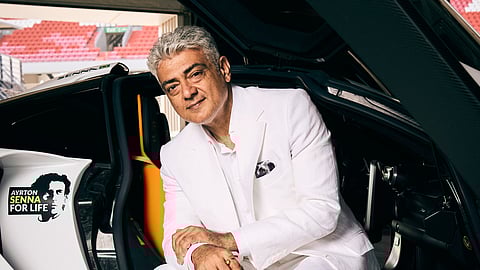


Stardom cannot be plotted. It is bestowed, even if one attempts to slip away from it. Some stars, such as Rajinikanth, Kamal Haasan, and now, Vijay, have found ways to funnel their reel fame into real votes, following the Tamil tradition of performer-to-politician.
Not Ajith Kumar. He is a reluctant star.
“I am in the movies basically for the money and, frankly, I have a hard time believing those who say they act for the love of acting,” the actor told Rediff as far back as 1997, very early in his career. It was a shocking admission then. It remains shocking now. Most stars pretend the adulation is incidental, and that they’re artistes first. It now feels like Ajith simply said the quiet part out loud — and then spent the next three decades trying to mean it.
Born in 1971 in Secunderabad (now in Telangana) to a Sindhi mother and a Malayali father, he dropped out of school and was drawn to the rough hum of bikes and cars. As a young man, he briefly apprenticed at Royal Enfield in Chennai before switching to a garment export business, where his good looks launched an adjacent career modelling those clothes. Cinema came knocking, but in fits and starts.
While he made his debut in 1993 with Amaravathi when he was 22, it was only in 1995 that his career took off with Aasai. Even as Ajith wasn’t chasing stardom, the rumblings of a fandom could be heard in the demand for a moniker — now a sure sign that people want to speak of you without saying your name, out of reverence. “Aasai Nayagan” — chief of romance — was workshopped in the discourse. His mailbox would be full of love letters from girls written on handkerchiefs in their own blood. He responded sincerely, but uncomfortably.
Over time, as he transitioned from musical romance to raw muscle, he was referred to as “Lucky Star” or “Ultimate Star”. But the moniker that stuck was “Thala” — meaning leader, or the head — based on his character in A.R. Murugadoss’s action film Dheena (2001). The word kept being referenced in puns throughout his filmography. This chorus of “Thala” swept through his films and the discourse around them in the aughts, but it was only in Mankatha (2011), a decade later, that it was officially used in the title credits — incidentally, also the last time any moniker was ever used for Ajith on screen.
Then, in 2021, he released a statement on Twitter (now X): “I henceforth wish to be referred to as Ajith, Ajith Kumar or just AK and not as ‘Thala’ or any other prefix before my name.”
Why? Because he wanted to make two things clear — that he was an actor first, and that he would never run for politics. There was no larger ambition driving his career. But even as “Thala” was removed from his title card, the jokes continued in his films unabated. Ajith wasn’t escaping stardom; he was negotiating it on his own terms.
This tension animates his entire filmography, one that competes with his racing career for his time — and increasingly, loses.
Right before his debut film’s release, in a practice session he injured his back and was bedridden for a year and a half. Actor Vikram had to dub his portions. Despite that setback, in 1999, when asked to pick between cinema and motor racing, he picked the latter without hesitation.
In 2003, he released only one film because he was focusing on his racing debut at the Formula BMW Asia Championship. Six years later, he was back on the tracks for the Formula Two Championship in Europe. When asked about his return in an interview with the Malaysian news outlet, The Star, he said, “I was in a race meet last February and Shalini [his wife] said she had not seen me so happy in a long time. She told me to pursue my dreams of racing.”
Back in Chennai, his fans were wondering about his next film — his 50th, a milestone. Gautham Vasudev Menon’s name was floating around as director, but Menon could not wait for Ajith to return from his alternative career. A film slipped away in pursuit of the race.
Here was the impossible situation: Ajith needed fandom to sustain his acting career, which funded his racing career, which was what actually made him happy. He was ambivalent about the very thing that made everything else possible.
So, he walked a tightrope. Even as Mankatha introduced him as “Thala”, he played a negative character — a taboo given the perception of on-screen and off-screen moral leakage, where to hit a character is to bruise the actor, a personal affront to the fan. Months before the film’s release, and ahead of his 40th birthday in 2012, he sent letters to the office-bearers of all his fan clubs, asking for them to be disbanded; among other things, he wasn’t happy with his name being used for political gains against his will. Then there’s Kireedam (2006), where the hero ultimately fails. After a disappointing initial run, the film was re-cut to let the hero triumph — a change Ajith himself didn’t support.
“While Ajith’s early films invited realistic identification with his characters, his later films offered the fan-spectator what M. Madhava Prasad calls symbolic identification, a relation founded not on representational similarity (he is like me) but on hierarchical difference,” anthropologist Constantine V. Nakassis observes in his 2020 essay The Hero’s Mass and the Ontological Politics of the Image. Ajith demanded an audience, even as he was wary of fandom; he desired acting, even as he was wary of stardom.
Despite a year of five back-to-back flops in 1997, and other big-ticket failures such as Aegan (2008), Aasal (2010), and the recently released Vidaamuyarchi (2025), Ajith kept returning to the screen. That return is testament enough to his enduring stardom.
Even as Ajith retreated from the public eye — not granting interviews, not doing films for extended periods — fans found other ways of marking his presence in their lives.
In 2019, he called a local pizza joint to order pizza. When he introduced himself, there was a sudden shriek on the other end. That call was recorded and uploaded to YouTube with the title, “Thala Ajith order Pizza see his Simplicity”. Overnight, it amassed a million views.
Even fans of actor Vijay — seen as his contemporary and rival — commented in solidarity. Small acts of kindness, such as Ajith carrying a baby bag for a woman with a 10-month-old child in an airport in 2023, became spaces for fans to extend their fandom through viral Reels; breathless recaps of mundane moments elevated to myth.
The star, however, seems largely indifferent to this. Even in 1997, after a spate of hits and being the blue-eyed boy of Amitabh Bachchan Corporation Limited (the company signed him on for their debut Tamil venture) when asked how he was feeling, he told Rediff, “Today, I am all over the place; tomorrow I may be gone, I may have to make room for someone else. So, why make a big song and dance about it all?” His reluctance seems rooted in the possibility of his ephemeral fame. Or perhaps, in the hope of it.
Now, at the age of 54, as his filmography has taken a decisive turn towards low-hanging fan service in films like Adhik Ravichandran’s Good Bad Ugly (2025) and the familiar action heroism of V.H. Vinoth’s Valimai (2023), Thunivu (2024), and Vidaamuyarchi, a question arises: what happened to the Ajith who trusted debutante directors to push his filmography in strange, sometimes rewarding directions?
Perhaps this is the bargain he’s finally struck — give them the fan service that funds the racing. Because right now, he’s partaking in the European racing season, having debuted his newly formed team, Ajith Kumar Racing, this past January in Dubai. He’ll then begin shooting Ravichandran’s next film. This seems to be the model Ajith will follow going forward — though whether he’s racing between films or filming between races, only he can tell.
Stardom has been remade in his image after all, just not in the way anyone expected. He didn’t reject it; he simply refused to let it consume him. In an industry built on worship, Ajith Kumar has spent three decades insisting on his own humanity, his own limitations, his own elsewhere. The fans, for their part, have loved him all the more for it — even when he wishes they wouldn’t.
Most stars want to be everything to everyone. Ajith Kumar just wants to be left alone with his cars. That he cannot have this simple wish is perhaps the cruellest irony of reluctant stardom.
To read more exclusive stories from The Hollywood Reporter India's November 2025 print issue, pick up a copy of the magazine from your nearest book store or newspaper stand.
To buy the digital issue of the magazine, please click here.