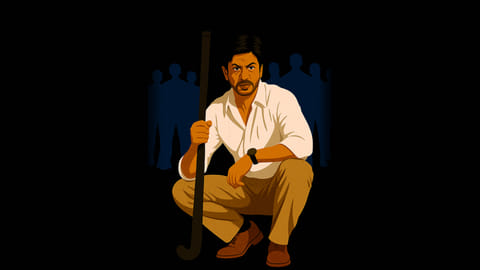


2007 was the year of sports dramas in Hindi cinema. While Dhan Dhana Dhan Goal brought football to the pitch and Say Salaam India celebrated cricket — India’s sporting religion — it was Chak De! India, a story about women’s field hockey, that surprised everyone by sprinting to the top.
A sport long neglected in both public discourse and pop culture found its unexpected place on the big screen and became one of the highest-grossing films of that year.
Shah Rukh Khan’s face may have graced the poster, but Chak De! India was never meant to be a star vehicle. Its heart lay in its ensemble cast — a team of young, relatively unknown women trained to play hockey.
In a speech at the University of Edinburgh in 2015, Khan recalled his initial doubts. “We had some of the brightest minds making the film like [producer] Aditya Chopra, [writer] Jaideep Sahni, [director] Shimit Amin,” he said, as reported by Indian Express. “We had young girls who learnt how to play hockey. We had [producer] Yash Chopra backing it. But when I saw the film at its first screening, we all looked at it and felt it was the worst film we had ever made in our lives.”
And yet, what followed was nothing short of a cultural phenomenon.
The movie opens with Kabir Khan (Shah Rukh Khan), the captain of the Indian men’s hockey team, accused of betraying his country after a crushing defeat to Pakistan. Branded a traitor by a media-fuelled frenzy, Khan disappears from the sport, only to return seven years later — not as a player, but as the coach of the Indian women’s national hockey team.
What begins as a redemption mission for him turns into a larger commentary on prejudice. The team he is handed is a fractured group, drawn from different states, languages and social classes. Players from Haryana, Jharkhand, Punjab, Manipur and more come with their own biases and baggage.
As they battle their internal rifts, gender discrimination and institutional apathy, what unfolds is a gritty underdog story. From being underestimated and even mocked, the women’s team rises through the ranks to reach the finals of the World Cup. In doing so, they don’t just win a trophy — they reclaim the pride of wearing India’s colours.
What people love about sports is the display of strength, unity and discipline. What people love about films is how they often dismantle stereotypes and change narratives — Chak De! India did both. It dared to question the idea of who gets to represent India and how.
Shimit Amin’s restrained direction, Sahni’s sharp script, and Salim–Sulaiman’s soaring score combined to create a film that was cinematic but never superficial. Not to mention, the now-iconic locker room monologue — “Mujhe states ke naam na sunai dete hain na dikhai dete hain (I can't hear or see the names of the states)” — was a manifesto for inclusive nationalism.
Today, Chak De! India is taught in management schools, dissected in gender studies classes, and quoted in locker rooms and boardrooms alike. It stands as a landmark in Indian film history, not because it had a superstar or a dramatic climax — but because it dared to imagine a different India. One where redemption is possible, where unity is earned, and where every girl with a dream and a stick can write history.