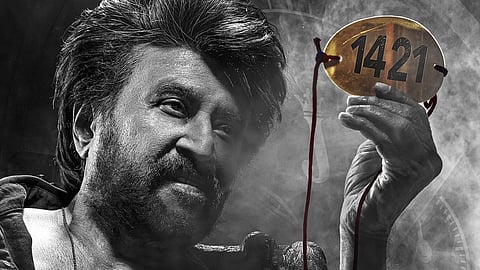


Like writer-director Lokesh Kanagaraj’s most triumphant film Vikram (2022), his latest potboiler, Coolie, is an onslaught of details—characters, events, and backstories, pile up in quick succession of dialogue, so relentless that sometimes before a plot crease gets ironed out, another doubt furrows our brow, until the very act of asking questions, demanding clarity, feels like checking the time while missing the bus. Preferring factual density over narrative clarity, the film runs on the hope that this density could pose answers to questions.
Unlike Vikram, however, these details begin to feel like a frail scaffolding for a film without a stable and compelling centre. Information is not given out cunningly or injected thoughtfully, but dumped out of context, just to keep the ball moving. There is a sticky sense that every piece of information is only doled out to make the next scene possible.
In the aftermath of the film’s release, lists were being made of “plot holes”, from banal questions like what is the point of Monica appearing suddenly—contextless pleasure, obviously—to more serious allegations about what the central villainy of the film is, which the hero Deva (Rajinikanth) is trying to douse. Some even considered one of the early theories of the film—that it is a time travel film, for how else can you explain characters shifting cities with so little as a push of the pen on paper.
The provocation and innovation of Lokesh’s cinema is that you can use relentless, swerving logic, instead of melodramatic excess, and bloated side-plots, to keep a film moving—nay, racing—forward. He lubricates this fact-finding mission with auteur-stamped style, slick violence, and musical numbers with so many extras, it turns the horizon into a haze of bodies.
But when logic itself begins to feel like an act of faith, plot conveniences begin to feel like plot holes, and what we get is proof of Kanagaraj’s faltered cinema.
A MacGuffin?
No. Only much later in the film is Deva told that his biological daughter—a daughter he never knew existed—would call him one day on that rotary dial number, and it is only then that he keeps one ear to the phone, hoping his daughter would call him. At the beginning of the film, there is no reason the telephone needs to be bestowed with such narrative possibility and hope. Or if there is, the film does not care to lay out its cards.
What is this friendship between Rajasekhar and Deva—what did Rajasekhar do in his past life that his paths crossed with a hot-headed coolie and union leader?
At the funeral, his eldest daughter, Preethi (Shruti Haasan), shoos Deva away in anger. Why? What does Preethi know about Deva’s past life that she throws him out? This question is quickly forgotten, until the very last scene, where, having wrapped up the film’s drama, at the airport, she apologises to Deva, noting that her father had told her things about him—what things? Why would Rajasekhar fill Preethi’s ears with ill words for Deva when he also believes that Deva will save Preethi when push comes to shove?
Deva was married to Rajasekhar’s sister, this we are told, and just as quickly told of her death in a gas leak explosion, and after the event at the docks thirty years prior, has kept his distance from the family. A possible reason? She is mad because he was absent?
A love between Preethi and Deva—a central love—needs to be broken to be mended, but Kanagaraj’s indifference to its brokenness makes the mending feel like a narrative shrug of a shoulder. So what if Preethi is Deva’s biological daughter?
Now, while Deva is trying to avenge Rajasekhar’s death by killing Dayal, he, too, chances upon the organ trafficking ring—remember how, in Vikram, Amar, the leader of a black ops squad (Fahadh Faasil), investigates and chances upon Karnan’s intentions, initially considered lecherous, eventually virtuous? Here, the twist is not from vice to virtue, but from vice to more vice—and Deva’s response in the film suddenly feels vague, without direction. These twin forces—the desire to exact revenge, and the desire to save the coolies—are they inextricable? When do they become one and the same?
In the first twenty minutes of the second half, Deva is doing tasks that Dayal asks him to, because the latter has Preeti kidnapped—breaking into the docks’ restricted area to collect the files for which Rajasekhar was murdered. What can he do with these files? Why does Dayal want Simon’s son—a strain of moral hope in this film—to be killed? The whole character of Saravanan (Dileepan) and his “boss”—whoever that is—slips past us without context or consequence.
In a later scene, he tells Deva that it was Dayal who murdered his friend. Does this become an act of solidarity, of gratitude, or trust, trying to see if he can replace Dayal with Deva? Simon makes a case that Deva is the closest person to Simon. The film is so insistent on twisting a moment, by first giving us the action, and later, its rationale, that it forgets its villain’s villainy. Why does Simon trust Deva despite knowing his ulterior motives and this nagging sense that they have crossed paths in the past?
And, perhaps, this is the acting, but there is no menace in Nagarjuna. Even when he finds out about his son’s death, the camera prefers a wide-angle, with a spectacle of a hundred scenes live-streaming his death, and him shrieking as a small silhouette, instead of a close-up.
Dahaa, on the other hand, desires Deva’s services, wants to make him his right-hand man, and is so meek, bowing down to his father’s wishes, that it feels like Deva, and not Dahaa, holds the keys to power. To end a film with a special appearance is to promise a larger world, one where the film’s victories suddenly feel unresolved. Kanagaraj was trying to do something new with this formula, by using this scene to further cement Deva’s heroism, through humour, and some pan-Indian solidarity of languages, not destabilise it through horror. It felt like a terrible misreading of a genre pleasure.
So tossed, knotted, and convoluted the film is that when Dayal makes an appearance in this scene, to be kicked off into a deep pit, and buried—I realised that I had forgotten about his character amid the mayhem. (His capture is off-screen; we must believe that he is caught, because the movie is now uninterested in him, his chases, and his escapes.)
Cigarettes and alcohol are symbols of collar-up coolness in cinema that Rajinikanth has dabbled in, with his famous cigarette tosses, but restrictions—like the health warning sticker that has to be on every scene with smoke, and protests by a local political party—have pushed him to, instead, play cool with objects like chewing gum. It was only in Jailer (2023) that he returned to the cigarette—the cigar, really—on screen, but that character’s moral scruples were wound up in a complicated heroism.
For a film, like Coolie, that insists on him being some moral centre for the young to draw inspiration from, the film quickly forgets both his moral pedigree and the youth who take succour from it. He seals the villain’s death with a beedi, and also, the film’s decision to go where facts take it, even if these facts are so fabricated, so sudden and loosely tied to the film’s flesh, they begin to resemble fables.