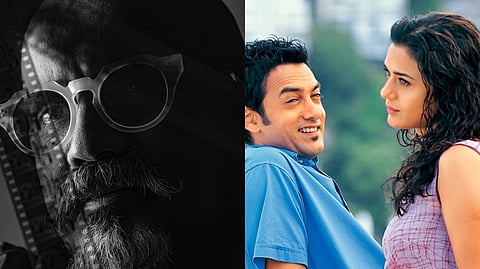


“I was the oldest person on the set," says Ravi K Chandran, after pausing for a second to remember the first thing that popped into his mind about the shoot of Dil Chahta Hai. “I was 38 or 39, and the next oldest crew member must have been 27." It was what he describes as a 'cool set', filled with committed youngsters who wanted to change the status quo of their industry.
It’s been 25 years since the release of the film and it now claims a special place in the history of Indian cinema. As Ravi K Chandran points out, even the fashion, the hairstyles and the set design have started to make their way back, just as any trend repeats itself after a certain period of time. Still, Chandran does not recall the film’s sets being a bed of roses, with all the dynamic changes its makers were attempting for the first time, a bit “too drastic” for the cinematographer’s liking, who was already a decade into his career in 2001. “In the South, we are used to walking onto the set and shifting things around as we pleased,” Chandran explains. “Be it furniture, a light or some prop, we would just move it up and down, focussing only on what it added to the beauty of each frame. To be fair, we often didn’t even care about continuity.”
But on Dil Chahta Hai, he recalls an incident a few days into the shoot, when this habit of his crew annoyed Suzanne Caplan Merwanji, the film’s production designer. Her team had planted everything on the set with military precision. As Aamir Khan once pointed out, even a drawer in Akash’s (his character) bedroom was filled with socks, not because it was needed for the scene, but because that would add to an aspirational “lived-in” quality for the character. On one day, when a team member of Chandran’s adjusted a prop, Suzanne ran up to him, annoyed.
‘Sir, did I touch your lights?' she asked Chandran. ‘Did I touch your camera? Did I touch your lenses? Don’t touch my furniture’. Chandran replied with a tense 'no' to all of these. “She corrected me and told me that both she and I needed to discuss every single before I made an abrupt change to her sets.” He remembers feeling upset at the micro-aggression, but he realised later on that there was a method they were all working towards.
“By this point, I’d worked on many movies but none with all these rules,” he adds. “Just as we entered the sets, we were all asked to deposit our phones into a box. It was only during lunch that we were allowed to see them again." The shoes of crew members were fitted with rubber socks to make sure they didn’t make any sounds. "Even tennis balls were fixed onto the bottom of our tripods for the same. This was really strange for people like me, because we were used to having our own microphone on the sets to shout out instructions to members of my crew.”
Dil Chahta Hai was among the mainstream Indians films to be shot on sync sound, a rarity in South Indian cinema even today, because “our actors are from so many different places and industries that it’s not possible for a lot of them to speak the film’s language.” Back then, however, a new kind of filmmaking discipline needed to be formulated, to pull off what director Farhan Akhtar and his team had in mind.
The film also initiated the first AD system, with both Zoya Akhtar and Reema Kagti a part of the directorial team. The pre-planning that went in to the film was unusually rigid and detailed. After a day’s shoot got over, actors and core crew members would be called to the sets to rehearse for what for the next day. “Even if Saif, or Aamir, or Akshaye did not have a shot, they’d still come back for this rehearsal. They also stayed on to give cues for the other actors to perform. This was also possible because we were shooting in Bandra, which was not too far away from their homes,” Chandran says.
It was also the first film in which Chandran worked with a gaffer (the head of department for anything to do with a film’s lighting) and a grip (the person in charge of rigging camera equipment). A set had been built for the film’s climactic portions. Lights for these scenes were required to replicate the whitish glow of tube lights, the kind you’d find at hospitals. When this was being discussed, the film’s gaffer told Chandran about a new set of lights called Kino Flo that could recreate the same effect. “Kino Flo lights had just come to Mumbai and we were among the first to use them on a film. Instead of that whitish glow of a tubelight, these lights came very close to achieving the natural skin tone of our actors. It was so new that a lot of DOPs even asked me about it.”
One of these was the legendary Ashok Mehta, a man Chandran considers his guru. Mehta was shooting next door for a film when he asked to come and take a look at how Chandran had lit this scene. “Ashok sir was like child when he came to our set,” he says. “I clearly remember him covering the back of his arms to see how the light was falling on his skin. He asked me some questions about the colour temperature and about how I lit it up, that too without any shadows. He then climbed up to see what the sets looked like from the top and asked me why I had decided to double bounce the lights off the walls to get a certain glow.” He speaks of this day fondly, after twenty years, because, “Ashok sir was the master from whom we learnt so many of these tricks. But on that day, it was like I was doing something worthy of his attention.”
Many of these methods were the norm in the West, but a bit too ideal and farfetched for how it all worked on Indian sets. “Honestly, instead of feeling excited, I remember walking into the sets quite reluctantly as a result of this rigid shooting style."
It was during the Sydney leg of the shoot that Chandran was called upon by Mani Ratnam. Here he was getting his bearings on an unusual film and the legend proposed that Chandran shoot Kannathil Muttamittal, his next about an adopted Sri Lankan girl, and her journey back to finding her roots. As conversations with Ratnam became constant, Chandran chose to show Mani Ratnam an earlier cut of Dil Chahta Hai. “He became the film’s first audience.”
Just like Chandran, other cast and crew members were also trying to understand the final film they had ended up making. “Aamir, for one, saw the edit and wanted to speed it up.” Chandran was unsure about certain calls Akhtar had made, such as the long pauses that were left in between the dialogue, just so a character could laugh or react. In another film of the time, all of these pauses would be removed on the edit. But like the crew, the film’s editor, the great Sreekar Prasad, had been chasing a new rhythm.
“Mani sir said he wouldn’t change a single thing,” remembers Chandran, after a special screening of the film in a theatre in Chennai. “That gave us relief and a lot of confidence about it all finally coming together.”
Not much needs to be said about how the film fared upon release in August, 2001. In the coming years, Chandran noticed how the success of Dil Chahta Hai and of Lagaan slowly paved the way for all of those rigid filmmaking patterns. Rubber shoe covers, tennis balls, sync sound, the first AD system and a deposit box for mobile phones would soon become the norm of most Hindi films. “The film did work, but I’m sure not if one can call the film path-breaking. All the changes it brought about, creatively and technically, happened organically and slowly, with the appeal of the film continuing to grow even today.”
Chandran also reminds us that, for the stature the film’s visuals holds today, he did not get a single award nomination for his work. By then, Chandran had come to terms with his work not getting due credit, at least at the time of release. When he met Sanjay Leela Bhansali later, with whom he’d go on to work on two breathtaking films, Saawariya and Black, Bhansali told Chandran that he was impressed by the visuals of a film he feels noone has seen. “Of all my films, he said he wanted to collaborate after seeing Saat Rang Ki Sapne.” It’s a memory he uses to break down what happened to Dil Chahta Hai, a film that has achieved a distinctly ageless visual quality, the sort that defies trends or fashion. “That’s always the case with any artwork that’s shockingly new… it has a way of throwing people off, before they learn to grapple with it.”
Ravi K Chandran is Canon’s Cinema EOS Ambassador