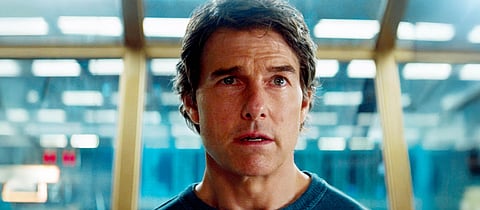


My mission — should I choose to accept it — was to rewatch all the seven instalments of the Mission: Impossible film series in 48 hours. Once the message (idea) self-destructed, I set out on this wild adventure within the realms of…a bedroom. Eat, Sleep, Cruise, Repeat. I started out as a nutty cinephile in anticipation of the 8th film, Mission: Impossible — The Final Reckoning. But the joy of seeing a 29-year-old action franchise from its birth to advanced adulthood got so overwhelming that I switched roles and wore my serious mask: I am now a film critic who binged a lifetime's worth of spectacle for “research purposes”. It’s one of those rare weekends when I can accurately declare that I consume movies for a living.
I met various versions of myself along the way. The snobby 10-year-old who parroted his dad’s love for James Bond when his friends recommended Mission: Impossible. The 14-year-old who shyly looked away when the screeching cars of two spies circled each other like flirty leopards in Mission: Impossible 2. The freshly graduated kid who dismissed III as the worst part of the ‘trilogy’. The nerd who spent hours mourning Hindi cinema’s inability to come up with a Burj Khalifa stunt after Ghost Protocol. The red-blooded chap who struggled to look past a Rebecca Ferguson crush in Rogue Nation (2015) and Fallout (2018). And I had to physically halt my eye-roll when I met the sullen guy who panned Dead Reckoning: Part One (2023) for being tedious and self-absorbed — what was he, or I, thinking?
It’s also been fascinating to see the trajectory of the biggest superstar in the world — or more specifically, the trajectory of the long-running movie series through the lens of its indefatigable superstar. Different actors have starred as James Bond over the years, but in this case, different spy versions of Ethan Hunt seem to have played Tom Cruise. The first film by Brian De Palma (sandwiched between Cameron Crowe, Stanley Kubrick and Paul Thomas Anderson movies) reflected the auteur-like ambition and big swings of a young Cruise in the 1990s; there’s a bit of Jerry Maguire in the way he cobbles together his own team after being ejected by the system. The intensely human and long-haired Hunt of the second and third ones marked his Vanilla Sky (2001) and The Last Samurai (2003) phase. The more kinetic and elastic Hunt from the 2010s — across Ghost Protocol, Rogue Nation and Fallout — expanded Cruise’s modern-messiah quest through movies like Oblivion (2013), Edge of Tomorrow (2014) and Jack Reacher (2016). And the perseverance of Hunt in Dead Reckoning: Part One echoed Cruise’s big-screen-saving pinnacle after Top Gun: Maverick.
There’s no such thing as a bad M:I entry, of course. But since I’ve put in the “research” and remain disoriented about why I’m having dreams about being Ethan Hunt (or Ethan Hunt as me?), a ranking list is only fair:
In isolation, John Woo’s Australia-and-Spain-trotting summer saga is an extremely John Woo movie: ultra-stylised, a corny Hans Zimmer score, the ‘80s Hong Kong action aesthetic, eclectic shot-taking, lots of love-storying. It even has a prescient pandemic-coded core — where a corrupt pharma giant manufactures a deadly virus so that they can profit from the cure. But as a follow-up to the 1996 original, Woo’s film feels like the only B-movie of the lot. It’s a narrative and spiritual anomaly in the series, a film that Bollywoodised Ethan Hunt so hard that the subsequent entries did a character-reboot of sorts. The film-making language has more in common with the director’s 1997 film Face/Off (including the white-dove slow-mos) and Broken Arrow (1996), sacrificing the ‘impossible’ anatomy of action for something poetic and pulpy. Cruise leans into his boyish rom-con persona with Thandiwe Newton as a sporting company — but sue me for being reminded of the doomed Hrithik Roshan-starring Kites (2010) instead. However, Dougray Scott’s Irish-villain act is sinister enough, mostly when he senses that Newton is a mole, but consciously ‘allows’ his lust to impair his judgment. To be fair, if there’s one weakness the good and bad IMF agents have across the series, it’s their penchant to get framed, fooled and disavowed. Even for highly trained and skilled killing machines, the groin wants what it wants.
In terms of pure, high-adrenaline, gravity-and-imagination-defying set pieces, there is no better entry than Fallout. It locks into the DNA of the series like seldom before, combining cutting-edge technology, seamless visual effects, Cruise-scale madness and gritty practical staging to deliver the most memorable sequences: the double-trouble HALO jump over Paris, the bare-knuckled combat battle in a pristinely clean men’s restroom (a moment imitated — and lessened — by many pretenders since), and most of all, the ridiculous helicopter chase and crash in the Himalayas. But Fallout suffers from a kind of between-eras density: too many players, too many subplots and shifting loyalties, a general lack of macro-purpose. Henry Cavill does well as the CIA ‘counterpart’ and belated baddie, but it’s hard to escape the fact that Fallout keeps fumbling for momentum between stunts. The shtick of every new CIA director or IMF secretary being won over gets old, Vanessa Kirby’s White Widow exists because she must, a goofy nuclear dual-bomb conspiracy stays goofy, and Ilsa Faust’s on-off situationship with Hunt starts to adopt the aura of a reluctant reunion party.
Apart from having the most casually unhinged villain (Philip Seymour Hoffman), J.J. Abrams’ entry is the one film that tries to explore Hunt as a man beyond the missions he becomes a machine for. By bringing in Michelle Monaghan as his fiancée Julia, it seals Mission: Impossible as a moral antidote to the womanising, suave, naughty and sex-addicted agents of the commercial spy-verse. That was the real ‘impossible mission force’ all along. The only infidelity in this franchise is the kind where Ethan Hunt keeps cheating…death. He doesn’t drink or smoke or swear, is a serial monogamist, a loyal friend (Benji is introduced as his human Google map), and even dares to have zero chemistry with female agents and assassins across the films. It’s a testament to Cruise’s family-friendly, Disney-for-adults stardom that he still makes Hunt such a compelling, haunted and oddly fragile spy whose longing for white-picket-fenced companionship is channelled through the way he operates — he excels at longevity and durability and short-term deceptions, but often gets blindsided for trusting too easily. The film goes too far in that it gives him a happily ever after, but the next cycle uses III as the ghost that haunts a white-knight personality crafted entirely from survival instincts. For better or worse, Hunt is rarely as alive as when he dies for a minute in Julia’s hands.
The subtext of an old-school Hunt attempting to destroy a shapeless AI software before it conquers cyberspace and controls the world — or an analogue Cruise trying to stop algorithms from diluting the big-screen experience — is hard to resist. It’s as urgent as they come, especially because the actor actually “rescued the movie business” with a huge Top Gun sequel. In Dead Reckoning, Cruise and director Christopher McQuarrie design a greatest-hits package that doubles up as both eulogy and mission statement. It’s full of hat-tips to previous instalments, but it also makes a slow-burning spectacle out of the uncertainty of a future we’re already in. Throw in a two-piece cruciform key, the emergence of a female IMF recruit, a primary-character death, a bunch of decidedly vintage locations — the Arabian desert, Rome, a misty Venice (a throwback to De Palma’s misty Prague), the Orient Express — and this part transcends its plottiness to capture the gravity of what it means to live today.
The stakes are personal, even if Cruise overcooks the meat around the bone to keep reminding us of his flesh-and-blood significance. I wouldn’t call it vanity, but perhaps the superstar, as both producer and lead, has earned the right to shepherd this era of mythmaking. The hype around performing his own stunts (conceived to traumatise insurance companies) literalises his image as a hard-working superstar who never takes his fame for granted. He puts in the miles, pushing the limits of creative mortality in pursuit of an artistic, do-it-yourself immortality. In the process, he’s become the poster boy of a genre that went from positioning itself as a speedy fairytale on the promise of technology to a cautionary tale about evolving too fast.
A shadowy anti-IMF outfit called The Syndicate. An antagonist that looks like a Saw (2004) villain. A sultry MI6 agent on the run. A triple assassination attempt at the Vienna State Opera. A bike chase across Casablanca. A lung-bursting underwater mission-turned-extraction. A foggy Tower of London shootout. Rogue Nation is an endless buffet of slick and catchy cinema-weds-entertainment moments, most of which now headline the museum of Mission: Impossible lore. The arrival of Rebecca Ferguson as the tragic-mysterious Ilsa Faust — only the second woman to summon the fabled hero’s feelings — refines a franchise in danger of choking on its own testosterone. Her sharpshooting posture at the opera, in high heels and a flowing yellow gown, instantly unlocks the franchise’s chastity belt; even a platonic romance looks alluring. Ethan can’t stop himself from hunting her and being hunted by her in equal parts, thereby turning the film into one of those adventures where the suspense of desire offsets the chatty physicality of the narrative. The supporting cast — Jeremy Renner, Simon Pegg, Alec Baldwin, Ving Rhames and Tom Hollander — solidifies the balance that Ghost Protocol so cannily restored. Cruise embracing anti-establishment in a movie called Rogue Nation is a dish that’ll never get stale. To paraphrase one of his many ex-IMF colleagues gone rogue over the years, I couldn’t stop “grinning like an idiot”.
Back when there was no blueprint or reference for the technical and cultural direction of M:I, De Palma weaponised this first-mover’s advantage and made a semi-arthouse crime thriller posing as a Hollywood action movie. It’s astonishing to watch today, not least because of how relaxed and retro the film is in form, and also because you have to keep reminding yourself that this was the Ground Zero of modern espionage dramas. Nearly every ‘template’ and theme today can be traced back to the legacy of De Palma’s original. It’s difficult to imagine a franchise starter looking and feeling the way this does: the split diopter shots, cascading dissolves, the Hitchcockian tensions and shadows on cobblestoned streets, the dry detective-like vibes, the interplay of silence and sound within set pieces, the sheer patience and control of the editing. It resembles the kind of nostalgic noir one sees as old-fashioned productions within newer productions (cases in point: Entourage, 2004, Babylon, 2022, The Studio, 2025). When you least expect it, there’s that pulsating train-versus-helicopter-in-tunnel climax that established Cruise as an action star who imparted the value of immersive reaction shots. The rippling of his skin from helicopter blades expresses more than the whole bodies of beefed-up stars like Schwarzenegger, Stallone and The Rock. It’s this vulnerability — the ability to die but the will to live; the mainstream resistance to pain but the indie capacity to bleed — that came to define the brand of Ethan Hunt.
It had to be the one with a delightfully wonky Anil Kapoor cameo. Jokes (or not) aside, Brad Bird’s Ghost Protocol reinvented a franchise grappling for a funnier, sharper and edgier identity. You can tell how sure it is from the way it begins — in a silly-smart Russian prison, with Hunt effortlessly breaking out of (movie) jail amidst a pattern of visual punchlines. It has the kind of self-awareness and levity (thanks to Benji’s debut as a ‘full-fledged’ field agent) that marked the early Marvel movies. Little dots of humour humanise the scale of the breathtaking Burj Khalifa sequence and the aborted Kremlin heist — with Cruise harnessing a bodily energy that merges Chaplin and Buster Keaton with his own comic timing in Tropic Thunder (2008) and Rock of Ages (2012). Everything in the film is outrageous and, at times, moving.
One of the great things about the franchise is how it accepts the passage of time: several movies can be made out of the unseen events between the movies. Backstories are sensed, not shown. In this case, it’s Hunt’s agile return to bachelorhood after being briefly married — a sacrifice that beautifully reveals itself in the final moments of the film. A glance back is always a romantic gesture, and while there are more cinematic examples of this (Shah Rukh saying “palat” in Dilwale Dulhania Le Jayenge; Sebastian and Mia in La La Land), none disarm like the one in Ghost Protocol. There is, after all, no protocol to deal with the audacity of an action movie asking for your tears.