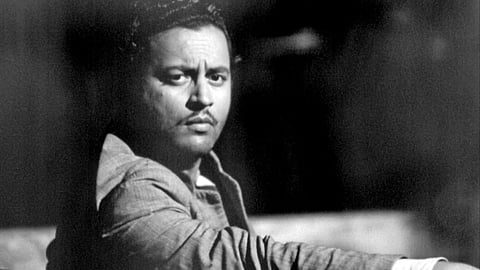


Guru Dutt’s filmography is often painted by its tail end. With all that sadness in his later films—Pyaasa (1957) and Kaagaz Ke Phool (1959)—and his later life, which was cut short at the age of 39 by mixing alcohol and sleeping pills, one forgets it was a career that began with bumbling joy—Aar Paar (1954) and Mr and Mrs 55 (1955).
His cinema has, instead, been read as a writhing compendium of heartbreak and loneliness, perhaps because it is these films which have endured time—Pyaasa being a colossal success in its time, featured in TIME Magazine’s All-Time 100 in 2005, and Kaagaz Ke Phool, a colossal failure in its time, which, like most tragic films, gained greater currency in the future.
Celebrating Guru Dutt’s birth centenary, here are five frames from his filmography that captures the wide, often playful, often pathetic quality that emerges when seen as a whole.
Mr & Mrs 55 was named after Hindu Marriage Act of 1955. Lalita Pawar plays Madhubala’s aunt, and divorce-bill activist, with Guru Dutt playing a struggling cartoonist who is pulled into her plans. She is against marriage—perhaps, even love—while the arc of the film bends towards marriage, towards love. Playful and bumbling, these scenes of Pawar and her coterie of women, express the anxiety of a new kind of feminism, although not in the kindest light.
One of the many joys of Guru Dutt’s cinema is his inclusion of the teetotaling Johnny Walker aka Badruddin Jamaluddin Kazi, once a bus conductor, with the comic-interlude song genre. If ours is a ‘cinema of interruptions’, these moments serve to buoy the film’s spinal narrative with sidelong glances and meandering asides, turning a film into a world. Johnny Walker’s asides were as such, and they include ‘Sar Jo Tera Chakraye’ from Pyaasa, ‘Aye Dil Hai Mushkil Jeena Yahan’ from C.I.D. (1956_ and the lovely ‘Jaane Kahan Mera Jigar Gaya Ji’ from Mr. & Mrs. 55, where Yasmin and him flirt around an office, turning a room into a playground of the heart.
A courtship tango between Gulabo, a sex worker (Waheeda Rehman) and Vijay, a poet down on his luck and fortune (Dutt), is actually more complicated—Gulabo is trying to lasso a customer for the night and sings a song, one which happens to be written by Vijay. Vijay is trying to enquire about how she caught hold of his words, but Gulabo interprets his interest in her song for interest in her. These songs breathe more than their context, allowing into the “plot” a sense of romantic respite and ambiguous air, fabulating reality into something more joyful, and less coherent.
The Mohammed Rafi song opens the film, and the images of director Suresh Sinha’s (Guru Dutt) fame alongside the images of its eventual collapse, produce a song that is thick with history and foresight. When the chorus picks up, a rousing surfeit, it is hard not to feel that the voices that hold up the body of a hero being crowd surfed might also be the those that carry a bier in a procession. It is this ability to use a chorus to shut a life’s gilded years that is used in Jubilee, where this song was reworked by composer Amit Trivedi to signal the end of a studio, a life, and a love affair.
Though the film was directed by Abrar Alvi, the songs of Sahib Bibi Aur Ghulam were helmed by Guru Dutt, a tussle of control whose stories are as (in)famous as the film. In this song, shot entirely around a bed—something Sanjay Leela Bhansali would try and re-create in ‘Ang Laga De’ in Ram-Leela (2013) or ‘Meri Jaan’ in Gangubai Kathiawadi (2022), shot entirely in the backseat of a car—Meena Kumari, dazed in alcohol, sings for her philandering husband. It is a doomed desire, in Geeta Dutt’s voice, that she sways to.
Bhansali often remarks that his female characters are emotional descendants of Meena Kumari or Guru Dutt—per his description—inhabiting their fractured beauty that he milks to the hilt. Separately, there is enough grief to supply a filmography. Collectively, it is a flood, one that buries this film.