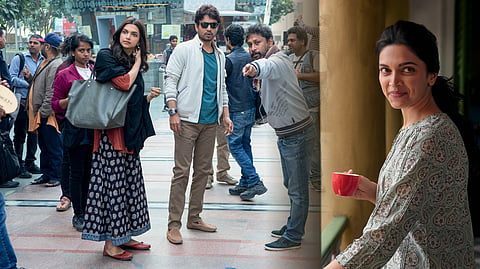


A decade on, Piku is lightning in a bottle. Written by Juhi Chaturvedi and directed by Shoojit Sircar, the film still doesn’t look or sound like a film. A lot of it is everyday chaos — domestic dysfunctionality, the soundscape and mind-scape of co-existing and existing. The storytelling is almost incidental. The camera doesn’t show, it reveals. People don’t act; they react. Cacophony is a comfort zone; saltiness is a safe space. They talk over each other, cut one another off and behave like messy humans who’ve lived and grown in a space rather than sanitised characters who pretend to live there.
One sees in Piku Banerjee (Deepika Padukone) the accumulated gravity of 30 years in the way she speaks and scowls, in her hypochondriac dad Bhaskor (Amitabh Bachchan), 70 years of boyhood, manhood, adulthood and (opinionated) parenthood. “Outsider” Rana (Irrfan Khan) bares a history of working-class drifting and striving. The Banerjee bungalow in Delhi’s Bengali suburb — CR Park — emanates decades of squabbles, familiarity, smells and cultural quirks. Piku, Bhaskor, relatives and neighbours move around as though the walls and furniture have rearranged themselves to accommodate their routines. It’s a home constructed from hoarded memories and ritualistic attachments. There’s a perpetual presence of all the time that has passed and all the words that have been said.
The film revolves around a road trip to Kolkata, but the people in it bristle with an untold “before” and “after”. One can almost touch the flashbacks of seminal events: the funeral of Bhaskor’s wife and Piku’s mother; the pressure on Piku to grow up faster; the crabby man moving in with her and expecting her to be his daughter, wife and mother at once. These are juxtaposed with her nights of loneliness, tears and reluctant situationships; her workaholism — the co-founding of a firm and its success — becoming her escape; family gatherings where Bhaskor becomes a tea-stall liberal by attacking the “regressive institution of marriage” and the “servility of housewives”. Every gesture is a rusty habit, every debate is a drill, and all motion is an aggregation of previous emotions.
One can also touch the flash-forwards. Perhaps in 2025, 10 years after Bhaskor’s death, Piku and Rana are in a live-in relationship: She finally sees herself through the eyes of someone who is both amused and enthralled by her. Maybe they didn’t get married because they didn’t need to. They do annual trips to Kolkata where they revisit the spots from that sightseeing day together and meet the tenants in her ancestral home; the Banaras hotel is their little in-joke. Maybe Piku became the breadwinner for a while so Rana could shut down his taxi business and pursue civil engineering projects in the NCR region. Maybe the ageless Chhobi maashi (Moushumi Chatterjee) is unwell, and Rana is the only one who makes her laugh with his deadpan jokes.
The essence of Piku is that it straddles that precise phase between the past and the future. It’s located in the genre-less uncertainty between nostalgia and hope, hindsight and prescience. Piku herself is in that awkward stage where her father is now a flawed person to her, not an overbearing parent. He wants to be seen, but all she can do is see through him. She knows that his open-mindedness about women being financially and sexually independent is a front; it’s a reverse-engineered philosophy, a story that an educated widower tells himself (and others) to rationalise his need for a full-time custodian. His aversion to Piku getting married is not some progressive stance; he just wants her life to be centred on him and nobody else. His paranoia becomes a weapon to retain her devotion.
But there’s also another dimension to his drama. Bhaskor considers it her duty to look after him in return for the sacrifices he made as a father — a transactional bond disguised as unconditional love. Rana’s “entry” into their bubble becomes the catalyst for Bhaskor’s exit; Rana influences the old man to live instead of trying to not die. The only selfless thing that Bhaskor does is pass in peace the moment he realises that Piku’s soulmate has arrived — the constipation was a metaphor for all the clogged-up discontent of not being able to find a “deserving” suitor for his daughter. Like most Indian parents, his love is rooted in the illusion of control: He has steered her life inside out, right to the point of scaring away her boyfriends and “choosing” her eventual partner. In a way, Piku and Rana’s is an arranged match; the long drive with Bhaskor was a meet-cute and rishta meeting rolled into one.
To truly understand the cultural impact of Piku, it’s necessary to understand a nation’s relationship with parental reverence and generational differences. Hindi cinema has a history of pitting the arrogance of modern youngsters against the sanctimonious purity of their elders. These stories often choose a side: Their sympathies lie with the old guard in a country where seniority is romanticised to uphold the narrative of tradition. The act of caregiving then becomes the conflict and the resolution — anyone who rejects this circle of life is demonised as a thankless son or daughter.
The stars play the roles of “sanskari” Indian heroes who show the rest how it’s done. Take Swarg (1990), where Govinda plays a house help turned celebrity who avenges the riches-to-rags journey of his employer (Rajesh Khanna) by punishing his family members. Or the most popular of them all: Baghban (2003), where Salman Khan is the godly adopted son to an old couple — played by Amitabh Bachchan and Hema Malini — who’ve been reduced to burdens by their ungrateful biological children. Baghban remains every second ageing parent’s bible.
What Piku did, and continues to do, is humanise the culture of caregiving. If movies like Baghban were the binary “expectation” panels in a Sooraj Barjatya–fuelled age, those like Piku unfold as the difficult and bare “reality” panels. Bachchan’s character here is a flesh-and-blood antidote to his Baghban avatar: He exudes the entitlement of a needy parent and a constipated love language. More importantly, the “youngsters”, Piku and Rana, have contrasting ideologies. Given the tensions and intolerances of his mother and sister, Rana cannot process the self-destructive obligations of familyhood; he cannot fathom the price of abandoning one’s own identity in service of parental egos. Piku brims with resentment and toxic empathy for a father that has no sense of boundaries, but she gets defensive the moment Rana questions the mentality of her father. Like her old man, she reverse-engineers her notions of freedom to vindicate her situation; she has no choice but to commit to her role and embrace the contradictions of caregiving.
Despite this clash of outlooks, the film doesn’t take a side or deliver a message — there’s a refreshing “it is what it is” frankness, a moral ambivalence, about its tone. Rana spends hours observing Piku and her baba, equal parts curious and exasperated; Piku agrees with this gaze but stops short of judging her father. Neither wins, neither is victimised, and Bhaskor’s personality isn’t “cured”. For better or worse, everybody is complicit and nobody is culpable. In short, there is no right or wrong within the social imminence of living. It’s why the title is the name of a person, not some righteous adjective or allusion to the humane functionality of growing old.
On a personal note, the Piku-Rana chemistry is very much a reflection of my own relationship. My Bengali partner is Piku-coded in her approach to caregiving: anxious, intermittently bitter but strangely grateful for the crushing responsibility of guiding her parents. She considers the role-reversal a privilege, while I often consider it a tragedy. I flare up the second my parents mention the word “duty”. But this distaste for dependence has been shaped by the fear of being the only child from a broken marriage; my desire to not be “held back” stems from the uncertainty of moving forward.
Now that I’m on the brink of long-term caregiving, the denial has graduated to resignation. The sight of a mother losing her memory or a father unwilling to concede defeat is enough to soften the Rana in me. There is no escape from the indignities of age. A mature Bollywood movie becomes a reminder that it’s normal to be confused, to be mortal, to resist, to struggle, to pity, to hate within the confines of love. After all, it’s always been Piku’s world — and we’re just giving in it.
To read more exclusive stories from The Hollywood Reporter India's May-June 2025 print issue, pick up a copy of the magazine from your nearest book store or newspaper stand.
To buy the digital issue of the magazine, please click here.