

You either believe artificial intelligence (AI) is the future, or you believe there is no future. About a year ago, Mustafa Suleyman, a British AI entrepreneur, noted that AI will develop human levels of capability within three to five years — that is, by around the turn of the decade. Pop historian Yuval Noah Harari called this possibility, where technology can make decisions and create ideas independent of the human push, “the end of human history”, history being that which humans have steered into being. The narrative is that AI is going to inaugurate an era of post-history.
In cinema, too, these questions are quickly filed into exaggerations and arguments, because AI has crept into various aspects of filmmaking, with varying degrees of intensity. While in the US, studios are engaging in what The Guardian calls a “machine-learning arms race” — Oscar-winning actors like Adrien Brody are having their accents in films chiselled into shape by AI, AI film festivals are being organised, and unions are protecting artists against the onslaught of AI — in India, the tide hasn’t turned completely, but the waves have been eddying.
Ajay Devgn’s announcement of Prismix, his AI company specialising in “generative AI storytelling” and the trailer release of Naisha, India’s first AI-generated film, directed by Vivek Anchalia, set to release in May 2025, came within the same week. The groundwork for the explicit inclusion and exhibition of AI, however, has been in the making for years now. Naisha has since been postponed, since the AI technology has changed drastically in the last few months. "Didn’t expect AI to reach here this fast," tells THR India. These films are "rendered", not made.
Director Shakun Batra tells The Hollywood Reporter India, “AI-generated dubs have already made their way into our movies, and often we don’t even realise it. It is already part of filmmaking, quietly transforming the process.” Cinematographer Ravi Varman, reminiscing his journey in the British Cinematographer (January 2025), writes “During COVID-19, AI technology also allowed us to complete unavailable actors’ on-screen presence by using their body doubles and replacing their faces with realistic AI-generated faces.”
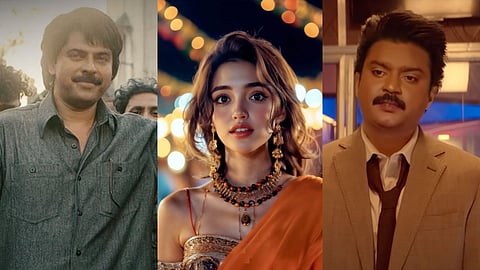
Among the cast of the Malayalam film Rekhachithram is “AI Mammootty” — a de-aged composite deepfake of the actor made by uploading over a thousand photos of Mammootty when he was younger to arrive at a proper image. Shameer Muhammed, the film’s editor, tells THR India, that they also used AI on found footage of the late John Paul, screenwriter, “What he was saying in real life was different. With AI we changed the lip movement, to have him say what we wanted."
It is not just the scratched presence of one or two bodies in a scene, but entire scenes are being conceived using AI. Director Dibakar Banerjee directed the “first commercial theatrical film in India that uses AI significantly” in the climax of Love Sex Aur Dhoka 2 (2024) — where one of the characters, a video game vlogger, descends into a nightmare in which he gets haunted by images and worlds he has not seen before. “The whole thing is done on AI, including the simulation of actual actors from the film, making them appear in different [avatars] in the AI sections,” Banerjee tells THR India.
In marketing and film promotion, too, AI is being used extensively. Last year’s Merry Christmas used AI to generate images of its cast members against backgrounds — synthetic images, whose synthetic-ness has become an aesthetic in and of itself. Recently filmmaker Lokesh Kanagaraj shared the trailer for the re-release of the 2004 Tamil hit film Autograph. The trailer was reimagined by AI.
Director Pa. Ranjith, actors Tovino Thomas and Prasanna, too, shared this trailer, with good wishes. Again, there is that synthetic look, untouched by the breath of human presence — otherworldly, dead-eyed, clear-skinned, somewhere between really good animation and really bad reality. What Banerjee was deploying in his film as a nightmare, other filmmakers are depicting as life itself.
There are two broad, but not so disparate levels at which AI is operating in cinema — one that AI artist Sidhant Gandhi calls “donkey’s work”, and the other is the creative side of filmmaking. One is helping cinema become more efficient, and the other is re-drawing the very lines of what we consider cinema.
AI has already made significant inroads in pre-production. “It is being used in pre-visualisation, storyboarding and concept art. Earlier, we would sit with concept artists and give them a prompt, based on which they would paint an image. Today, the prompt is being recorded and it is being fed into an AI image generator. The better artists then work on it a little bit, otherwise it just looks very ‘AI’ — you can tell,” cinematographer Sudeep Chatterjee says. Certain mechanical jobs will be rendered obsolete by AI — this could be the storyboard artists or the assistant editor who lines up the shots (though this would require AI to be more aware of and adept in Indian languages, which it isn’t) or entire teams dedicated to rotoscoping, going through a film and cleaning it up frame by frame.
“Recently a director built an entire set on AI for his production designer. This makes it easier to communicate and saves a lot of time,” Mitesh Mirchandani, a cinematographer, tells THR India.
Given these advancements, are we far from a world where a singular voice can prompt the set design, lighting and costume to produce moving images, that if sculpted, pared down, cut up, produces cinema? Screenwriter and AI artist Prateek Arora, on a panel on AI at the MAMI Mumbai Film Festival, clarifies, “I am not trying to be alarmist, but there will be a significant portion of storytellers and filmmakers — I don’t know if you can call them filmmakers — who will probably never use a camera, who will generate their entire visual narrative [on AI]…. It is a completely different paradigm.”
Chatterjee, though, is cautious. While he acknowledges that the leap from an image to a video, a storyboard to a camera movement is the gap of a code, he still feels the cinematographer as an image-steering figure will still be relevant even if “my role might change a bit”. Mirchandani agrees: “You still need a human element to prompt AI”. Colourist Mahak Gupta, who was also present on the MAMI panel, responds to AI’s presence in her field of work: “I am more interested in seeing AI create efficient workflows…. But, as colourists, we are doing a lot of subtle, nuanced, intuitive work that I don’t think AI is intelligent enough for.” Gupta has since revised her initial optimism. Earlier she thought it would take ten years for AI to catch up. But with shrinking budgets and technology catching up, Now she feels that horizon is closer—three-five years.
Face-tracking, though, is something AI has produced marvellous results with. Colourist and film producer Sidharth Meer notes, “We used AI extensively on Jigra, where we tracked Alia’s face, brightened and sharpened her eyes. It gives you a [stronger emotional connection to] the character.” Another tool that Meer is tinkering with is “depth-mapping”, in which the foreground and background can be extrapolated and colour-graded separately.
Neither are egregious or substantial changes to cinema. Editor Nitin Baid, speaking to THR India, also observes AI being used extensively as a “check” in the filmmaking process — screenwriters checking if the beats of their script make sense, soliciting suggestions on interval placement and the film’s climax when stuck, or composers auditioning singers by inputting voice samples to get a sense of how they would sound on a track. Meer notes how it is used to get market research on the addressable audience size for a particular film.
The argument made by those who see AI as cheaper and more beneficial, but also those who see it as inevitable, is that from painting to photography, photography to film, and film to digital, every generation has suffered through, endured under, and emerged from a tectonic shift. Casualties might include the loss of labour, and the leaving behind of technology that could not catch up.
“Think about how music evolved — once reliant on big orchestras, then transformed by artistes like A.R. Rahman, who could create entire soundscapes from a single room. Filmmaking is heading in a similar direction,” director Shakun Batra notes.
But as Vishal Misra, the vice dean of Computing and Artificial Intelligence at Columbia University, tells THR India, “People keep saying that AI is going to replace you. But it is actually a human who knows how to use AI who will replace you.”
Besides, the very idea of what an artist is, what art is, will expand to incorporate AI, notes Batra, who feels like the conversation should not just be about fear but adaptation. “The role of an ‘AI artist’ is going to be a new kind of creative profession. Remember, VFX wasn’t considered an artform worthy of an Oscar for a long time, until people recognised its artistic depth. AI can, in some ways, be seen as an extension of VFX, and while there are important questions about ethics, ownership and protecting all artists — both traditional and AI-driven — it’s ultimately expanding what’s possible in storytelling.”
Is AI to be faulted for the structural and semantic shifts it might cause? Banerjee thinks AI is a convenient scapegoat when the real villain is the “oligarchic, late-stage capitalist system that is working with various forms of dictatorship to enslave us, to mine our data and to sell endlessly to us, and over time isolating us from the rest of the society”. There is no point throwing a hatchet at AI, which is just a symptom of the broader rot. To pull this point in a Marxist direction, what is the world that those arguing for AI’s increased efficiency are moving towards? What is the point of increased efficiency if the realm of labour — that is the workday, the work hours — does not shrink? The efficiency that AI is producing is not in service of greater freedom, but greater profit. The question of AI’s efficiency is rarely followed up with — efficiency to what end?
The worry also is what this broader system is using AI to accomplish. Given the current technology, Misra notes, the output is often perceived as “generic”. And in a culture that favours efficiency over artistry, and one where AI offers an easy pathway to efficiency, it is artistry that will be hung out to dry, the generic cinematic image becoming inevitable. “A lot of unimaginative filmmakers will use AI to find the look of the film,” Banerjee notes, but clarifies that this will just be another wave of “similar looking and homogenised content”, the previous iteration being streaming and how it has made all stories look and sound alike.
AI will democratise cinema, there is no doubt. “You no longer need a massive post-production house to create large-scale VFX. With tools like Sora or Google Veo, you can generate stunning cinematic shots — imagine dragons flying across a battlefield — for just a $200 subscription fee. In the next few years, we’re going to see 24- or 25-year-olds making films that look like they had a ₹100-crore budget, all from their laptops,” director Shakun Batra tells THR India. Pulling further at this point, the idea of what a “₹100-crore budget” film looks like, will also change.
This democratisation will come alongside a glut. Gandhi, speaking of AI’s capture of film promotion, notes, “Eventually in our business, flooding is everything, right? You flood the market with something and then people get used to it. If you have AI on your side, with flooding, you’re going to be spending less money and reaching more people. So eventually most marketing is going to shift towards AI.”
There is Iconz, for example, an aggregator and digital IP monetisation platform that uses AI models of big stars, so fans can interact with them, even take selfies. One of their products is a “customisable digital avatar system…perfect for virtual customer service, e-learning, or personalised virtual assistants” — the plot line of Vikramaditya Motwane’s CTRL, a film that gestures at an over-reliance on machines being the beginning of an end. Amitabh Bachchan signed up with Iconz in 2023.
“Whenever we shoot commercials these days, a lot of the companies require celebrities to do an AI scan — using this they can create whatever they need to,” Mirchandani notes. This has been in the making for a while. At the end of the pandemic, Cadbury got Shah Rukh Khan to endorse 300,000 small businesses using deepfakes of the actor. Mirchandani clarifies, “A lot of actors have been retaliating, though, because there is no rulebook or decorum with AI.” Besides, how this will affect their value as a brand is a toss-up. Will they be able to charge less for their likeness as opposed to their being?
The legality of AI is also something people are scratching their heads over. Since AI is produced from a data bank of everything that already exists, who would own the copyright if AI has produced a work of art? How does one protect the artist? Actor Anil Kapoor’s concern about the misuse of AI, about its capacity to exploit one’s image and voice for commercial gain without consent, led the Delhi High Court to rule in his favour; Kapoor copyrighted himself — as did Bachchan.
How about the art form — how does one protect that? How does one protect the process of making art? Gandhi makes a useful distinction between artists for whom “validation comes from process versus [those for whom it comes from the] outcome”, the former being more vulnerable to AI. Mirchandani, too, notes that the happy accidents that take place as part of the art-making will be totally lost to AI’s radical, rapid but limited clarity. A new kind of process yields a new kind of art. The myth of art-making will cease. What about the myth of the artist? Will that survive this onslaught?
With actors now offering their AI-produced likeness over their presence, Banerjee sees a faint but present silver lining. “A lot of the nonsense that producers go through because of superstars not coming on set or not being able to act…you might actually get an AI engine that makes them act better. If that happens, I’ll definitely use it.”