

Even if you knew nothing of Jafar Panahi’s biography—his arrests, his filmmaking bans, the years spent resisting and reinventing under surveillance—you’d still sense the lived experience coursing through It Was Just an Accident. The film’s final movement, a sequence of such subterranean force that it seems to bypass the mind and lodge directly in the spine, feels unmistakably shaped by someone who has endured the machinery he depicts.
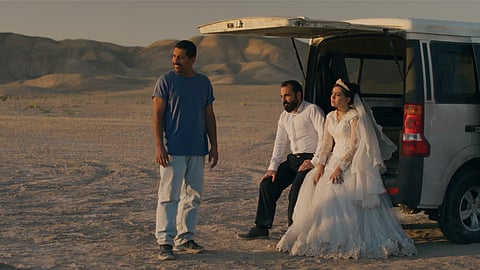
Its premise is disarmingly small: Vahid, a mechanic played with a bruised gentleness by Vahid Mobasseri, once endured interrogation while blindfolded in an Iranian prison. Years later, a customer named Eqbal limps into his workshop, his prosthetic leg emitting a creak that stirs something terrible in Vahid’s memory. From this faint auditory echo, Panahi constructs a dark comedy of escalating unease—a Beckettian chamber piece complete with a sly nod to Waiting for Godot, where recognition becomes accusation and everyday banter slides inexorably toward menace.
For viewers unaccustomed to the rhythms of Iranian cinema, the performances may initially feel stylised, almost stilted. But somewhere past the midpoint, the film’s tonal oddities click into place: Mariam Afshari and Mohamad Ali Elyasmehr carry their characters’ grief and shame with such lightness that the humour lands with paradoxical grace, especially as the plot veers into abduction, absurdity and something far more frightening.
Panahi frames violence as a residue of trauma, sedimented into ordinary people who have long learned to navigate corruption, bribes, and the tyranny of endurance. “It was just an accident,” a mother tells her child after the family car runs over a dog. “God surely put it there for a reason.” The little girl’s reply—“You killed a dog. God has nothing to do with it.”—lands like a slap.
The final twenty minutes are a slow-motion plunge from grim humour into pure dread, a reminder that the grotesque and the surreal emerge not from fantasy but from the lived distortions of life under authoritarian rule. Panahi’s rage, as always, simmers beneath the film’s deceptively airy surface; the question is where, and at whom, that rage should be directed. Systems? Individuals? Ourselves?
It Was Just an Accident offers no tidy conclusions and no consoling exits. Only the uneasy realisation that moral clarity is a luxury, and that the violence people commit is often inseparable from the violence they’ve survived. It leaves you rattled, questioning, and very much awake.