

People make films because they just do. We pry and look for origin stories, moments of epiphany, of foresight. Some directors even indulge this as part of their myth-weaving. Celebrated Hong Kong New Wave filmmaker Ann Hui, however, gives us nothing — she makes films because she simply does. “I don’t think very much. I just make films,” she says in a conversation at the 29th International Film Festival of Kerala (IFFK).
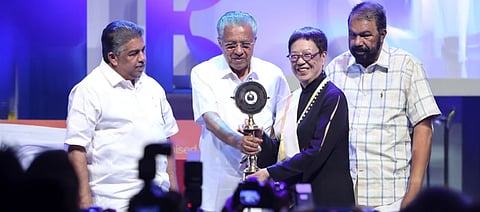
Hui was awarded the IFFK Lifetime Achievement Award. The award comprises ₹ 10 lakh, a sculpture, and a citation presented by Chief Minister Pinarayi Vijayan at the opening ceremony of the festival on December 13. By being bestowed the Lifetime Achievement Award, Hui becomes part of a long, illustrious list that includes Mrinal Sen, Werner Herzog, Dariush Mehrjui, Majid Majidi, Fernando Solanas, Jean-Luc Godard, Bela Tarr, and Krzysztof Zanussi.
A prolific artist, she can be considered, as critic Justin Chang writes “more journeyman than auteur”, given her work across genres — from the slapstick horror comedy to wuxia epics, romantic dramas to the soft melancholia of ageing. Since her debut in 1979, Hui has directed 26 feature films, two documentaries, and many shorts, and throughout she has refused to be pigeonholed into being considered one kind of director, slipping from grasp every time the grip tightened.
Though now, she might have hit a hard stop. “In my 77th year”, Hui notes in the conversation with journalist Saraswathy Nagarajan, “I am doddering.” Filmmaking is not just the intuitive theatrics of thought, but the studied mechanics of labour, too.
Age is something Hui is grappling uncomfortably with. When asked if she found being a woman in film challenging, she quips, “I wasn’t aware I was a woman when I started working on films.” After studying at the London Film School, when she returned to Hong Kong in the 1970s to work in television, the pay was so low for this new medium that it only attracted women. Her superiors — men — never pushed her into her gendered cubicle, either. Instead, she notes, “I suffered more from the discrimination of being old,” before shrugging, “People have to live through all kinds of discriminations.”
Hui, throughout her career, had to battle many perceptions. When she made Boat People (1983) — a film on post-war Vietnam, considered work of Chinese-backed propaganda, that went to Cannes, despite protests by the French government — she had to come out and explain that she does not go into films with an ideology to cement and edify. Does this make her ideologically neutral? She replies no.
She does not wallow — in politics as in pathos, “You cannot feel heartfelt about things all the time .” Her relationship to things she loves does not need words. Her images suffice, “I don’t want to keep chewing on my feelings. I don’t want to keep talking about my feelings about [Hong Kong].”
This explains the light touch her cinema has, what Chang describes as “examining the quiet ripples unleashed by her characters’ everyday interactions”. Treading the path of filmmakers like Hou Hsiao-hsien and Edward Yang — whom she recognises as much younger than her — she is chasing the mundane as a site for cinema. Be it infidelity in July Rhapsody (2002) or ageing and the class barrier in A Simple Life (2011), her stories are ripe for melodrama and yet they fall lightly on the surface. This gentleness does not seem forced as much as some resignation to the rhythm of life — this is how life is lived.
When asked about her perception of the Hong Kong New Wave of which she was part, a label attached in retrospect, she notes that it was, perhaps, only a year or two of creative collaborations, before things got “corrupted”, with producers warning filmmakers not to share scripts. Her diagnosis of the current condition in Hong Kong cinema is dire.
On the one hand, there is the state censorship, which she feels is, in some ways, worse than that under the British. Then there is the fact that despite acclaim, there is no funding, even for her, and there is a general, unwritten preference for “innovative” cinema that has put traditional narrative at risk of obsolescence in film festivals, “Traditional films are not celebrated at film festivals.”
She describes a moment when she served on the jury of the Berlinale and was told categorically — if she cried through a film, that does not make it eligible for the award. Feelings are low hanging fruit, in this reading. One that Hui muscles against. Cinema, in her telling, is looking elsewhere, and Hui’s viewfinder is uninterested, perhaps, incapable of that elsewhere. A thorough drifter, though, Hui’s cinema is an elsewhere on its own. The viewfinder will catch up.