
The last Bengali film to play at Cannes was a restoration of a Ray classic. It’s telling, as international film festivals have long forsaken Bengali cinema, save for brand Ray, Ritwik and Mrinal. There are exceptions like Q’s Garbage (Berlin, 2018), and Aditya Vikram Sengupta’s Once Upon A Time in Calcutta (Venice, 2021), but by and large Bengali cinema has seemed unable to break into the top-tier film festival circuit, plagued by a kind of insularity. Which is why the news from Rotterdam is heartening.
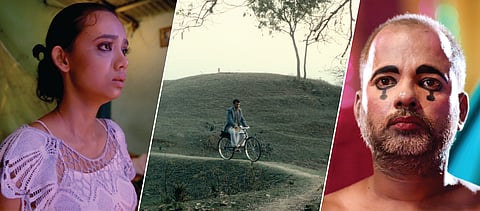
Not one, not two, but three Bengali films will be playing at the ongoing festival that is being held from January 30 to February 9. While Suman Mukhopadhyay’s Putul Nacher Itikatha (The Puppet's Tale) is in the Big Screen Competition, Pradipta Bhattacharyya’s Nodhorer Bhela (The Slow Man and his Raft) and Ishaan Ghose’s Morichika play in the Harbour section. These films are part of a larger Indian contingent that also includes Varsha Bharath’s Tamil film Bad Girl, in the Tiger Competition.
One of the things that has kept Bengali cinema away from international film festivals is a certain reticence. Take Bhattacharyya for instance. He’s a film festival skeptic. His films are defiantly anti-festival. “I edit and teach and that’s my livelihood, I make the film not to earn or for fame, it’s more personal. I have always thought in European festivals you have to make a certain kind of film… I don’t want to compromise,” he says.
In 2019, around the time of the release of Bhattacharyya’s last film Rajlokkhi O Srikanto, I wrote an article on his largely under-seen body of work. Stefan Borsos, the newly-appointed curator of South and South-East Asian films at IFFR, read it and found him interesting enough to look at his films online and get in touch with him on Facebook. Borsos really wanted Rajlokkhi O Srikanto at IFFR 2020, but there were several technical complications by then (the film had been released and was available online). And Bhattacharyya’s lack of enthusiasm didn’t help.

But Borsos kept in touch with Bhattacharyya, following his work over the next few years, doggedly checking on the status of his new feature film. “Sometimes a filmmaker doesn’t have the experience. Or if you tell them, they take it casually. I continuously followed his (Pradipta’s) work, got on his nerves probably asking if he has something,” says Borsos in a Google Meet. “One of the main purposes of Rotterdam is to find those who are not making films tailor-made for festivals,” he adds.
Borsos is responsible for getting all three Bengali titles to Rotterdam this year. He has seen Ghose’s impressive first film Jhilli and had been familiar with Mukhopadhyay’s work since Herbert. Given the festival's emphasis on Tamil and Malayalam films in the recent past, was there any such focus on Bengali cinema this year? “Not necessarily. In the past there has been an additional attention given to South Indian cinema, but every year it’s a bit different. Like there are no Malayalam films this year… there are so many reasons a film can’t be shown. So it all came together this time.” He adds, “I think Bengali cinema is back in an interesting way. All three of them are very different artistic voices.”
Here's a look at the three Bengali films playing at IFFR 2025:
Putulnacher Itikatha
Putulnacher Itikatha is ostensibly about a doctor in a Bengali village at the time of WWII, but you could be forgiven for thinking that it’s about everyone crushing on Abir Chatterjee. The actor plays the central role of Shashi, a Western educated doctor dreaming of practising in London, but stuck in a godforsaken village. He has no dearth of women swooning about him, but his passivity comes in the way. He’s handicapped by the same inaction when faced with an ideological crisis. Mukhopadhyay lets other characters around Shashi challenge him: Jaya Ahsan’s Kusum is a tease, while Parambrata Chatterjee’s Kumud is a scene-stealer.
Mukhopadhyay hopes that the critiquing of his hero subtly hints at the failure of contemporary intelligentsia, and he traces it to Manik Bandopadhyay’s novel, which it is adapted from. His films have been largely adapted from works by celebrated Bengali authors (including a 45-minute film he made for Hoichoi based on Chekhov). It comes naturally to Mukhopadhyay. “I have been born with the world of stories. I grew up reading “Podipishir Bormi Baksho” and “Aam Atir Bhepu”. If you go back to the masters of our culture — Ray, Ghatak and Mrinal in cinema, and Shambhu Mitra, Utpal Dutta, Ajitesh, the pillars of theatre… they have all freely adapted. When I adapt a film, it’s not like I don’t think I am not doing anything original,” he says.
Nodhorer Bhela
The titular protagonist in Nodhorer Bhela is something of a figure of protest in an increasingly fast world. Physical ailment of some sort, although unexplained, has rendered him slower than a sloth. Bhattacharyya, once again, finds a quasi-fantastical element in the real world. Nodhor becomes The Slow Man in the traveling circus which has camped out at the village. Thus begins the naked dance of capitalism. Nodhor’s pathetic life is made into a spectacle, as we plumb the depths of human depravity. But there’s also beauty, pathos, a sense of fun, and Ritwick Chakraborty’s riotous act as the circus manager Haradhan, a crooked, short fused villainous character.
Bhattacharyya likes to take his time to make a film. There was a seven year gap between his first and second feature; a six year gap between the second and the third. And yet, owing to the strictures of the Bengali film industry, he has to contend with fewer days of shooting. Bakita Byaktigato was shot for 28 days in 2010 and Rajlokkhi O Srikanto for 17 days in 2019; this one was shot for 13 days in 2024.
“As a film worker, the problem is that in 2012, if the remuneration was ₹100, in 2024 it is just ₹90. You see the economical comparison? 12 years later, it should be at least three to four times more; but expenditure has now increased, and remuneration has dropped. While you used to do one job earlier, now you have to do three. And on the other hand, there is no work,” he laughs.
Morichika
Just like his debut feature Jhilli, Ghose trains his lenses on people living on the fringes in the subaltern pockets of Kolkata, continuing to show the city in new ways. Priya is a young single mother with an infant and a job, and Kishen is a young man from Bihar who has come to the city to find work. The two protagonists never meet, but we follow them in a parallel way. Ghose deep dives into the realities of the characters, but he doesn’t allow their sufferings to define them. One of the film’s most rapturous sequences feature the two men, Kishen and his friend Pawan, playing football for leisure encountering a group of B-Boys in Maidan.
Ghose also shoots his own films, which lends them a kinetic energy. He has made a practice of roaming the streets of Kolkata with a camera photographing people. This leads him to undiscovered areas, like the Howrah underbridge or the basti of the horse-cart wallahs of Maidan. Add to that the training of documentary work under his father, Gautam Ghose. Ghose works as independently as possible; he edited Morichika, shot it in real locations, did the production by himself, had no assistant director and self-financed the film. A smaller crew means greater intimacy with the actors, he says. Next time he will do it all over again: “It makes you grow if you do things yourself."