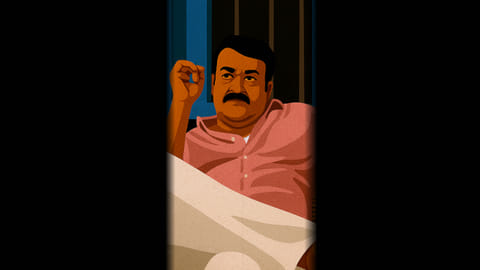


An investigative drama. A family drama. A slapstick comedy. A police procedural…these were the various genres Jeethu Joseph had dabbled in before he made 2013’s blockbuster Drishyam. Back when it released, with a run-of-the-mill trailer and a poster that showed Mohanlal enjoying a good time with his on-screen family, we expected a film along the lines of Jeethu’s second film, Mummy & Me, about the importance of loving one’s family. The only clue may have been the film’s caption, ‘Visuals can be deceiving.’
Five minutes after the first set of shows were over, viewers struggled to get up from their seats, unable to fully comprehend the full impact of what they’d just witnessed.
The line ‘Visuals can be deceiving’ must have played out like a cruel in-joke between crew and cast members who already knew the film’s ending and the surprise it would make viewers feel. Because, of course, in theory, it is another movie about loving one’s own family but only in the most twisted sense. It did not ask whether you would kill for your family; it went a step further by asking us to participate in the murder and then help bury the body. Apparently, the audience fully supported the idea.
It became the highest grossing Malayalam film of all-time (back then) and the first film in Kerala to cross ₹50 crores. It was remade in Tamil, Telugu, Kannada, Hindi and Sinhalese. It’s Chinese version, Sheep Without A Shepherd, was a superhit too and recently, there was talk of a Korean version of the same film— making it the first Indian movie to get a Korean remake.
Just as impressive among all the film’s achievements was the success of the sequel. Although it released during the Covid-19 pandemic, that too directly on OTT, it was a worthy sequel to a modern classic. If Georgekutty was the ‘hero’ of the first film, you see the second film raising serious philosophical questions about the true price of committing crime and of how punishment may have led to salvation for someone like him.
Joseph, despite the respect and love he received for the film, has also opened up about the weight of expectations and how audiences and producers alike now demand that his films come with a twist like Drishyam’s.
His immediate follow-up in Malayalam, Life of Josutty, about a humble Malayali villager and his big move to a foreign country, wasn’t even given a chance. Audiences were too obsessed with Drishyam to let its director make a simple movie about life’s simpler choices. One finds this hangover affecting his most release too, Mirage, a film that tries to throw a twist at the audience so often that it ties itself up into knots.
But as the director gets into the final days of shooting the third part of Drishyam, the final conclusion, he’s back to peeling off the layers of one of Malayalam cinema’s most complex characters. In an interview with Film Companion, its lead actor and screen legend Mohanlal confessed that he himself hasn’t yet fully understood Georgekutty and how he thinks.
In the same interview, Joseph tries to explain his understanding of people like Georgekutty. He said, “After the release of Drishyam, a psychiatrist told my friend that a wife brought her husband and complained about how he was very moody and didn't talk much. After many sessions with him, he confessed about having an affair. When that woman got pregnant, he admitted to murdering and burying her in his house. But after some time, the incident started affecting his mental state. This happened 10 to 20 years before the release of Drishyam. Humans are like that. The first thing they will do after committing a crime is to try and bury it. The only difference in Drishyam is it's buried under the police station; the rest all are something that has been happening around.”
As morbid as it sounds, the impact of the film may even be gauged by the introduction of a new term in pop culture. ‘Drishyam Model Murders’, is now an accepted term in which real-life crimes that resemble scenarios from Drishyam, with “offenders attempting to conceal evidence or mislead police investigations, often by fabricating alibis or destroying incriminating bodies.”