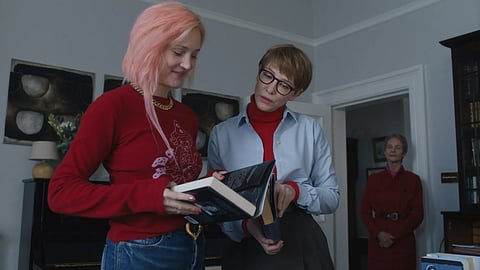


The anthology film has always been cinema’s most precarious balancing act, a form that promises multiplicity but often collapses under the weight of its own cleverness. Jim Jarmusch, no stranger to the pleasures of fragmentation, ventures into this territory again with Father Mother Sister Brother, a triptych whose title hints at familial geometry but whose execution proves more elliptical than elegant. Like so many anthologies, it banks on the hope that the whole might transcend the sum of its parts; instead, its parts retreat inward, leaving the whole strangely hollow.
The first two chapters, Father and Mother, come closest to achieving the deadpan shimmer of classic Jarmusch. They unfold with a rueful, unhurried absurdism, the kind that burrows into domestic unease and stares at it until it becomes funny, then painful, then funny again. Adam Driver and Cate Blanchett, each anchoring their respective segment, elevate the material with the kind of interiority that feels almost smuggled in. Their characters are drawn with a deliberate vagueness, yet the actors’ micro-gestures—the fleeting glances, the barely audible exhales—turn silence into something more emotionally charged.
The minimalism, though graceful, proves double-edged. It gives the performers room to shape the negative spaces of their characters’ lives, but it also keeps the viewer at a distance from these people and their lives.
What emerges is a lovely assortment of moments—wry, brittle, and fleeting—that never quite gather into a satisfying emotional crescendo.
The final segment, Sister Brother, offers a relationship the first two withhold: a functional connection. But the cost of that connection is steep, and the melancholy it releases feels abrupt, even jarring, as though the film had pivoted into a different register at the last possible second. Indya Moore and Luka Sabbat share a strange chemistry that’s compelling on its own terms, if only because it seems to belong to an altogether different movie.
Water, cups, Rolexes and flashes of red clothes—red like blood that binds these characters—thread lightly through the triptych, suggesting the faint outline of a unifying motif. The cast, predictably, rises above the patchwork: Tom Waits plays beautifully off Driver’s dutiful son; Blanchett finds an intriguing countercurrent in Vicky Krieps. You can sense the potential humming underneath, never fully realised but impossible to ignore.
If you approach it with patience, it might work. There's nothing here that isn't technically sound. If you're looking for a stellar ensemble, a few intriguing ideas, some perplexing symbols (those skateboards?), and able to embrace Jarmusch idiosyncrasies with impish devotion—then Bob’s your uncle.