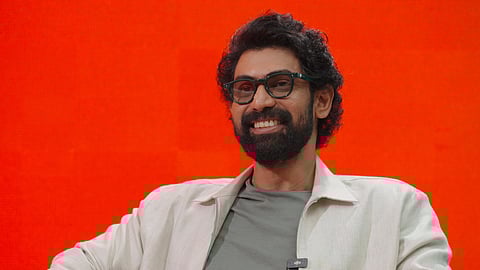


When Rana Daggubati looks back at Baahubali, it isn’t the scale or the success that comes to his mind first, but the years it took to make it. The long, unpredictable six-year stretch changed how he saw cinema and storytelling altogether.
“What I really learned from Rajamouli was to not be bound by time,” Daggubati says. For someone who came from a fast-moving industry where actors chase a release every year, Baahubali became the opposite, a project that demanded patience and faith. “We thought it would take a year and a half. It took six. But every single day, we were excited. We didn’t know how big or small it would be, we were just making something honestly.”
That passion, he says, became infectious. “You could feel the energy on set. Everyone knew we were doing something for the first time. You would be thrilled about the chariot you were riding or the weapon in your hand, and that feeling somehow reached the audience. They felt it too.”
Daggubati remembers the first time the film travelled beyond its home turf. “It was a Telugu film, but when we screened it in Mumbai, Karan Johar got the whole industry to watch it. People were asking, ‘Who is this guy? What is this film?’ That curiosity, that buzz, it came back to us.”
The sequel only took the ripple global. “When Baahubali 2 went to Japan, that’s when I realised it wasn’t just a film anymore. It was a moment. It showed us how far Indian cinema could dream.”
For Daggubati, the lesson was simple but lasting. Time spent with conviction isn’t time lost. “You don’t need to rush,” he says. “You just need to believe in the story you’re telling. That’s what Rajamouli taught me. And that’s what changed my life forever.”
Watch our full interview with Dulquer Salmaan and Rana Daggubati on our YouTube channel