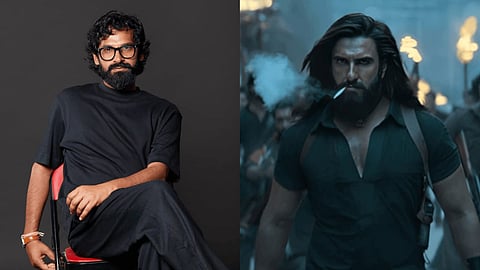


A teaser lasts two minutes; filmmaking, till the night before release, remains endless. Which is why production designer Saini S Johray is still in disbelief over the overwhelmingly positive response the first look of Dhurandhar has received, as he continues to shoot for the film. Launched as a special birthday gift for its lead star Ranveer Singh, the action thriller's teaser was a thumping visual unit, featuring slick action blocks and a world of espionage presented with quintessential movie swagger.
But behind the magic was more than a year of sweat, sleepless nights, ambitious globe-trotting recce, and a team that refused to stop, despite injuries.
In an exclusive chat with The Hollywood Reporter India, Johray—who has worked on The Family Man, Inside Edge and The Night Manager—talks about the "massive" sets he mounted for Aditya Dhar's Dhurandhar, from Madh Island in Mumbai to visualising Pakistani lanes in Thailand.
Edited excerpts:
From your point of view, can you describe the world of Dhurandhar?
A production designer who works on any film has to recreate the world that a director is imagining. So, when I met Aditya last year, his simple brief was that he wanted to make a stylised film, featuring never-seen-before action. At the same time, it should not look manicured and pedicured; it should look real and gritty. He didn't want the hyper-stylised sequences which end up looking unreal and take you away from the story.
I have worked with many directors, but Aditya's knack for detailing is phenomenal. He constantly wants to push you to do something new. He is also a very cool, composed director; I have never seen him panic! And then there was something else which also surprised me...
What?
An actor who put so much effort and curiosity into production design was Ranveer Singh. I have never seen an actor who takes such a keen interest in props, allowing them to become familiar with them. He would do that, check everything, wanted to know what all was there, would offer his inputs as well, which were fantastic. This is a passion project for everyone, but Aditya and Ranveer—who would not stop shooting despite getting injured— took it a notch higher with their dedication. They were so collaborative, which is why this looks so special.
Can you break it down to the number of sets that you created for the film? I believe there was also a set mounted in Thailand...
It took me almost three months to design this film in terms of breakdown. March-May we spent designing, June was for recce and July we started shooting. I had 15 designers in the beginning on my team for the project. We would work 12 hours a day because it's a very vast film. I think in my career, it's one of those films that has the maximum number of locations.
How I calculate films as a production designer is that, let's say we shoot for 60 days, and there are 100 locations in that film. Which means, on average, we will shoot at two locations per day. But here, it was four locations a day! There was a lot of designing, detailed work to do, as Aditya was very clear that we can't do anything that looks fake.
What kind of research?
How the characters looked, what their houses were, the entire history and geography, right down to the detailing of the kind of gun they used. To give you a local context, a don living in Dharavi would be different than the one living in Mira Road. The internet is also limited; you can't see how someone's house would look from the inside. So we relied on newspaper cuttings, old videos, and news to understand the geography of the particular area of Pakistan. Then, finally, we created a six-acre set in Thailand. We also built a massive set on Madh Island.
How long did it take you to build the Thailand set? And why there?
It was impossible to shoot the scenes in Mumbai with the stars we have. We wanted a huge six-acre land and a studio wasn't possible. The dates we had were in July, which means, of course, you can't put a set in Mumbai because of the monsoons. We had done recces in different countries but we finally arrived in Thailand. It was the perfect landscape for us to build a larger-than-life set.
For The Night Manager, you had erected a set during the Sri Lankan economic crisis, where the locals had also helped you. Did something like that happen here?
Yes. So, we had to build this six-acre set in 20 days in a country where I cannot take a lot of people from India. I cannot fly down 500 people there to make the set! So, of course, I had to collaborate with artists there. We had Thai manpower of almost 300-400 people and in total, we were almost 500 people working day and night for almost 20 days to create this six-acre set!
Now, if you had to create Bhindi Bazar (an are in Mumbai) in Thailand, you will have to find the props to get the right kind of detail. Now, Thai people don't know how Bhindi Bazaar looks, so I had to make sure that everything looks 100% real and not Thailand at all. If you look at the teaser, you wouldn't even notice it!
And the other set was on Madh Island?
Yes, that was a massive set, around four acres. That set had a lot of action, including a lot of scenes with explosions. The kind of blasts and action we are doing in the film, there is not even 1% of that in the teaser! I really mean it.
This seems so spread out and massive. How does this work? How many people are in your team?
So, as of this moment, I have 150 people in my team, plus additional local support! These 150 people are spread across multiple locations because the amount of action is happening, it's left, right, centre and you need this manpower to pull it off. These people are spread out in seven different locations across four different cities. One team will be in Chandigarh, another in Patiala, and one is preparing in Mumbai, for Ladakh!