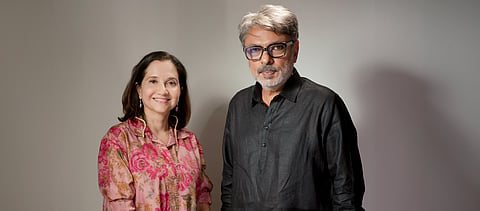


“Filmmaking is the dearmost [sic] thing to me in life. It is my god, my mother, my father, my lover; everything is cinema.” At the first edition of THR Talks, filmmaker Sanjay Leela Bhansali, in conversation with Anupama Chopra, Editor of The Hollywood Reporter India, discussed the one big love of his life — cinema.
The root of such undying passion can be traced back to the filmmaker’s childhood. “You have to understand where I come from in the first place,” said Bhansali. He urged the audience to visualise a 300 square-feet home with colourless walls in a small chawl, with four to five people living in the cramped little space.
“The conversations I heard early in my life were about my father [Navin Bhansali] having invested money in a film called Jahazi Lutera (1957), which was released before I was born. But, while I was growing up and as I started understanding words, all I heard was ‘cinema mein paise dalna nahi chahiye (one shouldn’t put their money in the movie business)’,” he recalled.
Yet, the lure of the film world remained in his family. When Bhansali’s grandmother had saved ₹10,000, she, too, chose to invest it in a film called Sone Ke Haath (1973), as the producer was his father’s friend. “We never got that money back,” he revealed. “But as a child staying in that house, I started living in a dream world. The reality was very harsh, so now, I never go anywhere near a realistic film.”
The opulence in a quintessential Sanjay Leela Bhansali production provides a glimpse into this fantasy world. His mother [Leela Bhansali] loved to dance in the 100 square-feet of space she had, and therefore, Bhansali’s heroines dance in the grandest of sets in all of Hindi cinema today. In the same vein, Devdas (2002) is a tribute to the alcohol bottle cherished by his father.
“I am the filmmaker who has painted those colourless walls with innumerable hues and [turned them into] beautifully designed sets. That is where the dream started,” revealed Bhansali. “It is personal cinema; it is uncomfortable. I get emotional when I talk about it, but that is where the filmmaker was born.” And so was his love for the art form. He understands that his art is the fruit of immense angst and loneliness, but also of great joy today. “I’m now a joyous, happy filmmaker,” he said.