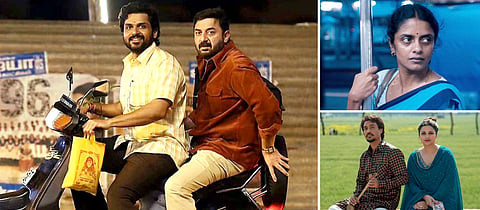

On a good day, what we call ‘pan-Indian cinema’ is an intangible sum of several parts. The cultural multiplicity of the country, as well as the demands of modern journalism, often demand that we categorise it into different industries. It’s not reductive, just necessary, because it’s impossible for any single critic to thoroughly cover every film industry at once.
That’s why we can afford to segregate our conclusions: Hindi cinema had an underwhelming year (again), Malayalam storytelling ruled (again), Telugu blockbusters blew hot and cold, Tamil cinema remained the dark horse, and Bengali films tried again.
But the remarkable thing about the best movies this year is that their language—and where they came from—rarely felt like a distinguishing factor. Their individualism somehow made them more universal. Without using the cliched phrase ‘transcends boundaries’, the ethnic specificity of these films stayed true but invisible. Watching and processing them had more to do with their emotional and narrative language.
At times, how the characters expressed themselves mattered more than what they spoke. It takes you a while to even remember their aural identities: Malayali melancholy in a Mumbai film, Punjabi angst in a Hindi biopic, English bridging the mother-daughter gap in a Himalayan town, kindness and nostalgia in a Tamil Nadu hometown, and so on.
Which is to say that 2024 has been a diverse and exceptional year for the ‘Indian film industry’. It’s been a year in which stories of people or a place have trumped productions about a region or a space. Through this lens, India became an idea in perpetual transit: a shapeless country composed of migrations, longing and belonging.
On that note, it’s only fitting that the first-ever list of the 10 best Indian films—across mediums, free of labels, and in no particular order—be chosen (and debated, negotiated, implored, and loved) by The Hollywood Reporter India critics.
Here goes:
Ullozhukku
Christo Tomy’s first feature Ullozhukku, after Netflix’s hit documentary Curry & Cyanide: The Jolly Joseph Case, places at its heart two women dealing with the death of a member of their family. It hasn’t stopped raining since this death, making it impossible to go ahead with the burial. But there’s a lot more than a corpse that needs to be buried for Anju and her mother-in-law Leelamma to move forward and be free.
With secrets, half-truths and a whole lot of lies that get unearthed in these rains, this intense story about women escaping the traps of patriarchy couldn’t have been told better.
Prem Kumar’s delightful second film is what you’d call the opposite of a coming-of-age drama. Instead, it lovingly nudges its two protagonists to stop acting their age, embrace a bit of immaturity, and find themselves in the process.
With multiple scenes that play out like the many nameless games children play, Kumar gets two middle-aged men to shed their inhibitions, reach into themselves and remain the emotional fools they once were, all of this while singing Ilaiyaraaja songs under the Thanjavur night sky.
Manjummel Boys

This nerve-wracking survival drama could so easily have been just another movie about humanity prevailing in times of intense stress. But Chidambaram’s film becomes so much more for the way in which it integrates minute details in the emotions, making it feel personal, both in times of loss as well as triumph.
The idea to use Illaiyaraaja’s song from Guna as a Checkov’s Gun made it a film that transcended borders. The result is Malayalam cinema’s biggest-ever hit with as many fans across the border as it garnered back home.
Aattam
Aattam is about 12 angry men sitting across a dining table, passing judgement about a female colleague who finds herself in a painful situation. But instead of discussing the issue, we listen to varying opinions that reflect the mindset of these men and their hypocrisies.
With individual biases or benefits trumping all forms of morality, we exit Aattam finding ourselves just as culpable as the 12 men who weren’t angry enough.
Lubber Pandhu
It’s not everyday that you see an intense sports movie centered around the male ego discuss so many other issues with such dexterity. The movie dealt with the politics of exclusion, without it ever feeling forced—speaking about the pangs of separation experienced by a fully-grown adult when his wife leaves him. Lubber Pandhu also tackled complex interpersonal relationships within the family, without it feeling dramatic.
Besides all this, it also gave us the fantastic character of Yashodha and an introduction scene that’s worth whistling for.
Girls Will Be Girls
Shuchi Talati’s Sundance-winning film is a tender, tough and sure-footed debut that features two of the most complex performances this year. It stars first-time actress Preeti Panigrahi as a teenager in a sexual awakening and coming-of-age drama, and the formidable Kani Kusruti as the mother stuck in her own sexual-suppression drama.
Their stories collide and jostle for attention in a movie that beautifully explores the confluence of adolescence, womanhood and everything in between. Seldom has a gender-based movie about loneliness and desire felt so warm and inviting.
Despite lofty themes of first love and mother-daughter tensions, Girls Will Be Girls is, at its core, the humanisation of little moments and invisible truths.
Amar Singh Chamkila
Imtiaz Ali’s return to form proves that Hindi biopics can still be curious, inventive, energetic and socially expressive. Starring an excellent Diljit Dosanjh as slain singer Amar Singh Chamkila, the Netflix film merges visual and aural mediums, myth-making and storytelling, archival footage and Broadway-musical form to tell the story of Chamkila through the eyes of a Punjab that revered and reviled him. Ali is at his best when he bends the emotional chronology of his characters.
In doing that, he captures the essence of an artist in a heated debate and love affair with his environment—a rarity for a genre that is too often consumed by reverence and fear.
Laapataa Ladies
India’s official submission to the Oscars, Kiran Rao’s sophomore feature is witty without being sarcastic, familiar without being formulaic and important without being preachy. A charming crowd-pleaser about newly-wed brides who mistakenly get swapped during a train ride, Laapataa Ladies refuses to be a resounding statement about patriarchy, feminism and everything in between. It’s a rare film that acknowledges the context of its setting, and playfully walks home a point that most Hindi films emphatically drive home.
What’s more—it’s well-performed, cleverly written and subverts our relationship with mainstream cinema.
Kottukaali
Like his excellent debut Pebbles (2021), Vinothraj’s second film Kottukaali (The Adamant Girl) too is a film that’s entirely on the go. It is also a film that plays out in real-time, during what is a life-altering event for the family in question.
Almost the entire duration of Kottukaali is a journey to exorcise Meena (Anna Ben) after her family discovers her affair with a boy from another caste. But we learn just as much about every single character on this journey as we do about the defiant Meena.
The film brims with so much life that you’re pushed uncomfortably close to its many explosive moments, without a moment of relief or the luxury to look away.
All We Imagine As Light
Kani Kusruti and Divya Prabha lead Payal Kapadia’s haunting, multilingual lament about two Malayali nurses navigating the phantom spirit of Mumbai. All We Imagine As Light opens like a nonfiction film about a city of grand fictions, where its migrants subscribe to the illusion of the place rather than the place itself.
The second hour sees it transition from the monsoon-tinged dream trap of Mumbai to the liberating confines of a coastal village. Kapadia’s literature-coded film-making bottles what it means to be hopeful and incomplete stories in a country that’s staged to invisibilise them.
Special mentions: Aavesham, Kishkindha Kaandam, Lucky Baskhar, Barah By Barah, Kill, Vaazhai, Bramayugam and Merry Christmas.