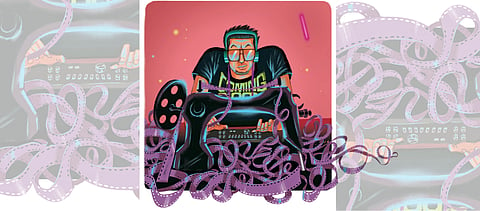


The job of an editor is to make sure the viewer stays with the film through every emotion,” explains Anoop Vilakkadan, a freelance trailer editor with years of experience in Hindi, Tamil and Malayalam cinema. “But a trailer editor is the one who ensures this viewer comes to the theatre in the first place.”
That’s how Vilakkadan sums up the basic difference between a traditional “long-form” editor and the less-than-a-decade-old practice of hiring specialist editors to cut a film’s trailer and teaser. “Earlier, it was the long-form editor’s role to also cut trailers of their films. But with elaborate marketing campaigns built around the trailer, the work that goes into cutting a trailer begins months before release. At times, the trailer cut is ready even before the film’s edit is locked,” Vilakkadan adds.
It’s not easy to surmise the number of human hours that go into editing a two-minute trailer. It took 21 different editors and hundreds of variations before the team of Shahid Kapoor’s Deva, finally arrived at the version that went out before release. In Mumbai, content strategy companies such as Feed The Wolf and White Turtle Studios work with teams of 30 or more editors to plan trailer campaigns after they’re hired by top studios. In the South, even veteran directors like Priyadarshan have often sought the help of director-editors like Alphonse Puthren to cut trailers of his films. The make-or-break powers of a trailer can be such that a badly cut trailer can result in a ₹10 crore to ₹20 crore difference on the opening weekend for a big-ticket film.
The impact of a trailer has not been this obvious in recent memory as it has been in the case of two Tamil films of this year. The vague trailer of recent Tamil superhit Dragon created so much confusion that it was pejoratively dubbed the sequel to Don (2022) based around the life of a college loser. Campaigns on social media further attacked Dragon for glorifying its protagonist, an engineering college dropout who has failed 46 exams.
“But that was a risk I had to take,” says Ashwath Marimuthu, the film’s writer-director. “The idea was to hide 90 per cent of the plot. In my first film Oh My Kadavule (2020), I had to draw audiences in by selling them the film’s high concept — that of a golden ticket giving a man a second chance. But with Dragon, I wanted the film’s interval twist to be a surprise. I could take that chance with a deceptive trailer because my hero Pradeep Ranganathan is coming off a ₹100 crore hit.”
The experiment seems to have worked with the film collecting upwards of ₹100 crore within a week of release. Audiences who came in expecting a loud film celebrating college-life debauchery were left surprised by the film’s wholesome U-turn post interval. “We could not have created this much love for the film without hiding the film’s interval,” Marimuthu adds.
The response was far harsher in the case of another Tamil film. Titled Bad Girl, the debut film of director Varsha Bharath came under intense online outrage for the way it portrayed the growing up years of a rebellious teenage girl, that too from the Brahmin community. The controversial trailer forced the team to push its release indefinitely, with the only relief coming in when the film won the Network for the Promotion of Asian Cinema (NETPAC) Award at the 2025 International Film Festival Rotterdam (IFFR). Speaking about the trailer, Bharath says, “The judgements have been made by people who have not seen the film. From the trailer, they have assumed that I’ve made a film glamorising a schoolgirl smoking and drinking. I thought it was obvious that I had cut the trailer in a way that we’re showing various stages in the life of a girl, right from school to college to adult life. But it was assumed that my protagonist was doing all of that while she’s at school, because they’ve decided to be outraged by the film.”
These two incidents may even be looked at as positive outcomes given how it drew attention (negative or otherwise) towards films that did not have huge marketing budgets of star vehicles. But when viewed from the side of the producers, the trailers could easily have been examples of promotional material working against the film.
“In the age of reels and social media, it’s become fair play to manipulate the audience,” says director Jayaprakash Radhakrishnan, who made the Tamil film Kadhal Enbadhu Podhu Udamai (2023). After making the film, which discusses same-sex relationships, Radhakrishnan found no takers for it for two years and in the process of finding a distributor, he learnt that “there were a couple who refused to watch my film because of the nature of my content. Others said they loved the film, but were apprehensive about the response and said they will present the film without using their name.”
“When this is the nature of people within the business, how can we expect a film to take a risk with the trailer when it deals with sensitive topics?” asks Radhakrishnan.
Speaking about the many times he was asked by distributors to hide the fact that this was a lesbian love story, he adds, “They wanted to first draw in an audience by making the film look like it was a heteronormative romance. They asked me to play up the character of the heroine’s male best friend and not show scenes featuring the leads romancing. But if we do that, then the trailer will be that of a film I had no intention of making. It’s unethical.”
It’s this dissonance between a trailer and the final film that can result in viewers feeling cheated. Even when viewers are prepared to think that the trailer isn’t entirely a shortened version of the complete film, there are still narrative and rhythmic ground rules the editor must follow, believes Abhishikta Kaila, a freelance motion-picture editor, who most recently edited the trailer of Don Palathara’s film-festival darling Family (2024).
She is from the first generation of film school–trained editors to graduate after deciding to become a specialist at cutting trailers. She is also among a handful of women to specialise in this profession. Kaila says, “I remember feeling this dissonance when I watched [Martin] Scorsese’s Killers of the Flower Moon. I fell in love with the craft of the trailer, and I remember clearly watching it several times for the way it was cut. But when I finally watched the film, I felt like the rhythm of the film did not match the rhythm of this trailer. It left me with a conundrum. Shouldn’t a trailer, however well cut, be in service of the mood, the themes, and the rhythm of its larger film?”
This artistic integrity could perhaps be what the film stands to lose when the trailer is cut by a rank outsider. For this specialist, when the obsession is to build curiosity and bring the viewer into the theatre, the trailer may be looked at as an entity almost independent of the story. And with trailers being cut by companies that also deal with market research and analytics, it becomes a work of science more than one that works on instinct.
“You cannot hold a shot for more than two to three seconds. You cannot have a second of silence in the trailer. For a big star’s film, we need to include at least one ‘punch’ dialogue and if there are action sequences, we must build the trailer around it,” adds Vilakkadan, about the unspoken rules for cutting a major film’s trailer.
He says, “Within these companies, there are even specialists based on the genre of the film. There’s an editor who specialises in cutting trailers for romances and emotional films. In my case, I’m generally called only for action films.”
But in the case of both Vilakkadan and Kaila, they are at the stage in their careers where they feel disillusioned with their chosen labour of love. “As an editor, I now choose to divide my work between long-form and trailers,” adds Vilakkadan. “Cutting trailers for a living has made me impatient. It is stressful and time-consuming and we’re always fighting against the clock to deliver multiple versions of the same trailer. At times, the scrutiny becomes so minute that even a single second from the trailer can lead to hour-long discussions. It is by no means light or easy work.”
With trailers becoming the work of multiple editors, it can no longer be seen as the creative output of any one creator either. “In some cases, I’ve heard of a trailer becoming the combined result of multiple different trailer cuts. They take the opening shot from one editor and then take the hero intro from a second guy, and then finally take an action montage from the third.”
This is why the nature of work becomes unrelenting and unrewarding, feels Kaila. “Almost every trailer is viewed by millions, in multiples of the people who finally end up watching the film. But the truth is the name of the trailer editor is seldom shown in the credits. In most cases, we cut the trailer knowing fully well that our work will never be known outside. It is thankless.”
The Trailer with 180 Million Views
The most watched Indian movie trailer today is that of Salaar, with combined views of over 180 million views on YouTube. The trailer was released in Telugu, Kannada, Hindi, Malayalam and Tamil. It was also the fastest to hit 100 million views, which it did in under 24 hours.
The fee charged by a freelance trailer editor depends largely on the scale of the film. For a moderately budgeted film, this may start as low as ₹5 lakh per trailer, going all the way up to multiple crores when the film production employs specialist trailer editors or companies to plan the promotional material of
the film.
To read more exclusive stories from The Hollywood Reporter India's March 2025 print issue, pick up a copy of the magazine from your nearest book store or newspaper stand.
To buy the digital issue of the magazine, please click here.