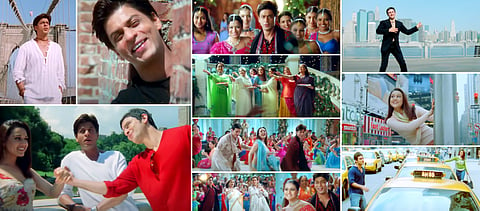


About 21 years ago, at a swanky hotel in Pune, Dharma Productions gathered a team of artists with a singular mission: to conceptualise and create the music of Kal Ho Naa Ho (2003). A short walk from the iconic German Bakery — where the title track’s melody first began to take shape — composer trio Shankar-Ehsaan-Loy, director Nikkhil Advani, lyricist and poet Javed Akhtar got to work. They spent hours crafting music that would endure for decades fueled by the tea, biscuits, and toast that producer Yash Johar generously brought them on trays. Why Pune? “Simply because it was convenient to get a bunch of people to Pune from Mumbai, put them together, and have them focus on one project — totally focus. The only way to make something this long-lasting is to give it your all,” Loy Mendonsa tells us, in an exclusive chat with THR India.
Nikkhil Advani’s directorial debut, which has been enjoying a resurgence in popularity since its theatrical re-release, follows Naina Catherine Kapur, played by Preity Zinta with a perfect blend of melancholy and hope — a reflection of her life in New York City. Her love story with Rohit Patel, portrayed by Saif Ali Khan with a raw, heartbreaking sincerity, forms the heart of the narrative. And then there’s unlikely matchmaker Aman Mathur, brought to life by Shah Rukh Khan with his signature devastating charm. The film, much like its characters, occupies a delicate balance — equally joyful and gut-wrenching.
But the core of Kal Ho Naa Ho is its music, which had to resonate both in the theatre and in the heart. “If you see the film as a whole, you’ll realize how balanced it is; we had to crack that balance with the music,” Ehsaan Noorani says.
If you had a working mobile phone in the early 2000s, chances are that you heard the title track of Kal Ho Naa Ho as a caller tune more times than you could count. “It was such a simple tune that it immediately surprised you and made a place in your head. Did you know that it came together in nine minutes?” Shankar Mahadevan smiles. “The tune had such innocence to it that when Javed saab heard it, he said, ‘My God! Now I am worried. The song is so simple that the lyrics will have to be equally simple. I can’t let the lyrics overpower the song.’ It had to be a perfect amalgamation of words and music.” Ehsaan adds, “He took about three weeks to write that song.”
In a moment of desperation, a young girl, Gia (Jhanak Shukla), turns to her mother Jennifer (Jaya Bachchan) and asks, “Humara angel kab aayega?” (When will our angel come to save us?). An orchestra swells, serenading Shah Rukh Khan as he enters. Sonu Nigam’s voice adds colour to Akhtar’s profound poetry, singing ‘Kal ho naa ho…’ — there may not be a tomorrow. “Sonu Nigam took the song to another level. He had already dubbed it, but then he felt that it needed to be redone,” Ehsaan Noorani recalls. “He wanted to simplify the singing to do more justice to the song. When we re-recorded it, it made so much more sense.”
Shankar-Ehsaan-Loy unanimously agreed that the title track remains their favorite song on the album. “When we released the first track, people went berserk. Of course, (that visual of) our dearest Shah Rukh Khan on the Brooklyn Bridge helped — that much alone would have been enough — but people really loved the title song. It just took off like a rocket. And, as a result, every other song in that film was met with so much warmth and love,” Shankar reflected.
The team also secured the rights to Roy Orbison’s iconic hit ‘Oh, Pretty Woman’, reimagining it for an Indian context. The first time Aman sees Naina, he can’t help but sing ‘Pretty Woman’, blending Bhangra beats with an unmistakably American hook. Dharma Productions later released Kal Ho Naa Ho - The Making on their YouTube channel, in which Javed Akhtar admits to his initial skepticism about the song — and how he was wrong. “Two or three years later, Roy Orbison's wife came down to India and insisted on meeting us for coffee. She told us that she had heard a million versions of the song, from ads to movies, and this was the first version she truly loved,” Ehsaan muses. “We kept only one line from the original and completely made it our own. I think that’s why it worked for her and for everyone,” Shankar says.
That wasn’t the only thing Akhtar admitted to being wrong about. In 1988, Karan Johar had asked the lyricist to write the music for Kuch Kuch Hota Hai, but he had declined, troubled by the vague double entendre of the title. The film went on to become a massive success, and Akhtar later said he regretted his decision. “Javed saab told us, ‘I owe Karan a couple of ‘kuch’s,’” Loy Mendonsa explains. “That’s why he wrote kuch toh hua hai (something is happening) / kuch ho gaya hai (something has happened) to return the two Kuchs he didn’t write for Kuch Kuch Hota Hai.” It is to Akhtar’s credit that the song seamlessly flows as a call and response number even when the duet is talking at cross purposes. “The song is very conversational, but when you watch the film it hits you. It just clicks,” says Shankar.
Over two decades later, audiences in Mumbai’s theatres are singing along to every song from Kal Ho Naa Ho — karaoke style — even clapping in unison during the iconic two-clap sequence of ‘Kuch Toh Hua Hai’. “Those two claps really lift the song. Nikkhil Advani did them in the scratch, and it fit so perfectly that we kept it,” Shankar shares.
Kal Ho Naa Ho’s urbane and metrosexual textures — and its music by extension — continue to resonate with audiences across the globe. “It has a very global feel to it, yet it’s deeply rooted in the Indian sound,” says Loy Mendonsa. Take the infectious ‘It’s the Time to Disco’, which combines rhythmic beats with strings and brass, but opens with the unmistakable sound of the tabla (a quintessentially Indian percussion), rather than the more typical Western sound of drums. The film’s diaspora story, centered on Indian immigrants in New York, naturally lends itself to this fusion. “People get intimidated by cross-pollinating cultures and become protective. But if you approach it authentically, it’s not that hard. Life in New York is a certain way, but at the end of the day, I still want to come home and have daal chawal. That was the core idea,” says Loy.
Peppered between the iconic numbers are little musical details that add up to a complete picture — what Ehsaan calls the “sur of the film” — such as the quirky ‘Kanta Ben’ theme which plays when Rohit's house help mistakenly believes there's a homoerotic bond between Aman and her employer. “We had so much fun working on the little things. The ‘Kanta Ben’ theme was hilarious. I told Shankar to sing it in an over-the-top Gujarati style; every time it plays, you crack up,” Ehsaan laughs. It’s not the prospect of a gay relationship which becomes the joke; the audience, like the film, is laughing at Kanta Ben, and at her homophobia. It’s an incredible quality for a film, made two decades ago, to have.
Kal Ho Naa Ho endures even today because, even in 2003, it was a forward-looking film that took the familiar tropes of Hindi cinema and blended them with the sensibilities of a new era and a new filmmaker. But it also stays true to familiar Bollywood beats. This is why it seamlessly includes a quintessential Dharma song like ‘Maahi Ve’ — the kind of track that would become a wedding dance anthem, replete with a recognisable Farah Khan hookstep. Everyone dances together — including Dharma regulars Rani Mukerji and Kajol — and the song has a perfect balance of humor and emotion. “A wedding is an emotionally volatile time for any family, and that’s what you’re trying to tap into as authentically as possible,” says Loy. While Aman and Rohit dance their hearts out, it’s Jaya Bachchan who steals the scene, her eyes glistening as she sings, “Chanda meri chanda, tujhe kaise main ye samjhau, mujhe lagti hai tu kitni pyaari re” (My dearest, how do I explain how much I love you). It’s at this point that adults in the audience start bawling. “That part is a beautiful drop in the song,” Ehsaan quips. “We got Sadhana Sargam to sing that verse because her voice is so naturally full of emotion. The way she sings it is bittersweet, capturing a love that persists despite the family’s dysfunction — coming together for the child.”
The trio crafted the song to convey the full spectrum of emotion. “We tried to give every emotion its full arc, but we don’t dwell on them,” Shankar explains. “The next line picks the song back up — it’s peppy, upbeat,” says Ehsaan. Loy adds, “It’s like we get it, but we also know it’s okay. Let’s move on.”
The film also follows a similar rhythm, flowing from joy to sorrow to comedy to heartbreak and back again in a way that never feels like emotional whiplash. Every feeling is allowed to breathe, to exist fully, before the narrative moves on. And that’s what makes Kal Ho Naa Ho and its music so powerful: much like life, neither the tragedy nor the romance waits for you; it’s you who has to keep up and make the most of every moment you are given.