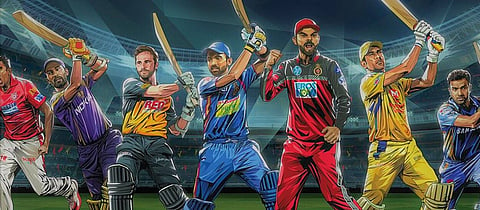


When the BCCI announced the indefinite suspension of this year’s Indian Premier League, citing escalating threats to national security, it felt like the air had been let out of summer. For weeks, the IPL had been doing what it does best: distracting us. With its nightly churn it gave us something to talk about besides the devastation. Now, suddenly, even that ritual is gone. And in its absence, all we’re left with is longing.
It’s a funny feeling — this ache for something that was just here. Twice in Inside Out 2 (2024), the character Nostalgia shows up too early, while the thing is still happening. You laugh, but then you wonder: can you be nostalgic for something that hasn’t even left yet? Can you miss something that was, until moments ago, right in front of you?
For fans of the Indian Premier League, the answer is a resounding yes.
Cricket is another colonial heirloom — like railways, afternoon tea, and an unshakable preference for lighter complexions. Once a sport of the white man, cricket has since been commandeered by the former colonies, who are now some of the best teams in the world. India, Australia, Pakistan, the West Indies, and even South Africa have repeatedly defeated England, the very country that invented the game.
“Most of the countries, and the top countries who play the game have that element of wanting to get back at the English,” says Brian Lara, legendary West Indies cricketer, in Netflix’s Explained episode on cricket. And really, who can blame them? England invented the game, but India owns it now — thanks in large part to the Indian Premier League (IPL), which has turned the sport into a billion-dollar juggernaut with more drama, glamour, and last-minute surprises than a cab ride through Mumbai traffic. Mihir Bose, author of A History of Indian Cricket, called the Indian Premier League a “super tamasha” — a spectacle, a circus.
Test cricket was the cricket — a five-day battle of skill, patience, and nearly indistinguishable men in white clothes and sweater vests. Then came ODIs, shaking things up with a one-day format that brought disruption and innovation. England, ever the inventor of games they would later struggle to dominate, introduced T20 cricket — a condensed, three-hour format designed for fast-paced action. Yet, as Suman Sajnani, a psychologist and long-term IPL fan, points out, “People did not take T20s seriously until the IPL.”
If T20 was cricket’s bold new experiment, then IPL was T20 on drugs. It was the ultimate fantasy made real — the kind of teams you’d assemble only in your imagination, now actually playing on the field. What if Virat Kohli, Chris Gayle, and AB de Villiers played together? “The IPL made that real,” Sajnani says.
But it wasn’t limited to the cricket. The IPL wrapped itself in a grand spectacle: celebrity-owned teams, opening ceremonies featuring stars, music, cheerleaders, DJs, and an atmosphere more reminiscent of a rock concert than a sporting event — everything about the IPL screamed entertainment. And in a country that has always loved cricket and a good show, it was the perfect storm.
“Films and TV serials used to slow down around the summers — it was a good time to give audiences a taste of something new,” says a source in television programming, speaking on the condition of anonymity. “Think about where they platformed the IPL — not on the sports channel, but on Set Max, an entertainment channel. That says a lot about how it was being positioned,” they added.
And positioned it was — not as a cricket tournament, but as a cultural event, complete with its own choreography. “I remember being 13 years old, sitting in front of the TV when suddenly, there was Farah Khan telling us to do the ‘Jumping Japang Jampak Jampak’ dance. And, of course, we all jumped,” recalls Sajnani. As the face of the IPL’s ‘Sirf Dekhne Ka Nahi’ campaign, Farah Khan turned watching into doing. For the IPL, being a passive spectator simply wasn’t good enough.
Even in between the matches, you would find something that would keep you hooked. “Every ad break was a new Zoo-Zoo ad, and I would wait to watch them all. I remember they even interviewed a Zoo-Zoo at the end,” Sajnani adds.
The game has changed, yes, but so has the advertising. Remember the team anthems that looped endlessly in every ad break? Those prime-time slots have been replaced by Instagram reels and 15-second clips. In the age of social media, there’s no urgency to buy visibility when virality is free.
Marketing gimmicks? You could call them that. But they did something fundamental. They took cricket, once the domain of the purists, the stat-obsessed, the ones who could debate the merits of a shot for hours and flung it into the laps of everyone else.
“Earlier, cricket was just catering to the hardcore cricket fans. This was a turning point where it wanted to reach out to others as well,” says Sidharth Monga, senior sports writer, speaking to The Hollywood Reporter India. “T20 was more accessible — A, because it was shorter; B, because it was simpler. Then, you had film stars around it.”
The IPL democratised cricket viewership. The buzz around the sport had never been louder. Previously, a non-cricket fan might have tuned in for the World Cup — maybe an India vs. Pakistan match, maybe the final if the stakes were high enough. But with the IPL, the debates stretched far beyond the sport itself. “It wasn’t just Dhoni vs. Rohit Sharma anymore, it became Preity Zinta vs. Shah Rukh Khan. Suddenly, everyone was in on the game,” Monga adds.
“I think, in many ways, it felt like India’s EPL (Premier League) — a tournament we could follow, support, and get excited about every summer. It became an event, a social activity where you got together, met friends, and watched the games,” says Shibani Akhtar, former sports presenter and now creator, producer, and actress, speaking to The Hollywood Reporter India.
More than just a sporting event, the IPL shaped how audiences experienced cricket. “I definitely think Extraaa Innings T20 brought a different flavour to the IPL compared to what we see now, which leans more toward a traditional sports journalism approach. Extraaa Innings added an element of entertainment, making the tournament more engaging,” Akhtar adds.
Extraaa Innings T20 was aired for eight seasons between match sessions, blending expert analysis with sharp commentary. It wasn’t focused singularly on breaking down cover drives and economy rates, the discussions were more candid and more accessible. “Ordinarily I would get up and leave between match sessions, but you felt like watching Extraaa Innings because you felt included in the discussion,” says Prateek Dadheech, TV writer and cricket enthusiast.
“There were dancers in the studio. There was Navjot Singh Sidhu. There were couplets every three seconds. And, of course, there was Shibani Dandekar and Gaurav Kapoor everything that came with it. That kind of wraparound show, with its strong entertainment focus — maybe that’s what I miss the most. Because now, cricket has become more serious. There’s less tamasha now,” he adds. As one former presenter points out, “On Star Sports, you can’t say what you want to. There are too many guidelines, too much branding, too little soul. That's perhaps why Gaurav [Kapoor] prefers to be on Cricbuzz instead of a primetime slot.”
“Ultimately, it opened the doors for people who weren’t necessarily hardcore cricket fans but could still enjoy the game by watching with those who were,” says Akhtar.
“I don’t think the spectacle was ever bigger than the game itself. The game was always exciting,” says Akhtar. The spectacle, she explains, was more of an entry point —something to draw in those who weren’t necessarily cricket purists or enthusiasts. “You’re enticing them to take a look, to watch the game, and hopefully get excited about the sport. And once they did, they’d realise this is a really great game.”
To Akhtar, entertainment wasn’t just about Bollywood stars in the stands or celebrity team owners. “The real entertainment was in the sport itself,” she says, especially in T20 cricket. “The fast-paced format brought constant action, quick partnerships, sharp fielding, spectacular catches. The pace naturally lent itself to the entertainment the sport brought.”
The IPL still has its appeal. Maybe it just feels different because we’ve been following it for over a decade — much like how a once-exciting ringtone now induces mild irritation. “We might just be experiencing fatigue,” says Monga. “It’s just that the world is moving faster now. Earlier, we had boomers, then millennials, but today, a new generation seems to emerge every two to three years. In a way, it creates a new era every few years.”
Which raises the question: Is it the IPL that has changed, or is it us? Perhaps the nostalgia isn’t really for the tournament itself, but for a past version of ourselves.
“You can very easily psychoanalyse this and say it’s not the IPL but our own past we’re longing for,” says Dadheech. “But that wouldn’t quite capture the nuance of this nostalgia. Yes, it was an easier time — summer vacations, relative political stability, a world that felt a little less divided, a little less stressful. But the IPL itself doesn’t feel like the celebration it once was, and that probably has to do with how many avenues for entertainment we have today. The novelty is just… gone.”
The paradox of modern nostalgia is that it arrives faster than ever. Once, you’d look back wistfully at a decade. Now, you can miss last Wednesday.
This is not to say that IPL viewership has declined — far from it. Just this year, JioStar unveiled record-breaking numbers from the opening week of its IPL broadcast: a cumulative watch time of 49.56 billion minutes across streaming and TV. That’s billion with a B. But even broadcasters have noticed a shift.
“Star Sports tries to position itself as highbrow, looking down on what Sony used to do, but they don’t quite pull it off. At least Sony didn't pretend,” says a source in broadcasting. And they have a point — Sony, in its IPL days, embraced the spectacle with open arms. “Once the IPL was over, people would say, ‘Well, time for Sony to go back to airing Sooryavansham on loop.’ And there was something oddly comforting about that — less polished, less pretentious, more raw entertainment.”
“Maybe it was the raw, unfiltered nature of surrendering to the circus that made it so appealing,” says Monga. “I remember when Rahul Dravid, coaching Rajasthan Royals, saw his team narrowly miss the playoffs. He was furious. He took off his cap and threw it in the dugout.” Pause for a moment. This is Rahul Dravid, the human embodiment of composure, the man who built an entire career on measured responses and steady hands. And yet, here he was, losing it over a T20 match. “In that moment,” Monga adds, “I saw a man who has scored 10,000-plus Test runs, someone who's seen it all, completely consumed by the game. And I thought, if he’s taking it this seriously, maybe it deserves more of our attention.”
Beyond the shifting tones of broadcasters and the ever-growing seriousness of cricket as a business, another invoker of nostalgia is far more personal: watching your heroes age.
“Earlier, they used to push Dhoni up the batting order for the spectacle of it,” says Sajnani. “Now, they’re only bringing him in at eight or nine because he can’t play more than five overs, and that breaks your heart.” It’s the realisation that the icons of your childhood aren’t ageless.
For those who grew up idolising players like Dhoni, Sachin, Gambhir and Dravid, their presence in the IPL was a kind of reassurance, a constant. But eventually, even constants shift. “Sachin couldn’t be captain forever. Dravid couldn’t play forever. Eventually, they phased out, took on different roles. At its core, it’s about how witnessing their ageing makes you keenly aware of the passage of time,” she adds.
At the same time, the IPL became a launchpad for younger talent. With 10 teams every season and a requirement of six Indian players per team, there was space for 60 names every summer — a kind of sporting free market that other formats simply didn’t allow. And with every new season, every fresh crop of talent, the veterans inevitably made way. “How long will you keep a 43-year-old strawberry farmer from Ranchi on the roster?” Sajnani says with a laugh, using the affectionate turn of phrase Dhoni fans have coined for their idol, who has retired from every other format but still shows up for IPL.
The IPL, in all its excess, in all its relentless churn of old and new, lets you witness the passage of time. The same tournament that once made your heroes feel larger than life now shows you, year after year, that even legends slow down.
Somewhere in that, maybe, is the real nostalgia. Not just for the game, or for the way things used to be, but for the version of ourselves that once believed they’d never change.