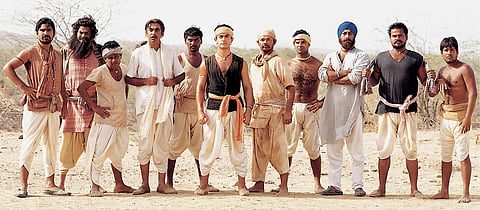


In Hum Dil De Chuke Sanam (1999), there’s “Man Mohini” — Aishwarya Rai Bachchan’s introduction song in the desert — the tempo, the game of seven tiles…in Lagaan, you see a similar sort of arid land. It’s the same area in and around Bhuj. (Art director) Nitin [Chandrakant Desai] and I had done Hum Dil De Chuke Sanam before Lagaan. After a lot of options were nixed for one reason or another, Nitin took Ashutosh [Gowariker] to the same plot of land where we had shot Aishwarya’s song and said, “What if we place the village here?” It had worked very well for Aishwarya’s introduction, but I had my doubts about placing a very large part of Lagaan in a space that was rather monotonous.
We kept that conversation open and spent the night in a tiny resort outside Bhuj. From there, we noticed some low mounds in the far distance. Ashutosh suggested we travel in that direction the next morning. So, quite serendipitously, we came upon a landscape with low mounds — one where the temple could be placed on a perch, another that naturally formed a stadium-like seating for the practice ground, and yet another that became the perfect spot for Bhuvan and Gauri’s rendezvous. Suddenly, the village was coming together — these are the small joys of the filmmaking process. The construction of the village on that piece of open land in the middle of nowhere is another story.
A period film, set in a remote village where there has been no rain for years, and then a cricket match is played against the British masters. Aamir [Khan] had been repeatedly told by industry veterans that he was embarking on a doomed venture.
But there we were, all working tirelessly to make it happen. In the same way, we had conversations about colour — first, about taking colour away. Greens and blues were a big no, and we found a landscape that naturally lacked them. Similarly, in costuming, colour was used very self-consciously. (Costume designer) Bhanu Athaiya, who had worked on Gandhi, brought in a very carefully curated palette. I remember Aamir wanted a strong tan on his skin — he would oil his body and sit in the sun. He was basically cooking himself. [Laughs.]
We had long, in-depth conversations about how to shoot and approach the cricket sequences in the film, starting from the prep stage. We were going to be filming in the open in Bhuj for days on end — the cricket shoot went on for about 30 days non-stop.
It was not an easy process: heading out in the morning and shooting till the evening. It was all “day/exterior” — a no-brainer in a way. At one point, there was an ongoing joke between Moolchand, the gaffer, and me: It felt like we were “clocking in” at a factory.
How do you approach this climax? Because, in a way, the final match is the climax of the film — and it’s a very long-drawn one. We had to keep reminding ourselves: This is a drama film, not a sports film. It’s not sports coverage. It’s about the stories within the match. That was our focus. That was the defining prism through which I shot it. There was a time when Aamir suggested using multiple cameras and shooting it like a real match. I remember that conversation — Aamir, Ashutosh, the production team, everyone in a room, discussing the possibility of bringing in a live audience and filming it like a live event. My response was quick and sharp: That’s not how we should do it. Why?
First, the electronic equipment used for sports coverage — even in 2001 — was far better suited to that approach than anything I could bring in with film equipment. Long lenses, multiple cameras, the sheer amount of film stock required — it wasn’t practical. Second, and more importantly, we were telling a story. That story needed to be told effectively. When we were on set, still debating whether to stay at one end of the pitch and call in different batsmen for their respective shots, I pushed back. I suggested filming person by person — because each character’s story was different.
Kachra’s story was different from Lakha’s, which was different from Bhuvan’s. That was a critical decision that shaped how the match was filmed. It had to be a mix of both approaches. When it came to the players, it was about character, story and drama. The language of filming shifted accordingly — subtly, but it did. It’s imperceptible; if you don’t notice it, that’s great.
Kachra, for example, has an affected limb. He’s a nervous batsman — the last man in — who can’t bat to save his life. He’s edgy all the time. I remember putting on the zoom lens and using it in a jagged, reactive manner, responding to his movements. His body language dictated the cinematography, letting the camera reflect his nervousness.
When Guran comes in to bat, he takes an almost comical, very frontal stance. I placed the camera bang in front of him, on the pitch, and created a flat, frontal visual. It was in response to what the actor was doing.
Whereas with Bhuvan, staying close to him throughout the match was vital. And then, the dynamic low-angle tracking shot for the finish — that was more his story.
It’s the little, imperceptible things that give the moment weight. Developing a visual language for the kind of drama you’re filming requires you to be fully present and alive to it on the day, in the moment.
Shooting in the sun all day was quite bothersome — from a continuity point of view. I would have a meltdown every day. The sun keeps moving. A player comes in to bat at 8:30 a.m. He plays his shot, it goes down the cover, the fielder collects it at noon, chucks it back to the wicketkeeper — probably at four in the evening. The wicketkeeper sends it to the bowler, who’s probably coming in for his next delivery at 5:30 p.m. How am I supposed to hold this together?
I didn’t. I just shot it. When you watch the film, do you notice the jumps in time? You don’t. Because the story is focused on the characters, and if the story is working, the sun’s position doesn’t really matter.
Here’s another thing: The climax required rain. The match has just been won, and as an act of God, the heavens open up and it pours. There was no way we were going to get overcast skies, so in the blazing sun, it rains. For me, it’s still a big problem. You have an open landscape, you’re in Bhuj, and we had some primitive rain machines — literally shower heads on water pipes, held up by a whole string of crew members. The entire lighting team was in on this act of making it rain.
In my mind, I had to process this: We’ve won the match, the villagers are delirious; the film is, in a sense, over. I wasn’t going to wait for overcast skies to make the rain look realistic — which, by the way, we did with the song “Ghanan Ghanan” — I went with the moment and let the rain happen in bright sunlight. The feeling was more important than the logic.
That’s the thing with cinema: There’s no right way. You trust your instincts, you own your choices, and the rest, as they say, is history.