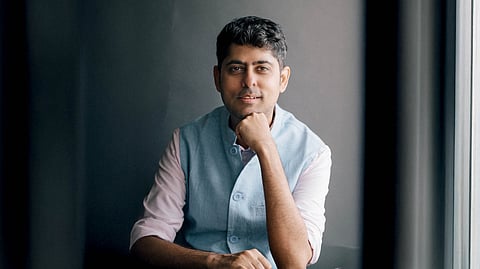


In a time when reading is often reduced to mindless scrolling, lyricist, satirist and stand-up comic Varun Grover remains a committed reader — one drawn to literature that disturbs, challenges and genuinely enlightens. Much like his own body of work — writing soulful songs like “Moh Moh Ke Dhaage” or delivering razor-sharp political satire with Aisi Taisi Democracy — Grover’s bookshelf is a reflection of a restless, questioning mind.
His literary preferences are far from ornamental. They are fragments of a worldview rooted in dissent, empathy and relentless curiosity. In Grover’s world, reading serves as both refuge and resistance. His library is a curated rebellion — deeply political, fiercely personal and always poetic.
The lyricist gives The Hollywood Reporter India a peek at his bookshelf this month.
What Grover enjoys most about Arundhati Roy’s 1997 bestseller is “the poetic prose, the quiet politics, the documentation of history and society,” he says. But he also appreciates its great sense of humour in this debut novel that went on to win the Booker Prize. In classic Roy fashion, The God of Small Things delves into the issues of class, race, religion and politics through the life of a family living in Kerala in the 1960s. It follows the life of Ammu, the matriarch, and her twins, Estha and Rahel. The politics of love is what the author ultimately breaks down in the story; what Grover calls “an all-time masterpiece.”
Uday Prakash’s Tirichh is a collection of short stories that grapples with the unfortunate realities of urban society. It speaks to the story of a teacher from a rural area and whether the poison of the forest-dwelling lizard ‘Tirichh’ is more dangerous than that of the city dwellers. “One of the most powerful, rooted, surprising bunch of stories in Hindi,” Grover says. It explores gritty tales of city life, one that lacks humanity, culture or education.
“Imagine Kafka-meets-Dahl-meets-Premchand,” says Grover describing Ganjifa, a short story collection by Naiyer Masud. An Urdu scholar and writer, Masud also received one of India’s most prestigious literary awards, the 17th Saraswati Samman in 2008. This collection, in particular, delves into “stories of people on the margins in an ancient city slowly disappearing under the dust of time,” Grover notes — which is why the book makes it to his list of favourites. There’s a strong sense of hopelessness and helplessness in every story. For instance, while the titular one explores death and resilience, another speaks of nostalgia and memory, against the backdrop of a garbage disposal area built over an ancestral home.
A vivid literary account, Kai Chaand The Sar-e-asman by Shamsur Rahman Faruqi gives a glimpse into life in the 1800s — the way people spoke, the poetry they shared, the art they created and the culture they lived in. Grover deems it to be an “epic novel, if there ever was one.” He adds, “It covers history, culture, anthropology, empires and human failings through a great set of characters during late Mughal and then British India.” The lifestyle of the nawabs, the nobles, the British and the common man is detailed in a poetic manner, making one feel as though they were right there.
“Can’t make a list without putting in one of the best graphic novels ever produced,” says Grover, calling it “a novel of great ambition, craft and emotion.” Craig Thompson’s Habibi is a sweeping, richly layered graphic novel that blends stories from the Bible, the Qur’an and The Arabian Nights with Islamic art and poetry. Set in the fictional land of Wanatolia, it follows Dodola and Zam, child slaves bound by fate, through a journey of suffering, separation and love. Thompson’s masterful storytelling and evocative illustrations create an epic tale full of emotional depth and cultural resonance — a complex, ambitious work that rewards readers with every turn of the page.