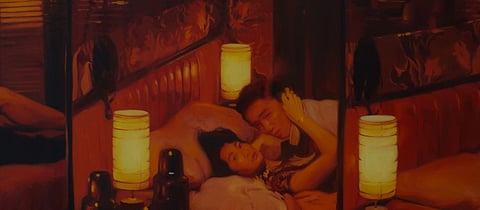


On the 25th year of Wong Kar-wai’s In the Mood for Love, one realises how its distinctive aesthetic marked by deep contrasts and warmed by the orange tungsten bulbs that cast long shadows on walls has left an indelible mark on the collective consciousness of pop culture. Released in the year 2000, the film is a meditative portrait of yearning captured in the silences and liminal spaces occupied by Chow Mo-wan (Tony Leung), a journalist, and his neighbour, Su Li-zhen (Maggie Cheung), a secretary at an export-import office.
Mo-wan and Li-zhen, over days, discover that their respective spouses have been having an affair with each other. In their individual attempts to investigate the betrayal, their worlds collide and crash into a devastating portrayal of urban solitude against the claustrophobic backdrop of a thronging 1960s Hong Kong through the lens of Christopher Doyle. It’s like a Rembrandt painting set in motion, which artist Varad Bang has chosen to call “The Weight of Love” as the title of his ongoing exhibition in Delhi’s Gallery Pristine Contemporary.
Upon entering the basement space awash with red, one is almost immediately propelled into Wong Kar-wai’s world, shrouded in an air of melancholy and haze that have become all too familiar in the palettes of films like Everything Everywhere All at Once (2022), Moonlight (2016), and Lost in Translation (2003). Trained in architecture, Bang’s fascination with Wong Kar-wai was born in the stillness of his pandemic-stricken days, when he was around 20 years old. He was arrested by the luminosity of Wong Kar-wai’s frames that jumped out at him like a Vermeer painting — oil on canvas — illuminated by the whites burning against the furrowing shadows.
Much like most others, Bang, too, was initiated into Wong-verse with In the Mood for Love. “The way Wong Kar-wai used light in this film — you know, how he isolates the character — stood out to me. The shadows also play a significant role,” the artist says. "Another reason was the way space interacts with the characters, and how, as human beings, as the audience, we’re made to feel like we’re sneaking in, or intruding on a private, silent, intimate moment the characters are experiencing. That really resembled a lot of the painters I was looking at the time.”
He picked scenes where there is an absence of a direct gaze, by design, so as to have the audience fill in the blanks almost voyeuristically, like characters embedded in that universe. “There is one where the woman is turning away from us, light falling on top of her — or when the characters are turned away, or the brushstrokes are soft, or the faces are obscured towards the end, where both of them are walking in the same direction but away from each other — those were the things I had in mind as a painter,” Bang points out. He believes that triggering the imagination through “that silence, that pause, allows the emotion to grow over time as you walk along the show.”
Eighteen paintings in varying sizes are laid out across the gallery converted into a Hong Kong apartment that is led into by thoroughfares and alleyways recreated by set-designer Sumant Jayakrishnan. There are chambers partitioned by curtains with a canvas showing Mo-wan working his vinyl record player against a mirror. In another corner, a vertical frame of Li-zhen peeking through floral curtains lined by houseplants sits next to a similar portière along an arch, with a rotary dial telephone perched next to it. “These visual choices are never just stylistic; they’re emotional currents running through the frame,” Jayakrishnan says.
The props, evidently, are period specific. A transistor radio is set atop a wooden chest of drawers, above which hangs a painting of one of the most impassioned kisses between the protagonists, as they become one with the flaming red wallpaper. “We incorporated lush, period textures and patterns — wallpaper with floral or geometric prints, soft table lamps with fringed shades, sheer curtains — these elements wrap the scenes in sensuality,” Jayakrishnan says. “Space should feel both confined and voyeuristic — like the audience is always catching a moment in passing,” he adds.
The sequence of paintings takes the viewer from pangs of solitude to tumultuous unions, and ultimately to star-crossed rifts that underline the poignancy of this 90-minute-long mood piece. According to Bang, Wong Kar-wai’s enduring relevance lies in this very ability of his to tap into the rich inner worlds of his characters through atmospheric motifs of bright colours in glaring lights engulfing its people in the deep shadows they cast. “All of us are constantly busy with work, or just the general busyness of life. It’s gotten even more intense now, especially with mobile phones. When people eat, they don’t want to sit alone — they want a screen, something playing in front of them,” he says. “That’s why the idea of solitude — the weight of solitude — feels even more relevant today. Those 10 or 15 minutes of just sitting quietly, doing nothing, feel so rare and important. And that’s something Wong Kar-wai captured so beautifully, even 20 years ago.”
Near the end of the show, Bang places a recreation of the scene where Li-zhen is resting her head on Mo-wan's shoulder in a taxi. A bokeh of city lights behind them, blurred through the back window of the car is replicated from the original scene almost too perfectly. One can barely tell it apart from what was captured on celluloid.
But what truly stands out are the depths of the black abysses — a symbol of Wong Kar-wai’s tragic romanticism wrapped in his hallmark graininess that Bang captures meticulously in his homage to an era-defining auteur of our times.