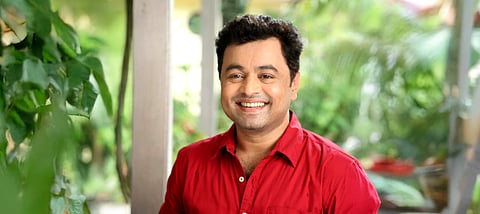


Actor, director, and writer Subodh Bhave has set himself up for an uphill task — he is bringing a reimagined Marathi theatrical classic, Sangeet Manapmaan, to the silver screen. In the world of Marathi theatre, few works command the reverence of Manapmaan, a 113-year-old musical masterpiece that had audiences in such a stronghold that performances often lasted up to 12 hours.
Written by playwright Krishnaji Prabhakar Khadilkar, the five-act play featured stalwarts like Bal Gandharva, and became synonymous with the golden era of Marathi musical theatre. Overflowing with melody and meaning, the play contained 67 songs, 35 of which became timeless hits; the likes of Ravi Mi, Khara To Prema, and Nahi Mi Bolat Natha remain staples in Marathi households to this day.
At its core, Sangeet Manapmaan is a tale of pride and prejudice, exploring the dynamic relationship between Dhairyadhar, a principled commander, and Bhamini, a proud young woman. Set in pre-independence India, the play was also a vehicle for patriotic fervour, urging the youth to value courage over material wealth. The simplicity in its plot was balanced by its emotionally resonant music, which carried messages of wisdom, angst, and societal commentary.
Adapting this cultural phenomenon into a film in 2025 comes with its challenges. Bhave faces the constraints of modern cinema — where narratives must fit within two hours and fewer songs can be accommodated. His version takes creative liberties, modernising the story while staying "inspired by" the original; Dhairyadhar now shares domestic responsibilities, and Bhamini’s agency as a woman is amplified. These updates aim to resonate with contemporary audiences while maintaining the essence of the original work.
However, cutting down the music — a central pillar of Sangeet Manapmaan — to make room for a narrative-driven format is a bold gamble. For a play remembered not just for its story, but also the sheer power of its songs, Bhave’s reinterpretation faces both the scrutiny of a dedicated fan base and the challenges of proving Marathi cinema’s potential on a larger platform.
The Hollywood Reporter India spoke to the director to understand the spirit of his inspiration.
Edited excerpts:
Why did you decide to make Sangeet Manapmaan? With so many legendary sangeet nataks (musical plays) in existence, what drew you to this one?
After my previous project Katyar Kaljat Ghusali, I knew I wanted to make a musical film. The search for the right story led me to revisit Sangeet Manapmaan, which had been sitting on my bookshelf for years. When I read it again, I realised it was a great choice. Marathi cinema rarely delves into fairy tales or the fantasy genre, so this felt like a wonderful opportunity to create a musical fairy tale... a fantasy film.
It took you three and a half years and 26 drafts to finalise the script. You also emphasised that the narrative was your priority. Could you share more about the process of selecting the songs? Originally the musical had 67 songs, 35 of which were classics. Out of those, only six made it into the final album. How did you make those choices?
Our primary focus was to create a film with music, not just a music album with visuals. For me, the story always takes precedence. The songs were selected based on whether they advanced the narrative or fit naturally into the plot. For example, if a scene required a dialogue-driven moment, we didn’t force a song into it. This approach meant we had to modify the original play significantly, but it allowed us to craft a new story while retaining the essence of the original.
So, it’s not a direct adaptation — it’s more of an inspiration. You’ve taken the core idea of the sangeet natak and transformed it into a movie?
Exactly. The main characters and themes remain the same, but we have made creative changes to suit the medium of film.
In another interview, you mentioned how theatrical performances like Fiddler on the Roof and The Sound of Music have successfully co-existed with their film adaptations. Do you feel a responsibility to stay true to the source material, especially for audiences unfamiliar with the original play?
It’s important to clarify that our film is inspired by the play, not an adaptation. While fidelity to the source is valuable, the shift to a new medium often requires reimagining elements. Our aim was to introduce this story to a new generation while keeping its cultural essence intact.
The political undertones of the original — set during the freedom struggle — are absent in your film. Instead, you’ve placed the story in a timeless, fairy tale-like setting. What led to this decision?
The political backdrop of the original era inspired many plays, but Sangeet Manapmaan wasn’t explicitly political. We wanted to create a story that transcends time and appeals to a wider audience. The fairy tale format allowed us to focus on universal themes rather than tying the narrative to a specific historical context.
You’ve spoken about challenges in finding theaters for Marathi films. Despite your illustrious career and backing from major studios like Jio Studios, does Marathi cinema still face hurdles in terms of budgets and distribution?
Absolutely. While Jio Studios’ support has been invaluable, the reality is that regional cinema often struggles to compete with larger industries. Budgets for Marathi films haven’t scaled significantly, especially compared to the booming South Indian film industry. The lack of ROI (return on investment) makes it difficult to secure larger investments, which in turn affects the quality and reach of our films. It’s a vicious cycle. The limited resources make the films less competitive, which means fewer people watch them, further reducing revenue and visibility.
Do you envisage this cycle being fixed at some point?
It requires collective efforts — better promotion, more platforms supporting regional cinema, and exploring pan-Indian appeal while staying true to our roots. The problem is that we don’t get enough time in the theatres — the playing field is uneven. Give us a week at least? Additionally, the show timings are also such that we can’t pull crowds. The 11 am show on a weekday will not drive sales, right? I’m not saying that distributors should bear losses for us — it is a business at the end of the day — but they should at least create a mandate where every film gets time to garner word-of-mouth. I think there are many incredible films that will find viewership if we just give them time to breathe.