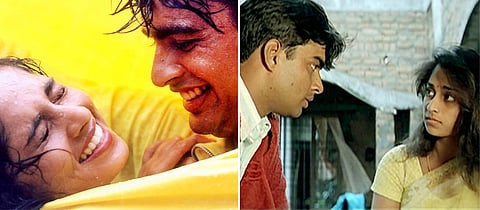


Released on April 14, 2000, the new millennium’s Puthandu release Alaipayuthey — Mani Ratnam’s romantic-drama featuring the debutante R. Madhavan and Shalini — straddled two worlds. There is, of course, the one between modernity and tradition — with two young urban kicks, Karthik (Madhavan) and Shakti (Shalini) falling in love, straying away from their parent’s expectations. There is also the one between Karthik’s rich, spoilt upbringing and Shakti’s hustling, middle-class one.
But, perhaps, more narratively explicit is the straddling between the past and the present that the film keeps shuffling between. It begins with Karthik trying to find a missing Shakti, frequently rupturing into flashbacks that quickly jot their love — how they met, how they kept meeting, how they married, how they broke off familial ties, and how, at the end of it all, wondered if the whole thing was worth it. As Mani Ratnam tells critic Baradwaj Rangan in Conversations With Mani Ratnam, “What interested me was that, in Hindi, this was the time the great romances were being made, all huge films. Hum Aapke Hain Koun!, Dilwale Dulhaniya Le Jayenge — those were the love stories. And I wanted to look at what happened afterwards.”
Initially, Ratnam wrote Alaipayuthey as a linear story, and was not able to crack the ending. Frustrated, he left it aside, and shot Dil Se! (1998), instead. Then a thought struck. It was only by deciding to keep flipping between the two timelines which meet in the second half that Ratnam was able to crack the film’s structure. With this he went to editor Sreekar Prasad — with whom he would begin a long, ongoing, and fruitful collaboration.
In this conversation, edited for length and clarity, Prasad breaks down a lot of the decisions they made, and the anxieties felt pursuing something strikingly different.
When you joined Alaipayuthey, was the back-and-forth structure of the film locked?
Yes. This was my first film with Mani Ratnam. He said he was making a small film, and asked if I was interested in working with him. It was a different narrative. Remember, this was 1998-99, and so we were afraid and excited how people would react to this back-and-forth narration. Back then in our movies, there used to be very clear flashbacks. But here, you are almost cutting between two parallel stories which come and join at one point in the second half. This was tricky.
Initially, though, the script had much more back-and-forth. But as we kept editing the film, over 17 to 18 versions, we reduced the number of these motions to make it easier to watch. We didn’t want it to be complicated for the viewer.
The film begins immediately with the ‘Endrendrum Punnagai’ song, but you start with the rap portion, a babble of words, which is actually somewhere in the middle of the song. Why did you want to bring it up to the fore like a headrush?
We fixed this later in the process of editing. Mani Ratnam wanted to introduce this new guy very candidly. Even the way it was shot, tight with the movement of the vehicle, not very even — it is not a classic shot. So when the song had to come in, we thought to open the film with that sort of rap energy for the character.
What are the conversations you and Mani Ratnam had, regarding those reverse shots of ‘Kadhal Sadugudu’?
Mani Ratnam wanted to shoot the song in reverse — but how do you as a viewer, know it is in reverse? For that, we needed a particular object to move. If you notice, there are a lot of cloth movements in the song to get mileage from the movement.
The difficulty was to match the lip movement, where the song had to be lip synced in reverse. Even though in reverse the song sounds gibberish, the artists had to shoot and sync to that.
What about the challenges of editing ‘Pachai Nirame’ where the frame rate was significantly slowed?
The concept of that song was colours. In a lot of places we let the slow motion dwell in the edit, so it gives you the feeling of freshness and burst of colour. In some places, even when it was not shot in a slower frame rate, we slowed it down.
But doesn’t this affect the lip sync? In a few parts, you can see it is slightly off..
A song is something which gets you on a high, with a burst of energy. It has to come at the right moment. It has to be a great song. We do all the things which make the emotions greater for you to enjoy it — that is the priority.
Was ‘September Madham’ needed, then?
See, it has a story, although it looks like an “item number” in the film. When two people are having a fight, instead of showing it only as a dull moment, we showed it through the song — although they are dancing, there is tension.
As an editor, does it get complicated trying to balance Sophiya Haque dancing for ‘September Madham’ intercut with the worried face of Shalini?
It is like a double-edged sword. You have to make sure one does not overshadow the other. There are directors like Mani Ratnam who tell stories through songs; at the end of the song, you should not feel like you have strayed far away from the track of the film. Even if it means that we sacrifice a bit of dance in the edit, we would do that.
‘Yaro Yarodi’ is an editing masterclass — there is a song, character and context is introduced immediately, there is also the high of a song. There is so much economy. When the footage comes to you, do you know at what point you break into dialogue?
That is all Mani. He wants a lot of conversation to come into the excitement of the song.
Can you talk about the transitions between the past and present, when the screen goes blue and the sounds are heightened?
We initially went with cold cuts between the present and past. But we realised that the audience was not ready back then for this kind of storytelling. So, if Madhavan is sitting in the station, the frame turns blue, and an exaggerated sound of trains takes you back in time.
One thing Mani Ratnam mentioned during his recent retrospective was that the whole fight scene between Madhavan and Shalini was rewritten and re-dubbed after it was shot, and so you can see the mismatch of lips and sound. How do you, as an editor, deal with this? Especially given that he shoots in long takes.
Invariably this mismatch happens, because in the edit, the scenes might not be in the order in which it they are written or shot. The screenplay on the editing table changes invariably. The flashback and flash forward were reduced. So, some dialogues needed to be changed, or what the scene was conveying might change. Then you tweak the dialogues into whatever the lip movement is.
Can you talk about that moment of silence in the climax? During the first show of the film, you had heard someone laugh at that point and got worried?
It is the tail end of the film, where all the other loops in the films are completed. Now, Karthik just needs to apologise and finish things on a positive note. Mani had decided that he wanted the scene to be silent. We were worried, because for our Indian audience — after all this energy — to suddenly have this silence in the climax might be a bit of a risk. Even in the theater, I was a little shaken. When the younger crowd murmured during the silent moment, that unnerved me. I told Mani that. He is seasoned, so he told me that it would settle with the audience after a few days.
Would you change the edit in any substantial way today?
One interesting thing happened after our edit. We had shown the film to some people in the Madras Talkies office. After watching it, one person in the office, someone from the accounts department, said that he loved the film. But when we asked whether he found the timeline-flipping complicated, he asked, "Where is the time going back and forth?" That is when we decided that he did not get that, but even then he enjoyed the film. We decided to let the film go.
Maybe if it was made today, we would have played a lot more with time.