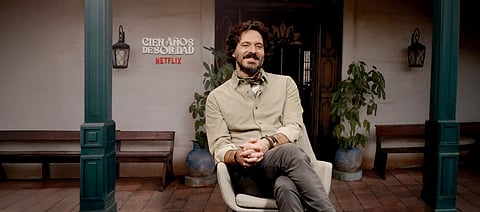


In this interview with The Hollywood Reporter India, Alex Garcia Lopez, the director behind Netflix’s highly-anticipated adaptation of One Hundred Years of Solitude, discusses the challenges and rewards of bringing Gabriel García Márquez’s iconic novel to life for a global audience. From navigating the pressure of adapting such a revered literary masterpiece to tackling the complexities of magical realism and political themes, Lopez offers a behind-the-scenes look at the creative process that shaped the series.
Now available on Netflix, the show brings Márquez's timeless story to a new generation, blending authenticity with global storytelling.
Edited excerpts from the conversation:
Alex, congratulations on getting One Hundred Years of Solitude adapted and on Netflix. William Kennedy once called it "the first piece of literature since the Book of Genesis that should be required reading for the entire human race." Adapting such an iconic and revered novel must feel like immense pressure; was there a moment when you realised the scale of the challenge?
Thank you. Yes, the magnitude of the project hit me from day one when Netflix approached me. I said yes immediately, but then I thought, "Wait, I should read the novel again." It had been about 20 years since I'd last read it, so I went back to it — first in Spanish, then in English to see how the translation would affect things. I was really struck by the scale of the story and its cultural significance. One Hundred Years of Solitude is probably the most beloved book not just in Colombia, but across Latin America.
To be honest, that pressure quickly shifted into a sense of opportunity. I felt incredibly lucky to have the chance to bring this story to life. I've worked on adaptations before, like The Witcher, but with this, I told myself I would really savour the process. I wanted to enjoy the experience of adapting such a marvelous novel.
You have previously worked on shows such as The Punisher, The Witcher, and Daredevil. Was adapting One Hundred Years of Solitude a big shift for you in terms of tonality?
Yes, in some ways, it was a big shift. A lot of my past projects involved heavy VFX and big sequences, right? But even in those shows, I’ve always tried to do things in a hands-on way, focusing on real moments and letting actors perform without relying too much on digital effects. I’ve always been inspired by ‘70s cinema, which was very grounded and real.
With One Hundred Years of Solitude, the challenge was really about executing the magical realism in a way that felt authentic. Those magical moments — like the bags of bones, the levitating baby, or the rain of yellow flowers — are unforgettable in the book. But for me, it was important to make those moments feel real, almost mundane, so they wouldn’t seem out of place in this grounded, Caribbean world. I approached it like I have with other projects: keeping it real, but also creating something cinematic.
This is such a universally-beloved story. But with Netflix’s global audience, were you conscious of making the show accessible to viewers beyond the Spanish-speaking world?
Not really. The themes of One Hundred Years of Solitude are so universal: love, politics, war and humanity fighting against its own destiny. That’s what makes the book resonate worldwide. The magic realism Gabo (Gabriel García Márquez) created is very specific to his upbringing in the Caribbean though, and it was important to me to stay true to that. I wanted the world of Macondo to feel authentic, deeply rooted in Colombian and Caribbean culture.
Today, with platforms like Netflix, there’s a global demand for stories from all over the world. Audiences are sophisticated — they can tell when something feels "whitewashed" or inauthentic. So our first goal was to make it feel as authentic to the Caribbean as possible. Once we had that grounded in reality, we aimed for a production quality that could match the best international standards like The Crown or Downton Abbey, so that it would appeal globally.
The book plays with time in such a fluid way, blending the past, present, and future. How did you approach this challenge in adapting the non-linear narrative for the screen?
That was definitely one of the hardest aspects of adapting this book. Novels like this, with such complex structures, require some difficult decisions. Early on, we knew we had to make the story chronological, or else it would become very difficult to follow on-screen. We do jump around a bit, but it is mostly in small moments.
Another challenge was adapting a novel with very little dialogue. The characters are rich, but much of the story is told through narration. When I first read the script, I was nervous — how would we bring these characters to life with so few words? But then I read the first sequence written by José Rivera, and I was immediately reassured. He created a brilliant narrative device by introducing a mysterious character at the beginning, one who reads the family’s story out loud, in a poetic and suspenseful way. This allowed us to bring in Gabo’s voice, his sense of humour, his rhythm. It was a brilliant solution, and from there on, I knew we had something special.
One Hundred Years of Solitude is also a deeply political work, exploring the history of Latin America and the aftermath of colonialism. How do you see the importance of telling these stories, especially from ex-colonial countries?
It is incredibly important. Colonised nations share a history of struggle, and even after independence, we continue to deal with the aftermath of that colonial past. For example, I knew very little about the War of a Thousand Days in Colombia — the beginning of the civil war. It was a war between two ideologies, the liberals and the conservatives. Gabo captures that absurdity in a very Caribbean way, showing how the innocent people — the women and children — are the ones who suffer the most.
When we show the violence of that war in the series, especially around the fifth and sixth episodes, I wanted it to be brutal and honest. That part of history still has echoes today. Gabo wrote this in 1967, but it’s as relevant now as it ever was. We’re still seeing these kinds of ideological divides — "red versus blue" — in so many parts of the world. Gabo’s message, asking whether humanity will ever learn from its mistakes, feels more topical than ever.