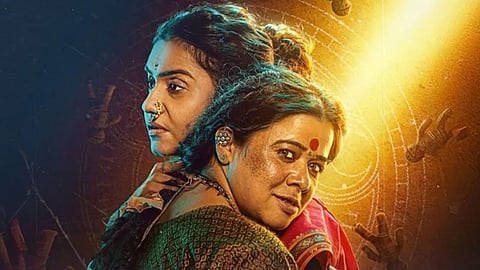


After a celebrated run in Hindi cinema, National Award-winning actor Amruta Subhash returned to Marathi film with Jarann, a psychological horror drama written and directed by acclaimed novelist Hrishikesh Gupte. Known for her unflinching commitment to emotionally layered roles, Subhash plays Radha, a woman spiralling into an unnerving psychological unravelling.
In this conversation with The Hollywood Reporter India, she discusses what drew her to the project, her complicated relationship with the horror genre, and the discipline it takes to act from the inside out.
Edited excerpts:
Q: What drew you to this role? It's not a space mainstream actors frequently inhabit. What felt right about the script and character?
Amruta Subhash: The writer-director, Hrishikesh Gupte, is a well-known Marathi novelist. I’ve been a huge fan of his work, especially his psychological thriller-horror novels. I remember connecting with him after reading one of his books just to tell him how much I appreciated it. That’s when he told me he was writing a film and that he’d imagined me in the role of Radha from the very beginning.
Apparently, he had seen me perform Ti Phulrani, the Marathi version of My Fair Lady, where I played Eliza Doolittle's character. There's a soliloquy in that play, an angry, vulnerable moment I perform alone on stage. He told me that’s when he saw Radha in me. He read the script aloud to me himself, and I was blown away. A well-written screenplay is pure gold for an actor, and hearing it from the writer, who had lived with it for years, made it even more powerful. I said yes immediately.
Q: You mentioned that the portrayal of Radha had to come from within. How did you prepare for such an internalised performance?
AS: I didn’t want Radha to fall into the trap of stereotypes we often see with mental health portrayals. So I worked with psychiatrists, tried to understand the root of Radha’s trauma, and imagined what the bodily effects of her inner unrest would look like.
So yes, the blinking, the slight tremors, the neck twitches weren’t just added as quirks. They had to feel like organic results of her psychological state. It was a balancing act. Fortunately, I was working with a director like Hrishikesh, and we were constantly refining it so it didn’t feel over-the-top.
Q: Did you shoot chronologically? And does your theatre background make non-linear filming more difficult
AS: As a theatre actor, I used to be overwhelmed by film schedules. I’d wonder, “We’re starting with my death scene?!” [laughs] But now I’ve accepted that this is how film works.
In Jarann, for instance, we had three major scenes with a psychiatrist that appear at different points in the film, but we shot them all on the same day due to location constraints. It was intimidating, especially for a role like this, where you’re constantly negotiating what to show and what to hold back.
I prepare thoroughly, but once on set, I rely on intuition. I rely on what the space gives me, what my co-actor brings. That keeps it alive.
Q: Horror can be brutal, especially towards women. What's your relationship with the genre?
AS: I totally agree. This is such a fantastic question because I was scared of horror and a lot of it, like the gory kind, still doesn't sit well with me. There was this show called Kile Ka Rahasya that I watched as a child, and it terrified me. But we didn’t all have TVs back then, so we’d gather at a neighbour’s house and watch it together. That shared fear was strangely enjoyable. The fact that it was a collective experience made it fun.
Still, I’ve never liked the way women are often treated in horror. When Jarann came to me, Hrishikesh gave me a list of films to watch. One of them was The Others with Nicole Kidman. That film showed me that horror can be elegant, beautiful, and even spiritual. That’s what we tried with Jarann—it’s more about inner fear than jump scares.
Q: What's been the most memorable reaction to the film so far?
AS: Someone came up to me and said, “Tai, tu amchya ghondhadala chehra dila”—“You gave a face to our inner turmoil.” That just stayed with me. It made everything worth it.