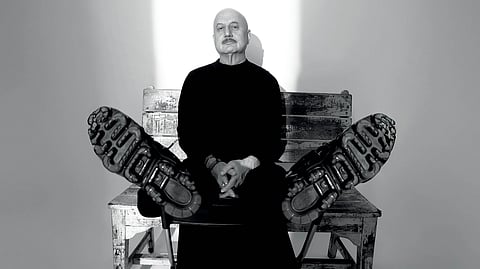


Anupam Kher doesn’t fear losing. Twenty years ago, he faced financial ruin; he has lost dear friends, battled getting typecast as an actor, and navigated the disappointment of a directorial debut that didn’t quite hit the mark. There were moments of desperation, too, when he was evicted from his home due to unpaid rent. Yet, Kher’s resilience remains unwavering because he believes that everything in life can be won back.
“I always looked at my life as a biography,” Kher reflects. “In the toughest moments, I’d tell myself that whatever was happening would one day become a part of my story. It’s a mindset that comes from growing up in a small town, where the only option was to dream big.”
In his office in the suburb of Andheri in Mumbai — where his acting school, Actor Prepares, thrives — Kher’s spacious cabin is a testament to his journey. It is a career spanning over four decades, including a leap to Hollywood and multiple National Film Awards under his belt.
The walls in his cabin are adorned with iconic movie posters — from the classic Mughal-E-Azam (1960) to Todd Phillips’ Joker (2019). But it’s the personal touches that truly reveal the man behind the legend: a treasured NCC ID card, his first, nestled among hundreds of books on his mammoth bookshelf.
“I keep the ID card to remind myself that this is what my beginning was. To always keep me grounded,” Kher says, pointing to other memorabilia in the room, which includes pictures with his friend, the actor Robert De Niro. “But we will come to that later,” he jokes.
Kher’s insatiable drive to excel is rooted in his childhood, a spark that has fuelled his remarkable journey across over 500 films. Born into a Kashmiri Pandit family — his father served as a clerk in the Himachal Pradesh forest department and his mother, a homemaker — Kher’s pursuit of the impossible has become a recurring theme in his life’s work. This is evident through his books, talk shows, or his latest directorial venture, Tanvi the Great (2025), which tells the inspiring story of a young autistic woman who embarks on a journey to fulfil her late father’s dream of saluting the national flag at Siachen Glacier.
“I think it stems from the fact that you only get to know your strength when you push yourself into a difficult situation. I never wanted to live a mediocre life, and it has nothing to do with fame.”
Kher’s humility is palpable as he reflects on his past. “I wasn’t the brightest student academically, but in my mind, I was always the most brilliant,” he laughs. His love for learning was ignited early on, thanks to his uncle, who gifted him Maxim Gorky’s Mother — a book that drove him to challenge the status quo, like his first audition for drama school in Chandigarh, where he played a woman’s role just to stand out.
“But I was very bad at it!” laughs Kher, who was still selected because, as his professor would tell him later, he was “daring”. Years later, armed with a gold medal from the National School of Drama, Kher arrived in Mumbai as “a bald, thin guy” who had the “guts to want to be an actor.”
“I wondered, why let hair come in the way of my dreams?” he recalls, with a hint of defiance that has defined his career. “Everyone told me I was crazy to play a 65-year-old man’s role in my first film, but I had to dare it. And I knew that someday, I’d be talking about it to a journalist.”
There’s something remarkable about Kher’s ability to navigate life’s curveballs with a storyteller’s instinct. He often finds himself thinking about the stories he’ll tell someday, over coffee or at a house party. This unique perspective — viewing his life in the third person, even as it’s unfolding — is a trait he’s had since he can remember.
“I don’t know how to explain it... It’s a way of escaping the present, of finding meaning in the struggles and the triumphs,” he says.
For Kher, this perspective was shaped by his growing-up years in a modest house in Shimla — one room, kitchen, and veranda — with his joint family. He remembers asking his grandfather, with childlike curiosity, why their family seemed happy despite being poor. His grandfather’s response has stayed with him: When you’re poor, the cheapest luxury you can afford is happiness. It shaped Kher’s outlook on life.
“Maybe I was born with an old man’s soul and a heart of courage. I will try and risk failure rather than not try. Unless you put yourself in a situation where it’s impossible to win, how will you know that there is the possibility of winning?”
Before he shot to fame with Mahesh Bhatt’s Saaransh (1984), Kher was living with his brother and another roommate in a flat in Bombay, where his next-door neighbour was the acclaimed action director Sham Kaushal.
Struggling to land any credible work, Kher just couldn’t earn enough to pay the rent and was “thrown out” with his bags. On the road with his brother and nowhere else to go, he remembered the office of a small-time producer, located in a shady hotel.
The producer called Kher for a narration and as he sat down, dangled cash in front of him. “He had some ₹10,000 and wanted me to act out the scene live as he read the lines. Every time I acted out the said scene, he would wave the wad of cash in front of me, and the moment I would try to snatch it, he’d take it away. But I didn’t feel small. It was desperation and I needed that money.”
Though Kher’s initial few years were dotted with financial struggles — despite his career having taken off with filmmakers like Bhatt, Yash Chopra, Subhash Ghai, Vidhu Vinod Chopra, Sooraj Barjatya and Aditya Chopra — he was never driven by monetary gains.
“My ambition and desire to do better was much more than my ambition to earn money...I wanted to make better choices. Even in the early 2000s, when I almost went bankrupt.”
In the 2000s the actor had turned producer and launched Anupam Kher Studio. He had produced films like Rituparno Ghosh’s Bariwali (2000) and Maine Gandhi Ko Nahin Mara (2005), even making his directorial debut with Om Jai Jagadish (2002).
But the production house started to nosedive without Kher realising that he was standing on a marsh, sinking slowly. “Till one day my CA told me that we only have ₹4,000 in the bank and the house and office was mortgaged. I had no money, but the perception from people’s point of view was that I was still successful!”
How did Kher bounce back from this? The same philosophy that anchored him from childhood: It will all turn out well, eventually. When a publishing house asked him to write his autobiography, he started taping his thoughts for an hour every day, recollecting all that made him and broke him. After a month, he had his life mapped out as sound bytes in front of him.
“I’m an actor — I didn’t want to write it, so I performed it! And that’s how the two-act play Kuch Bhi Ho Sakta Hai (2005) took shape. That play liberated me because I bared all my issues to the world, including my failed auditions. I felt like the tallest man on earth because people frighten you with what you are trying to hide from them. But if you tell them this is what it is, then what can they frighten you with?”
During my final year at drama school, I had submitted a paper on the films of Robert De Niro — Mean Streets (1973) and Taxi Driver (1976). I never thought I’d get to work with him! During a scene in Silver Linings Playbook (2012), I stood my ground over a discussion and only a king like him could identify that. Over the years, the bond deepened. He is shy, but he once sang “Happy Birthday” for me. One of his family members told me, ‘He has never sung it for us!’
To read more exclusive stories from The Hollywood Reporter India's September 2025 print issue, pick up a copy of the magazine from your nearest book store or newspaper stand.
To buy the digital issue of the magazine, please click here.