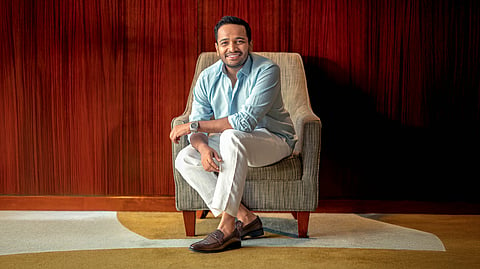


“Of course I introduce myself as a filmmaker,” says Basil Joseph, without a second of hesitation. He’s explaining what he would say to a stranger, when he travels to places where people are unfamiliar with his work in Malayalam cinema. He has acted in over 40 movies, but the work that continues to define Joseph — at least to himself — are the trio of films he has directed, Kunjiramayanam (2015), Godha (2017) and Minnal Murali (2021). It’s the sort of identity crisis a cinephile can only dream of — to have two equally successful careers within filmmaking, establishing Joseph as celebrated an actor as he is a director.
“But I don’t know what I’d call my present state of mind,” he says. “It’s a bit of frustration … I guess it comes from a sort of guilt,” he adds, searching for the right words. The last time he stood on set as director was more than four years ago, when he made Malayalam cinema’s first superhero movie, Minnal Murali. He’s been itching to direct again, coming achingly close to two films since, only for them to be called off for reasons beyond his control. “It’s not that I was slacking or distracted. These films took up so much of my time and effort with so many rewrites. But when it does not materialise after getting close, it sort of gets to you. Films and ideas have a shelf life, and you need to make it within a certain timeframe.”
As he opens up during this interview, he shuffles between the seriousness of the conversation with the infinitely more serious duty of babysitting his two-year-old daughter, Hope. Since Joseph began to feel this itch, he says he has more or less slowed down the pace with which he has been acting. He hasn’t signed on to act in a new film since October. “If I do not make that effort now, the film I want to direct will get delayed even further. I can’t afford that.” This film, he says, requires the dates of a big star, a big budget and lots of time to prepare. “If the film I wanted to make was small, I could have tried to do that along with acting. But because the film is ambitious, I need to give it my complete attention.”
He’s trying to explain the one specific aspect of direction he misses the most. “I think it could be the magic of seeing a single idea get bigger with each stage. Each time you keep adding to that idea, you witness a thought come to life.”
Joseph says it could also be the feeling of surrender that he’s been missing, “The kind when you’re only thinking about your film, obsessively, forgetting where you are or what time it is. Feeling engrossed in something that deep.” The final reason, he says, could be control. “With acting, I’m always dependent on others. There’s little I can do. But direction is entirely my world.”
But Joseph is quick to confirm that he’s always enjoyed the process of acting in all the films he has done so far. “I don’t know if it’s because I see myself as a bit of a padipist (a studious nerd in Malayalam), but with filmmaking there is a midpoint where you’re trying to merge academics with the creative. There are phases of intense learning in filmmaking in which you are going into all the aspects of it. You learn so much that you look up and it’s 3 a.m. and you do not feel tired. I’m yet to feel that with acting.”
He wonders if acting can even be approached theoretically like he approached direction. “I’m sure doing acting workshops or going to film schools might help in understanding acting from a more theoretical space. But for me, it has so far been instinctive. After I listen to a script, I work on creating a backstory for my character, so it becomes more personal. Then I must internalise the character in such a way that I find a middle ground between who I am in reality and the person I’m supposed to be playing. If I’m lucky, in those rare films, you reach a point in which you and your character merge into one. Maybe there are senior actors around who feel the high of that merging often, but for me, it rarely happens.”
The difference, he feels, is when he acts in movies like this year’s Ponman, where he aced the character of PP Ajesh. It was an author-backed role that is based on a real person of the same name. “To this day, we do not know where he is. After the film’s release, we expected the real Ajesh to get in touch with us. But he hasn’t, so we wonder if he is even alive…”
Ponman is among the rare films that not only changed how Joseph looked at himself as a performer but also how the industry perceived him. “Back when I was doing comedy roles, it was normal for me to get my first shot okayed. In comedy, we tend to become a bit desperate to create laughter, so we externalise the mannerisms. The comedy becomes physical. So, when I repeat a mannerism or an expression that has worked previously, the director is okay with it because that’s why they wanted me. They wanted me to repeat a funny expression.”
But since movies like Joji (2021), Palthu Janwar (2022) and now Ponman, expectations from Joseph have changed. He remembers the messages that came his way upon seeing his performance as a serious priest in Joji and how the industry has not looked at him in the same way since. Respect in the film world is often earned only when a comic actor succeeds in a dramatic role.
“They feel they can get more out of me after that. The first take is not enough, and the directors push me harder to deliver something new and different each time. So when they write, they feel I can pull off a hero’s Journey, like I did in Ponman. I can do a negative shade too with darker layers. I can explore more now than I could earlier. But maybe, the frustration I feel today has come from the exhaustion of having acted in too many movies in too short a span. I want to get back to directing as soon as I can. If it takes any longer, I’ll forget to introduce myself as a filmmaker.”
1. Filmmaker first, actor second:
Despite acting in over 40 films, he introduces himself as a director.
2. Director of:
Kunjiramayanam (2015)
Godha (2017)
Minnal Murali (2021) — Malayalam cinema’s first superhero film
3. Origin story:
An engineer by education, Joseph started out making short films. Some of these went viral and caught the attention of actor Aju Varghese, who reached out to him.
4. Frustration point:
He hasn’t directed a film since Minnal Murali. Two directorial projects since then were shelved. He was also rumoured to be directing the Shaktimaan reboot, which is now shelved as well.
5. Acting evolution:
From physical comedy to nuanced dramatic performances (Joji, Palthu Janwar, Ponman). As lead, his hits include Ponman, Sookshmadarshini, Jaya Jaya Jaya Hey, and Falimy.
6. Career shift:
Stopped signing new acting projects in October to focus on an ambitious directorial comeback.
7. Wearing multiple hats:
He juggles creative ambition with fatherhood — often multitasking interviews alongside parenting duties.
8. Why he misses direction:
For the creative control, deep immersion, and the joy of building an idea from scratch.
9. BCU:
All three of his films include Easter eggs and interlinked references. Fans call it the “Basil Cinematic Universe”.
10. A lesser-known fact:
His third film, Minnal Murali, was Malayalam cinema’s first superhero movie — released directly on Netflix during the COVID-19 pandemic.