
- REVIEWS
- FEATURES
- CANNES 2026
- LIFESTYLE
- GLOBAL
- LISTS
- THR VIDEO

Usually, my pre-production process involves repeatedly reading the movie’s script. The first time, I read it as a story, without thinking too deeply about work. With each fresh reading, I try to go deeper into the script and see what I can do to make it look different. This stage involves making notes on the sidelines of the script book. This could be ideas for shots, how to convert a passage into visuals through camera movement and at times, where we can shoot that sequence. When I’ve been trained to work in that routine, how can I crack it if I’ve just a week to go before the shoot? That was the challenge I was staring at, just days before the shoot of Sarvam Maya began.
Show Time
In hindsight, now that the film has done so well, it sounds wonderful but the days leading up to the shoot were very stressful. I also prefer to shoot my films in as few schedules as possible but with Sarvam Maya, we had to break the shoot several times to a total of seven to eight schedules. Imagine the challenge of making the film look uniform through all these breaks!
And then there was the challenge of the actual shoot days. Because Akhil Sathyan [the director of the film] is also an editor, we did not believe in editing on the spot. This meant each scene would often be broken into pieces and stitched together, without it being shot in sequence. I did not have the option to keep checking the spot edit to see if we got what we had set out to make.
The Pleasant Revolution
But I guess it all worked out because it’s a project that allowed us to work spontaneously. Going into a film without extensive preparation and references also allows you to find your path on how to film it. The process became a lot more fluid and flexible because of this. It also helped that we had zeroed in on a few core words and phrases to navigate the look and feel of the film.
“Pleasant” was one such word. So, we kept using a set of warmer tones and colours, often in that yellow and blue space. The idea was to create the feeling of having experienced a cold breeze caressing you…if that were possible to feel through the visuals of a film.
This could be why people today use the term “therapeutic” when they describe the film. They feel like they went to therapy when they finished the film and I’m glad we were able to pull it off — it’s the biggest hit of my career so far. The idea is to always keep updating oneself through the films you choose and try to understand yourself with each new experience.
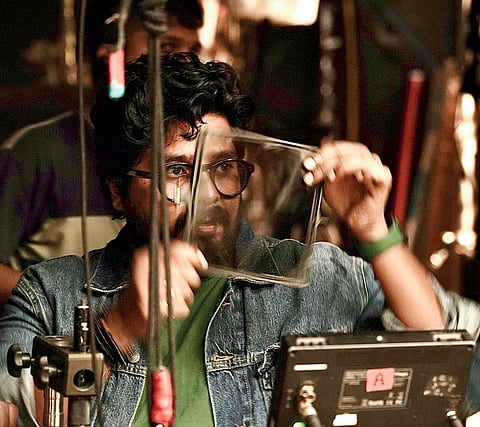
In that sense, I always see myself as a director’s DoP (director of photography). The imagery of the director is what I want to follow, and my work should always be in service of the script.
But this concept of a core colour has always guided me in the filmmaking process. In Nazriya (Nazim)-starrer Sookshmadarshini (2024), we wanted the base to be the colour red mainly due to the mysterious tone of the thriller. And in Thalavara (2025), a police story, we wanted the film to be consistent with several tones of green. Sookshmadarshini and Sarvam Maya are both films that are predominantly set in one location: Nazriya’s residential colony in the first and Nivin’s [Pauly] ancestral mana (home) in the second. We needed to keep working with camera angles too, apart from colours and tones, to make sure the viewer did not get tired of seeing the interiors over and over again, even though much of the story takes place there.
Jump Cuts
In Sookshmadarshini, for instance, the shot that I enjoyed planning the most was the sequence in which Nazriya’s character must jump over the wall from one house to another before Basil’s (Joseph) character got there. There was a lot of movement and geography to keep in mind because time was ticking. And in Sarvam Maya, my favourite portion is the flashback when Delulu (Riya Shibu) recalls what happened to her when she was alive. It’s the only portion that’s shot in a hilly terrain and the look of that portion is totally different from the rest of the film.
But if you ask me, there’s only so much one can prepare with the intention of specifically preparing for one film. Like most DoPs, I too try to keep watching a lot of movies and classics. We all try to keep learning about what is the latest in times of technology too, because our jobs are technical at the end of the day. Conversations with the director and reading the script will always help. But for me, the inspiration, and the fuel to keep working and reinventing has always come from outside of cinema.
It would only be fair for me to credit all my work to the deep connection I have with nature. I travel whenever I get the time and this is when all the real learning and real observations keep taking place. Nature is where I think I’d like to find my own voice.
As told to Vishal Menon.