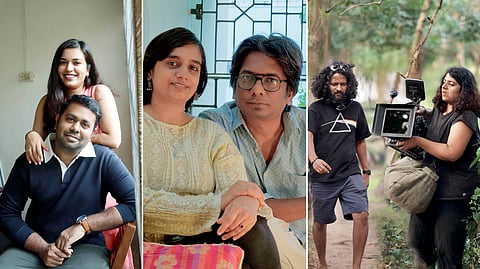


Co-writers who are married to each other but only write horror films together. A DOP couple that has shot over 100 documentaries and two feature films as a duo. A third husband-wife tag team who work on animated films, working out of the same home studio. We analyse the complex dynamics of balancing the personal with the professional as we talk to couples from three different disciplines about their love for each other and for cinema.
Co-writers — and the couple behind psychological thrillers — share the yin and yang of their complex working habits
“Pristine white washbasin,” is how screenwriter Kaavya Ramkumar described a prop she needed for a scene in her draft of Taapsee Pannu’s Game Over (2019). As the crew of the film set about shooting that scene, the wash basin on the location was anything “but pristine white.” It was a realisation for Kaavya as she was working on her first film. As a short-story writer, her words were limited only by her imagination. And here she was in the daily grind of a film set, where she’s brought down to the harsher realities of a million limitations. “I’ve begun to think twice before I add adjectives,” she jokes. “It’s easier to write words like ‘dilapidated’, ‘pristine’ or ‘wrecked’ rather than to find a place with those qualities.”
It’s become a part of the very nature in which she writes with director Ashwin Saravanan who also happens to be her husband. “It’s her writing that got me to reach out to her,” says Ashwin. “Even before I met her, I found her stories to be intense, dark, weird with psychological undertones. That’s the kind of stories I’m attracted too, so I reached out to her when I wanted to write Game Over.”
Kaavya was a practising doctor in Puducherry when Ashwin reached out. She had never thought of writing for movies, and admits that she hadn’t seen Ashwin’s first feature, the Nayanthara-starrer Maya (2015), when he messaged. “Everyone in my hospital had raved about the film but I hadn’t seen it. And when I finally watched it with Ashwin, he was only looking at my reactions. Personally, I too was at that phase in my career when I was unsure about pursuing medicine, so I took two years off to see if I had it in me to write for movies.”
The duo soon began to date, but only after they had set a professional workflow for the film they were writing together. “Ashwin would write late at night, and I would write early in the morning. As I was still in Puducherry, our conversations were structured, and our output was solid too. It might have taken time for me to learn the craft of screenwriting, but Ashwin was a good coach.”
She began by reading several movie scripts including the ones Ashwin had completed. Ashwin, on the other hand, kept pushing Kaavya through this process because he was sure of her potential as a very intuitive writer.
Meanwhile, according to Ashwin, there’s a structure that Kaavya brings that allows for the film to have a clear form and a set of paths that it will take. Without her, “I find myself getting stuck for as long as six months on one point. It’s extremely frustrating.”
This is one of many advantages of co-writing with a person you’re also married to. As Ashwin says, “When your partner works in another field, they can offer their objective perspective. Also, when you’re burning, they don’t really feel the heat. But at the same time, they might underestimate how frustrating the writing process can be if they’ve never written anything.”
He also explains the two sides to working with a spouse. “Writing, especially, can really get in the way of your personal life. There are no days off either because work always comes in the way. But we’ve learnt to give ourselves the space, and we find ourselves understanding each other entirely even without using a word.”
But the average day of a writerly couple, they both feel, is one of intense, “self-doubt, pessimism and cynicism.” Yet in those rare instances, perhaps as rare as once a month, as a couple, they achieve what Ashwin terms a “state of flow”. “The ideas just come together, and we don’t even have to talk to each other... Our output is not so much because of us as much as it is through us. Like how Brad Pitt says in F1, I feel like I’m flying.”
Together they’ve written seven complete scripts. Ashwin is currently writing a film independently, without Kaavya, “because this one’s very personal... I feel I should go at it alone without knowing the next line or the next scene. It’s been very very difficult.”
As for Kaavya, she does occasionally miss the intensity with which Ashwin can devote his entire life to writing and movies. “Ashwin can get obsessive and even a tad neurotic at times. But I want to approach it with a bit of objectivity because cinema is not my entire world. Plus, as a woman, even though I hate saying it, we have a bunch of other things to manage along with passion or work. It’s probably just the way we’re wired.”
The impracticalities of a not-so-normal workaholic filmmaker couple
“Let me explain our respective tastes by using the example of [Satyajit] Ray’s films,” says writer and animation artiste Jagannath Radhakrishnan (Jagan) about how different he is from his wife Aithihya. “Her favourite Ray film is Pather Panchali (1955) because it tells the story of the people through the landscape. Their village comes alive... But my favourite is probably Mahanagar (1963). For me, the characters and their inner selves are what makes a story,” says Jagan.
They’ve been working together, running the same animation studio for over 10 years, and agree that their aesthetic eye isn’t limited to their work alone. At one point, Aithihya recalls how they dragged home a heavy piece of art through a one-hour bike ride because they both had to have it at once. “It’s not something you’ll see in other normal couples,” adds Jagan, underlining the fact that they do not look at themselves as normal. “As an animator, I’ve always had to field questions about how and why our work takes so much time. But when I met Aithihya, she just knew how it works and the patience it requires to follow through.”
Besides calling themselves “abnormal”, Aithihya adds another adjective that has helped them survive. “We are also both workaholics; we work 16 to 18 hours daily. If our partner had not understood the nature of animation and how time-consuming it is, it might have been impossible to manage personal and professional life.”
They first met while working at an animation studio in Bengaluru. Jagan was then her senior and Aithihya had just quit a high-paying job in advertising to pick the “far more impractical” passion for animation. “I had to learn animation from scratch when I joined that company. I did not even have a work desk. But Jagan nudged me towards what I wanted to pursue so gently that he enabled that ambition... He saw something in me when no one else did.”
As for Jagan, it was her drive that got her to understand her a lot better. “I don’t think I could spend much time with someone who isn’t driven. Even if Aithihya was new to animation, I was sure of her ability to go into it deeper, almost obsessively. Forget being a workaholic, but I don’t think I can work with someone who looks at stuff like a nine-to-five job.”
Currently, at their studio, Aithihya focuses on 2D animation alone while Jagan works on 3D animation models. They also both teach storyboarding at institutions like NIFT and Mindscreen. “Even when we teach, it’s not in the traditional format. There are aspects that I’m good at and there are aspects that Aithihya is better at. It’s like completing each other’s skillsets to keep the class engaged.”
The conflict, in Aithihya’s words, arises when they’re not able to see the other person’s vision for the completed project. “During COVID-19, I was working on an animated short film, but I couldn’t explain what I was seeing to Jagan. He saw me toil for hours on end, asking why I was putting myself through this. But when I completed it, he was as thrilled as I was.”
Similarly, Aithihya talks about the earlier phases when she would be confused about Jagan’s opinions. “At times, I’ve not taken his suggestions... but there have been occasions when I regretted it, two or three years after he’d first pointed it out.”
These, among other things, are what keep their marriage surprisingly cordial. Not only do they live together but their studio too is a part of their home. “Often, it’s our work that creates tension in our personal lives. Neither of us are easy to please when it comes to work and we’re both very demanding,” says Jagan. “It’s an impractical way of life but that’s the only way we know how to work. Like I said, we don’t look at ourselves as a normal couple.”
Trying to learn each other’s language but finding a common language in cinema
It was during a recce to a remote village two years ago that Premkrishna Akkattu and Sraiyanti Harichandran learnt something invaluable about themselves. There was no four-wheeler access to the place, and their guide had to take turns on his bike to show them options for their upcoming shoot. Prem went first, taking photographs of locations he liked, with Sraiyanti joining the guide on his next trip there. And when they compared notes right after, the frames they’d individually finalised were shockingly similar.
“It was scary,” laughs Sraiyanti. “We might be married, and we work together as cinematographers, but we aren’t two bodies and one mind.” It got them to reconsider their creative partnership or a point of “saturation”, as they termed it. They’ve been working together across creative endeavours since they met a decade ago at an advertising startup in Bengaluru; their taste in art, books and cinema, “somehow merged into one,” Sraiyanti feels. They’ve shot 100 documentaries together and two feature films, Gargi (2022) and Detective Ujjwalan (2025), resulting in this singularity.
Even when they first met, it was their common love for indie cinema and documentaries that brought them closer.
“But I miss those times when there was healthy competition between the both of us,” recalls Prem. “We’d arrive at two separate frames or ideas for a shot, and we’d agree to use the one we both felt was better. Two thoughts went into each frame and we both grew creatively by the time we finalised one.”
In the beginning, Sraiyanti focused on camerawork alone with Prem taking care of the art direction. Somewhere along the way, they both became cinematographers in their favourite domain of documentary filmmaking. As for finding a common language, Prem insists that he had first tried to learn Tamil to speak to Sraiyanti. “But in due course, it was easier for me to end up learning Malayalam,” Sraiyanti says in unaccented Malayalam.
Professionally, cinema was language enough, though. “When we started out, I would focus more on shooting wides… to find a story within the frame. As for Prem, he really trips out on close-ups and extreme close-ups,” Sraiyanti adds, pointing out how they can both instantly recognise each other’s framing, even when they rummage through hours of footage.
But as one of cinema’s rare male-female cinematographer duos, they both wrestle with the politics of their profession and the biases that creep into their frames. “At least when we started out, the male gaze was very evident in the way Prem framed his shots. Even today, when I work with male directors, the male gaze dominates the way they conceptualise scenes. It’s not that all shots demand a female gaze, but with so much saturation, it’s important to discover alternate ways of seeing,” Sraiyanti explains.
And it’s not just about the male gaze, adds Prem. In most sets they work on, he recalls how Sraiyanti is often the only woman there. “There’s already a lot of pressure on us, especially when we’re shooting a feature film. In such cases, even if we both come up with ideas for a shot, we don’t have the luxury or time to argue about it. If it’s up to me, I usually always go with Sraiyanti’s option. The movie set is already patriarchal and it’s the last place where a man should undermine the choices of a woman,” he says.
This is primarily the reason why neither Prem nor Sraiyanti introduce themselves professionally as husband and wife. “On sets, the terms ‘husband’ and ‘wife’ already come within a hierarchy. We only refer to each other as husband and wife when we’re struggling to find a house to rent,” Prem says.
When it comes to deciding which projects to take up and which ones to leave out, the decisions haven’t always been easy. “We’ve worked on projects we’ve both loved and we’ve worked on projects that excited only one of us. But the easiest decisions have been projects we both didn’t want to do,” pauses Prem, “it was clear that we were doing it just for money.”
As for their life outside of cinema, Sraiyanti feels that it’s politics that often bind their thoughts and aspirations, admitting that her passion somehow revolves around documentaries and cinema. “Prem has been on his journey — working on shooting on and then preserving 16MM film. He is also a painter, and we both love to explore art.”
As Prem goes on to explain their common interests, he takes another pause to explain how there cannot be a separation between the personal and professional. “More than feature-film cinematographers, we still see ourselves as documentary filmmakers. That’s the process of taking a camera along and shooting the truth, without knowing where to begin. What we see and what we reflect in our art form comes from deep within us. Our profession is most personal to us.”
Pushkar-Gayathri
This director-writer duo has so far made four films together, including the Hrithik Roshan-starrer Vikram Vedha. They are also showrunners of two hit Tamil crime series, Suzhal and Vadhandhi: The Fable of Velonie. Some of their Tamil films, such as Va: Quarter Cutting and Oram Po enjoy a cult following for thier unique mix of genres and dark humour.
Vijay Kartik Kannan and Yamini Yagnamurthy
While their choice of films as cinematographers couldn’t be more different, their styles are just as distinct. Vijay’s films redefine the look of superstar films like Jailer and Daaku Maharaj; Yamini, on the other hand, is appreciated for her rustic, raw visuals in films like Saani Kaayidham.
Suhasini and Mani Ratnam
Not only are they both National Award-winning artistes in their own right, but they also share screenwriting credits for four films. Suhasini has written dialogues for three of Mani Ratnam’s films (Thiruda Thiruda, Iruvar and Raavanan). Ratnam reciprocated by working on the screenplay for Suhasini’s Indira, which was written and directed by her.
Geethu Mohandas and Rajeev Ravi
Theirs is a unique working dynamic, in which Rajeev Ravi has shot all of Geethu Mohandas’ features, including the currently-in-production Toxic: A Fairy Tale for Adults. But when he directed his second film, Njan Steve Lopez, the screenplay for the Malayalam drama was written by Geethu Mohandas. Rajeev also co-produced Geethu’s Moothoon, making their working relationship truly multi-disciplinary.
To read more exclusive stories from The Hollywood Reporter India's August 2025 print issue, pick up a copy of the magazine from your nearest book store or newspaper stand.
To buy the digital issue of the magazine, please click here.