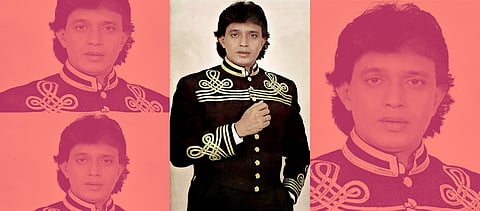

Mithun Chakraborty has seen it all in the world of cinema, and yet, he leaves nothing to chance even today. The “Disco King” has broken records for the maximum number of films released in a single year; he has been Bollywood's highest taxpayer, but has also considered giving up the profession after delivering only flops in a row.
However, across five decades in the business, the 74-year-old has stayed relevant, getting back into the game every chance he could. Now, as the latest recipient of the prestigious Dadasaheb Phalke Award for Lifetime Contribution to Indian Cinema, Mithun Chakraborty speaks to The Hollywood Reporter India, and looks back at his journey so far.
The conversation has been edited for clarity.
You are inching close to 400 films, and your latest has just hit the screen. Are you thinking of stopping any time soon?
(Laughs) I believe in destiny and time. We never know what destiny has in store for us. I cannot ever say that I am stopping. When destiny wants me to, I will stop. And as long as I can, I shall go on.
What was the experience of knowing that you “made it”?
I used to frequent Mahalakshmi Mandir and Haji Ali (both in Mumbai), seeking answers to many questions. I remember there used to be a big film poster above the petrol pump, and there were a number of days when I stood there just wondering whether I would ever see my face on it. And suddenly, I saw that the poster of a film I had done back in 1978 called Hamara Sansar had found its place there. Something struck; it was more intense than a dream come true moment.
You started on a high note with your National Award-winning performance in Mrinal Sen's Mrigayaa (1976). What kind of impact does Sen’s vision continue to have on you?
The impact that Mrinal Da had on me is inexplicable. When we talk about him, we talk about an institution — one that still has a profound impact on everything that I do. I still remember a few episodes when I had just started out under his watch. During Mrigayaa, he used to take me and drop me off at the village (in Jharkhand, where the film was shot) and repeat it every morning. He would rejoin in the evening, and ask me to eat, talk and work at the mill, and spend time with the people there. The effect was so deep, I could feel the character breathe and become more real with every passing day. I still use this exact cultivated ability to observe the body language of people to breathe life into a character.
You have been consistently associated with a distinct look and style. What does that mean to you?
I have never looked like the stereotypical hero; I am on the opposite end of the spectrum. When I walked into the industry, I was humiliated for my complexion. I became a hero, a star, by breaking all the notions and abstract rules that were in place so that the boy next door could look at me and think of making it big someday. Irrfan (Khan) had spoken about how he could see himself and his looks in me. So did some others with a similar complexion, and they dared to question: If Mithun can, why can't I? Eventually, these biases and the flimsy definitions of sophistication were broken in the industry. I always tell every fan of mine the same thing: If I can, so can you.
What do you feel about Mithun Chakraborty's place as the working man's hero, as the Everyman?
The workers behind the screen all day have always trusted me to influence positive changes in the industry, confiding in me the problems that they face. Initially, I was hesitant to be the face, but they kept coming to me, expressing their problems and addressing the general lack of respect. I became the Chairman of the Film Studios Setting and Allied Mazdoor Union. It started with only ₹7,000 in the account, and we helped it grow to ₹30 crores in 30 years. It has grown into one of the biggest unions in Asia, where the workers have been helped with financial assistance, insurance and pension schemes. I also headed the Cine & TV Artistes Association, raising funds and working towards the cause. It also grew into something very big, addressing issues and tackling them head-on.
What made you gravitate towards these responsibilities?
The pain. I have experienced the kind of pain, grief and humiliation that I never wanted another person to experience. The urge to help out even a single person in need pushed me to take on these responsibilities.
Comebacks have defined your career. What pushes you to pick yourself up every time you fall?
I never take defeat for an answer — or an ultimatum. I just push myself never to lose hope and keep fighting with sincerity. I always knew that sincerity would pay off, and it did. Being hopeful has always helped me in this journey to super-stardom.
How much of North Calcutta's Gouranga Chakraborty is still in you?
Gouranga Chakraborty will always find a place inside Mithun. Whenever I go back to my lane and my old friends, the adda at night keeps me going and helps me lighten up. Beneath the sparkly star is Gouranga, who just wants to do good and make his hometown and state proud. I can still see myself playing football with my mates on the crooked bylanes of North Calcutta whenever I close my eyes. All of that is Gouranga.
What is that one film that will define Mithun Chakraborty forever?
Disco Dancer (1982) — because of how it challenged me and how I dared to take it on. No other actor dared to try their hand at disco moves in India, so I was laughed at and jeered at. But I knew I wanted to do it and told Babbar Subhash (director) the same. And, I think daring to take that step ahead is what immortalises something, (and so) it became eternal. In every disco in India, there will always be Mithun. In every disco step, there will be Mithun.
