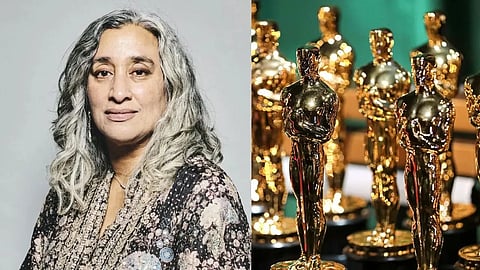


Filmmaker Geeta Gandbhir’s work insists on stillness and attention. With two Oscar-nominated films released almost back to back, The Perfect Neighbor (Best Documentary Feature) and The Devil Is Busy (Best Documentary Short Film), Gandbhir finds herself at an intersection of scale and intimacy.
One reconstructs a killing almost entirely through police body-camera footage, unfolding with the chilling inevitability of a thriller while refusing the comfort of narration. The other compresses the moral weight of America’s abortion debate into a single working day inside a women’s reproductive healthcare clinic in Georgia, where care, risk and routine coexist as a form of defiance.
In an exclusive conversation with The Hollywood Reporter India ahead of the 98th Academy Awards that will be held on March 15, the filmmaker of Indian origin reflects on what it means for this work to break through at this moment.
For her, the recognition is a culmination of years of work. Since Lowndes County and Black Power, which traced the roots of Black political organising in the American South, Gandbhir has consistently examined how systems of power shape lives, and how people live inside, around and against them.
Edited excerpts from a conversation:
Q: This is a rare year for you—two nominations, two different lengths and textures. When you step back from the logistics of the awards season, what does this moment feel like?
I think it feels like the culmination of many years of work, honestly. I think that I have always been working in this space, be it in scripted or documentary, in a space that sort of functions as a platform to talk about issues—social justice issues for the most part. So to me, it feels like this is work I’ve always been doing, but it has broken through in a way at this moment that feels really significant.
Q: Usually, a lot of attention suddenly comes your way when something like an Oscar nomination happens. Has that attention changed the way you’re thinking about these films, or are you trying not to let that noise affect how you engage with them?
It’s interesting. I think for a lot of us who work in this field, particularly in documentary or in making films that have an underlying message, the opportunity that the Oscars afford us is one to really elevate the issues. So for us, that’s huge.
It’s incredible when attention is brought to the film, but also to the film’s focus on specific societal problems. It’s amazing to have that spotlight.
Q: Let’s talk about The Perfect Neighbor, which is built almost entirely on police body-cam footage. There’s no guiding voice telling us what to think, which is something we see far too often in documentaries. When did you realise the film didn’t need you to speak through it?
I think almost immediately. This is not a film that we set out to make. And when I say “we,” I’m referring to my company, Message Pictures, and my producing partners, Nikon Kwantu and Alisa Payne.
The film came to us because Ajike was a family friend. It wasn’t until two months after she was murdered that we received the body-cam footage from the family lawyers. We were supporting the family as media advocates, trying to keep the story in the news, because oftentimes, without pressure from the media, cases like Ajike’s either languish or justice is not served.
When I received the footage and strung it out—I used to be an editor—I put it together chronologically and synchronised it for my own purposes and for the legal team, just so they could make sense of it, because there was so much of it. It was then that I realised there could be a film, and that the material organically told the story. The footage almost played like a scripted film, and a narrator or overarching voice wasn’t necessary.
Q: When Academy voters encounter this film, what do you hope they sit with?
I hope they can see, literally and chronologically, what happened in this tragedy. The feeling of the film is one of discomfort. Obviously, it’s meant to play like a horror film or a thriller, and that was intentional—we wanted to draw people in and hold them.
But I really hope they see the intersection of weaponised racism and access to guns, and the impact of predatory laws. Stand Your Ground (a law in the US that allows individuals to use reasonable force, including deadly force, in self-defense) factors heavily in this case, and it exists in about 38 states in the U.S. in some shape or form. It’s something we really want to push back against.
We trust the audience with this film. We believe they can go on this journey without being overly handheld or directed, and walk away with the information they need to think about what needs to change.
Q: I want to switch gears to The Devil Is Busy. Many documentary filmmakers, especially when working on shorts, struggle with what to keep and what to remove. When a film carries enormous emotional weight, how do you decide what not to include?
We always knew this would be a short, so we shot it as a short. We didn’t overshoot, and that was purposeful. We wanted the film to represent a day in the life of a women’s reproductive healthcare clinic.
One of the big creative choices was perspective. We originally thought about including patients’ perspectives, but ultimately decided to focus on the staff of the clinic and make it a day in their life. That choice allowed us to keep the film tight and succinct.
Q: There’s a sense of repetition in the film that captures the grind of daily life. How important was it for you to show that relentlessness?
It was very important. We wanted to show how these women—mostly Black women in a female-run clinic—are on the front lines. Their daily lives involve making life-and-death decisions for their clients.
Every decision they make impacts them personally. They could be arrested or jailed for one misstep. In Georgia, there’s a six-week ban, meaning abortion is illegal after six weeks. That’s incredibly challenging—they’re constantly calculating timelines, questioning clients, and sometimes turning people away.
There’s heartbreak, and there’s danger. Protesters are outside every day. They are under siege. This is something people don’t understand, and it was important to show what they’re up against.
Q: You’ve spoken about your background in editing. How do those skills show up when you’re working with emotionally volatile material?
Sam Pollard is my mentor—the great Sam Pollard. I came up under him, and also Spike Lee. Sam was an editor, and I tried to fashion my career after him, until I realised he doesn’t sleep. I couldn’t quite match that.
Editing is critical to storytelling. It’s the last frontier, the accumulation of everything. For me, leading with emotion is key. Coming from a scripted background, stories have to be character-driven and emotionally grounded. Otherwise, the audience isn’t captivated. Editing also shapes pacing and engagement. One of the hardest things is losing scenes you love. You always have to ask: does it serve the film?
Q: Are you able to detach from that love for a scene when necessary?
I think having editor training has helped. I’ll try to fit something I love in every possible way, but if it doesn’t work, it doesn’t work. That’s why the editor is so important. I don’t edit my own work; I think the editor is too important for that.
Q: Do you still think of yourself as an editor first?
Not anymore. I haven’t edited in about 15 years. So I don’t like to claim it. I think of myself as a director now, though my brain hasn’t changed—I still have an editor’s brain.
Q: Awards aside, what kind of access or leverage do you hope this year gives you going forward?
I hope it shows people—especially distributors—that these stories are commercial, that audiences will watch them. Our biggest challenge right now in the U.S. is distribution.
The Perfect Neighbor had a wide reach on Netflix, and we’re incredibly grateful. The accolades and the numbers show that people care. Streaming has democratised access, and documentary filmmakers have really found audiences through it. I hope that continues.
Q: As an Indian American filmmaker documenting policing and abortion in America, where do you place yourself?
I was born here, and I live here. This is my world. These issues are mine. My children face them. My community faces them. The idea that these are “someone else’s problems” is how power divides us. If policing fails one community, it fails all of us. If some people don’t have access to healthcare, none of us are okay. That’s the mindset we need for change.
Q: After working with such heavy material, do you feel the need to turn to something lighter?
The urgency is always there, but yes—I would love to make something lighter. My stories are often very hard-hitting, so I’d welcome making something funnier, where the issues still exist but aren’t so devastating.
Q: Finally, when this awards season ends and the attention moves on, what do you hope stays?
I hope what stays is hope—for filmmakers coming up, for independent films—that these stories can be seen, and that there are multiple ways for them to be seen. Even if we have to do it ourselves, it’s possible.
The ecosystem will go through ups and downs, but we have to fight for our autonomy and for these stories to be told.