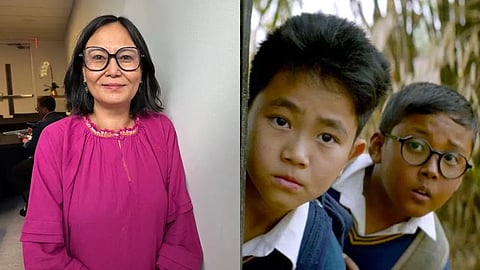


Boong travelled through festival circuits without the usual scaffolding that props up a “debut” in Indian cinema. No high-concept hook. No insistence on being read as a statement. It was simply a small film, told through a child’s eyes, set in Manipur—a place Indian cinema largely remembers only when it is already in crisis.
That Boong, a Manipuri-language children’s film by a first-time filmmaker, has now been nominated for Best Children’s and Family Film at the 2026 BAFTA Awards is not just a personal milestone for writer-director Lakshmipriya Devi. It is an anomaly. Indian films from the Northeast rarely enter global award conversations at all, unless filtered through reportage, conflict, or anthropology. Fiction, especially fiction that refuses to perform its pain, is almost never invited to the table.
Over the last couple of years, Boong found its place in international children’s and youth festivals, finding audiences far removed from its geography but instinctively receptive to its emotional logic.
In this exclusive conversation with The Hollywood Reporter India, Devi reflects on what it means for a debut film from Manipur to be seen on this scale, the deeply personal origins of Boong, and why choosing restraint and a child’s perspective was never a soft option.
Edited excerpts:
Congratulations on Boong being nominated for the BAFTAs. What does that recognition mean for a Manipuri-language children’s film?
When we got selected in Toronto, we never thought it got selected because it was a children’s film. It started getting into a lot of children’s film festivals because it was an Indian movie, irrespective of whatever language it came from.
But what really helped the film was that it got a platform that it would have never otherwise got. It’s set in a very alien place—people don’t know anything about Manipur except a very mainstream idea of what India looks like. This was completely different. The BAFTA submission itself was a shot in the dark. Everything with Boong has been a shot in the dark—zero expectations. So if something comes out of it, it’s like a bonus.
Do you see institutions like the BAFTAs as gateways or gatekeepers for stories from the margins?
I think they can be gateways, in the sense that people will at least start paying a little attention—starting from our own country. Boong is not just an independent film; it’s a regional-language film from a region that isn’t exposed at all.
People don’t even give stories from the Northeast a chance to be made or shown in mainstream spaces like cinema theatres. So yes, even that small attention helps.
At what point did you realise this wasn’t really a film about finding a father, but about losing illusions?
It was always about finding closure for me. It was extremely personal. I wrote this film to find closure for myself.
I had a very clear beginning, middle and end. Many of the characters and their arcs come from my childhood and what I went through. So it didn’t shift; it was always headed there.
How did you draw the line between personal memory and overindulgence while writing it?
The first time I wrote the story, it was very over-emotional—like pouring everything into a diary. But when I started writing the script, I realised it couldn’t be like that. It’s not a melodrama.
I stopped taking myself too seriously and started remembering how it felt to be a child. I remembered how much fun I had with my friends. That shaped it differently. It had to feel like the stories my grandmother used to tell me.
The film resists overt political commentary despite being set in a deeply politicised space. Was that restraint a conscious choice?
When I started, I thought this would be my first and probably last film. So my early drafts had everything—curfews, violence, strong political undertones. I wanted to say everything.
But then I realised this is a children’s film. It was losing its innocence. My childhood had politics everywhere, yes—but we were also flying kites and having fun. So I filtered it. I threw out the spam and kept what felt true. It had to be a Boong story, not my entire life dumped into a film.
The film keeps being categorised as a “children’s film,” often treated as lesser cinema. Do you think the industry misunderstands what children’s cinema can achieve?
When people first called it a children’s film, I said no—it’s for everyone. The protagonists happen to be children.
There’s such a lack of films for children in India. But you can say so much through children’s cinema. It’s like using puppets or animation—you can reach people without offending them.
What made me happiest was seeing children understand the film. In Sweden, it played in a 7-plus category, and they took so much away from it. That’s exactly what I wanted—like my grandmother’s stories, which stay with you even as an adult.
Looking back, was there ever a strategy for where Boong would land?
No strategy at all. We just made a film. The language happened to be Manipuri. We weren’t making a ₹100-crore film where every move is planned. Everything has been a series of happy accidents. We made it and then waited to see who would give us a platform.
What do you hope this BAFTA nomination opens up?
I hope it opens doors—not just for Boong, but for so many regional films that have never seen the light. If we can watch Korean films with subtitles and celebrate them, why not our own regional cinema? I hope this nomination becomes a small hole—and then a window.