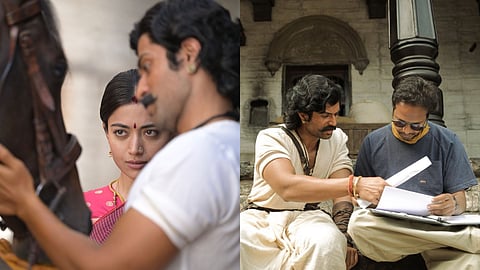


In the Madras Famine of the late 1800s, which Vijay Deverakonda and Rashmika Mandanna's Ranabaali documents, millions of Indians died at the hands of the British. Suffering might have been in our fate back in those years, but for his period action film, filmmaker Rahul Sankrityan wanted to reimagine the ill-fortune of this tiny piece of history. "I wanted us to win in the film," Sankrityan tells The Hollywood Reporter India in an exclusive interview.
Through the lens of folklore — and relentless violence — the film tells the story of a prophesied titular warrior (Deverakonda), who fights for the rights of people in Rayalaseema. In an interview, Sankrityan talks about why violence was necessary in this world, criticisms, writing a soft romance amid brutality, and his take on the box office.
It's been a few days since the release. How are you processing the reactions?
So, post-release, it's actually very exciting to see how people are reacting to the film. What I understood is that people are taking time to actually understand and digest, you know, the harshness of the film and the subject. I am now getting so many messages where people who are watching for the second time are understanding the film very differently. It's working very differently on them.
Can you take us through the idea behind the alternate history? There's a collision of folklore and real history in Ranabaali.
The film is nothing but my fantasy of real history. During the Madras famine, imagine that 8 to 10 million people died because all their food was shipped out of the port. From this land. So, I went, 'What if that ship didn't sail?' What if somebody stopped that ship and took those food bags back and gave them to these people? And what if all those people didn't die?
It's almost like how Inglourious Basterds (2009) explored a gang that wanted to assassinate Hitler, right? Something like that. We lost in history. But I wanted our people to win in the film.
The film also deals with a very soft romance in the middle of all the bloodshed. Tell us about writing Rashmika's Jayamma, who appears to have won a lot of hearts.
With the nature of the history the film deals with and the violence of it all, I definitely needed a balance. I wanted a nice, beautiful, feminine angle to the whole masculinity of Ranabaali.
If you see any hero's journey, any legend's journey, it deals with a lot of pain and loss. So, romance originates from the pain. Jayamma was written from the inner layers of my heart because I named the character itself after my mother. She was also from the Rayalaseema region, and she was my inspiration for the character.
I've grown up seeing very strong women in my life. Even in villages, women were decision-makers; not much happens without their consent. And they have a very strong say even when a man is doing wrong in the house. Being a homemaker doesn't mean you have to be submissive or follow the lead of the man. Homemakers were the actual decision makers.
Directing these two is just like one of my favourite memories of the whole film. It's a blessing for me to get Vijay and Rashmika as Ranabaali and Jayamma.
How do you approach criticism? Some viewers have pointed out that the film’s violence overpowers some of its other elements. When you come across such responses, how do you engage with them, and how much do they influence the way you look at your own work?
All reviews and comments are time-based, and a lot of it could depend on the previous film's impact. But I believe a film is forever.
So we have to be honest to the writing, to the world we are building. Be it the amount of violence or emotion, it has to be right for the script, and not for the state of mind of the people at the time. This is what I believe, and I write like that.
I felt whatever violence we have depicted was needed for the script. Every form of violence had emotion-backed sequences in the film.
Would you say you were mindful of writing these heavy action scenes even in the initial process?
Yes, we have. The real history is far more violent. We couldn't even show half of what I've read about.
The interval block, where the kids were subjected to atrocities, was based on a real incident I've read in one of the books. The kids were treated like that by one of the camp supervisors. The world needed that violence. But I was very conscious of how much to show and how much not to show.
Vijay Deverakonda has spoken about the amount of manufactured hate that actors are subjected to today, particularly on social media. As a filmmaker, how do you navigate a space where everything is constantly dissected?
It is very unfortunate to see, because the standard of watching a film is dying because of social media and how easily everyone’s opinion can be spread. That is diluting the purity and honesty of watching cinema for the sake of cinema.
I sincerely request that audiences look at the posters, teasers, trailers, songs, the cast and crew, and the honesty of the filmmakers, and then decide whether they want to watch a film. If you do decide to watch it, kindly just walk into the theatre and experience it for yourself. That first-hand experience is very important. The moment someone else's opinion enters the picture, it has already affected your firsthand experience of that art form.
Can you speak about the box office optics of a film and how important it is for you as a filmmaker? Even before the film's release, people were drawing comparisons to Jailer 2.
Box office is an important parameter for the industry and ecosystems to survive. So, that is a necessary thing that we need to achieve. But in the whole gamut of things, it's a very long process.
Cinema lives for a very long time, and so, while the budgets and box office are definitely important, they are a very small aspect of the lifetime of a cinema. That shouldn't completely dictate the entire journey and the lifetime of a cinema.
Can you talk about writing Vijay Deverakonda's character? There isn't room for subtlety in the way he speaks or emotes, and his body language is uniquely over the top. Was that intentional?
The overall tonality of the film is borrowed from the way folktales are narrated. If you listen to the old tradition of Burrakatha (an ancient form of oral storytelling), it's very high-pitched. The way they exaggerate their heroes, the way they add the elevations to the heroes, adds to that level of enthusiasm.
I wanted to present it like that. And there was a lot of myth and, you know, fiction to their heroes in their stories.
Their heroes can even fly in the air. They behave a certain way; speak a certain way; their actions are over the top. So, that was my pitch.
Can you also speak to us about what film you'd like to do next? Will we see you make a romance or a comedy?
I have multiple ideas now. Currently, there is one period grand film in the offing. And I'm also doing a very beautiful love story with a social fantasy element to it.