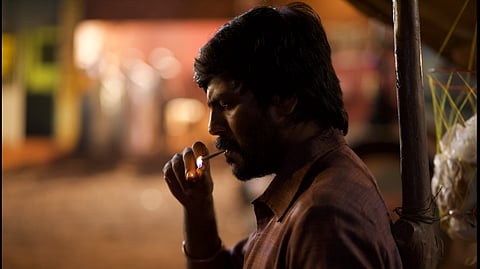


Rishikanth can’t find a second to catch his breath.
He’s been everywhere lately, not just on theatrical and streaming screens with his two recent successes — Dorothy and Modha Rathiri — but also on a whirlwind press tour across cities and states for both titles, which included a premiere at the Toronto International Film Festival (TIFF).
Tamil audiences can’t get enough of him. Some are terming him Rajinikanth for the Gen-Z (and to be fair, the actor does admirably channel the Superstar’s mannerisms in several moments in Dorothy; the smoking, the hair flips, and of course, the swagger), others are charmed by his languid, unassuming personality during his public appearances, almost as if he still can’t believe the hype around him.
“That’s absolutely right, it all still feels surreal. I haven’t even had a moment to process anything,” he muses, while hurrying to yet another press conference, this time to promote the film's Telugu release.
The Karthik Subbaraj film, starring Rishikanth, Sananth and Keerthy Suresh, has emerged as a flashpoint for Tamil cinema this year, drawing praise for its daring themes and garnering considerable support from the LGBTQIA+ community across India.
Meanwhile, Modha Rathiri, directed by Raja Karuppasamy, has found an unexpected second life on streaming after a lukewarm theatrical reception; the hilarious family-comedy follows a bride who wants out of her “first night” (modha rathiri) to reunite with her lover, much to the chagrin of her frustrated groom (played by Rishikanth) who reluctantly agreed to the marriage in the first place.
Both performances have catapulted Rishikanth into the limelight, as Kollywood doesn’t witness this kind of overnight stardom often. But to attribute his success to luck would be to overlook the 15 years he spent working towards it. Back in 2010, he was one among hundreds who arrived in Chennai every day from smaller towns, hoping to make it in the movies someday.
In a conversation with The Hollywood Reporter India, Rishikanth reflects on the lessons he took away from Dorothy, how he prepared with co-star Sananth to execute certain scenes, and his long road to leading-man status.
Excerpts from a conversation:
You’ve had quite a journey from making comedy sketches on YouTube to acting in films and now playing lead roles.
Yes, I’m from Thanjavur, and my family and friends I grew up with are all still there. I came to Chennai about 15 years ago to try to make it in the film industry here, and eventually became part of the YouTube group Temple Monkeys, where we did comedy and satire sketches for years. Eventually, I started acting in films (Sila Nerangalil Sila Manidhargal, Coolie, Sevappi and Indian 2, as well as streaming shows like Mathagam and Local Times, in which he was the lead).
But in 2026, Dorothy and Modha Rathiri released… and then absolutely changed my life.
Dorothy has been lauded across the country for its portrayal of a trans woman’s life and how a person comes to terms with a close friend’s gender identity. How did you approach a subject you weren’t particularly familiar with?
The honest answer is that I wasn’t very aware or knowledgeable about the topic, and I’m still learning about it. I did the project only because of Karthik Subbaraj; I came into it solely as an actor willing to educate himself.
See, we’ve explored various relationships in cinema such as the equation a man has with a woman, with his parents or friends, a conflict between two people, and so on. These are all emotions that resonate with us in our day-to-day life, and I’m familiar with them.
But when it came to the depiction of transgender people, it was completely new to me. We know about them, of course, but what happens when a close friend undergoes this kind of change? That is not an experience which I have had first-hand. So the idea was that audiences will also learn from the film, because not everyone would have experienced something like this personally.
The film has also faced backlash and criticism from some quarters, which Karthik Subbaraj has addressed. One point of contention is that Karthi and Subbu should have remained friends, and that the romantic angle felt forced. How do you respond to that reading of the film?
I don’t understand the hate.
You know, I’m a very normal, ordinary person in life, and I’m also coming to terms with this topic, like many others who have watched the film now. I always thought of a trans woman as belonging to a third gender, as someone who was separate from a man and a woman.
But what I’ve learnt through this film is to understand trans women as women, and not as people who exist separately from everyone else. They are completely women. You see that in the climax, particularly during the ceremony.
In another scene, a little earlier, you see Karthi talking to Vadivu (Ramachandran Durairaj) about Karthi’s time with Subbu on the road. He keeps referring to Subbu as ‘ava’ (her) and speaks about her affectionately. When Vadivu points out that what Karthi is describing sounds like love, Karthi instinctively reverts to calling Subbu ‘avan’ (him). Vadivu draws his attention to the contradiction, forcing Karthi to confront his feelings and recognise that he has has accepted Subbu as Dorothy now.
That stretch of dialogue really captures what the film is trying to say.
We say we respect trans people and their choices, but what happens beyond that? They also want love, and they also want relationships and family lives. We don’t often think about those aspects deeply enough.
Apart from Jeeva Subramanian (the trans actor and activist who also stars in Dorothy), I spoke to so many other transgender people while making this film, and many of them have this emotion that they’re unable to express. Nobody treats them as ‘normal’ or recognises them completely as women. They often say that their life after transitioning is neither here nor there, it’s somewhere in between. What they really want is to be recognised as complete women.
This was my education through the process of making Dorothy.
Dorothy premiered at the Toronto International Film Festival, which is a rare occurrence for a Tamil film. As someone who describes himself as a mainstream, commercial actor, what did that experience mean to you?
You’re right, I’m not at all an award-film or film-festival kind of guy! I’m a proper general audience person. I understand family audiences and what they want. I’ll continue doing a lot of commercial films going forward, but I’ve always wanted to do at least one film in the arthouse space.
When Karthik Subbaraj anna came into the industry, he gave me hope that a normal guy like me could also enter the industry. So, in a way, doing this film felt like I was repaying a loan to him. (smiles)
When TIFF happened, it was entirely a new adventure for me. I never expected to dress up, wear a tux, walk red carpets and present a film to an international audience. It was very hectic, and I didn’t get the time to really explore the place. But what really impressed me was how the festival audience received the film. They enjoyed it almost like a commercial film, which is exactly how we want to take it to people.
For me, that was the biggest thing. It wasn’t about proving that I had acted well in the film; I just wanted people to enjoy it.
There were plenty of challenging, intense scenes for you in Dorothy. But could you talk to me about the climax and that kiss, and how you and Sananth prepared for it?
As an actor, I can’t really take much credit. It’s completely Karthik anna’s writing. My job was just to reflect the passion he had for the story. Every scene was a learning experience.
When it came to the climax, Sananth and I had to figure out how we were going to approach the kiss. He’s one of my closest and oldest friends, so we did spend some time wondering how we would do it.
We kept telling ourselves not to think about it until the moment arrived, and to just let it happen spontaneously. When we shot it, we gritted our teeth and got through it. That was it! We brushed it off and moved on. After that, we even started jokingly calling each other brother and sister on set.
We performed the scene as two professional actors, but once the film came out, we realised the magnitude of what we had done. Two guys kissing on-screen in a Tamil film… we had taken it so lightly while shooting it. Only afterwards did we realise how significant a scene like that could be.
But Karthik anna handled it very sensitively. The fact that Sananth and I didn’t stress about it so much, says everything about his management of us as actors on set.
My character, Karthi, is essentially reflecting the audience, right? He hears the news, processes it, tries to understand it and eventually accepts it. That perspective is what makes the film work.
After 15 years of striving to make it in the industry, does this kind of success feel like validation?
Yes, for sure. About two or three years ago, I started getting opportunities to play some lead roles. But I turned them down at that point, as I wanted to upgrade myself slowly, from small roles to character roles, then supporting roles and eventually a hero
I could have taken on a leading role earlier if I wanted to, but I wasn’t sure whether the audience would accept me in that space. I agreed to play Maruthu in Modha Rathiri only when I felt that the time was right.
These have been a couple of life-changing months for me. For many years, I’ve been alone on this journey. Now suddenly everyone is looking at me, and that makes me want to be more responsible about the choices I make.
Having worked across YouTube, short films, streaming platforms and theatrical cinema, has your approach to these different mediums changed over the years?
I’ve never really differentiated between the mediums. Whether it was short films, YouTube, streaming or films, I approached them all in the same way. But over time, I’ve learnt about the financial side of the industry; the market, the economics of filmmaking and the business behind it. I’ve also understood how an actor’s image and optics work.
So now, theatrical films are what I’m aiming for. It’s what I came here to do!
What can we expect from you next?
I want the success and response to both films to sink in, and then I’ll reassess where I stand. For now, my next project is sorted, and I’ll announce it in December. The plan is to release that during the summer holidays next year; it’s a film for family audiences, in the vein of a Modha Rathiri.