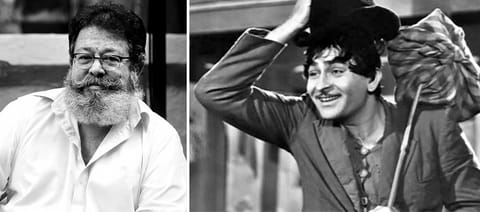


In September 2024, the 4K restoration of Raj Kapoor’s iconic film Awara (1951) was screened at the Toronto International Film Festival (TIFF). It was spearheaded by the National Film Development Corporation (NFDC) and the National Film Archive of India (NFAI).
This restoration was part of the National Film Heritage Mission (NFHM) launched in 2015 — a ₹ 597 crore project funded by the Ministry of Information and Broadcasting, to digitise and preserve film archives. Raj Kapoor’s RK Films had deposited its entire filmography with the NFAI, given their storage facilities and temperature control.
With 2024 being Kapoor’s birth centenary, and anniversaries being an excuse for remembrance, this archive is now being pulled up, with Awara in its restored form the first to appear from it. The press release before the TIFF screening noted that the restoration was “skilfully overseen by Kunal Kapoor”, nephew of Raj Kapoor.
“I saw the film just before it went to TIFF. We weren’t informed (before that).” Kunal Kapoor notes in an interview with The Hollywood Reporter India. By the time he had seen the restored version, it was too late to make suggestions or improvements in time for TIFF; he was certainly not “overseeing” the restoration of the print that was shown at the festival.
Talk of restoring Raj Kapoor’s films in 4K was always in the air. There was a retrospective on Kapoor’s cinema at MOMA in 1985, then in 2012. The latter screenings of the 35-millimeter prints were so coveted, they had to shift the screening from a smaller theatre to one that could fit over 400 people. It immediately sold out.
Since 2012, however, the technology and landscape for restored films have changed. The NFAI had to go back to the drawing table to scan the negatives, this time in 4K. The centenary celebration gave this 4K restoration process a push, and the “Raj Kapoor 100” retrospective between December 13-15th served as an event to work towards.
But film restoration is an involved process — requiring both time and labour, not to mention capital — that includes sourcing the available material, repairing the negatives, and then scanning them in the desired format — 2K, 4K, and now even 8K. The whole process could take over a year.
Most restorations in India, however, are “digital restorations”, that is, they do not repair the original negatives, but merely clean and scan the negative that is available, and then, frame by frame, digitally clean it up. This takes place on a much shorter timeline, and is cheaper, too. The Awara restoration, part of the larger restoration of Raj Kapoor’s films, is a digital restoration.
They first hunted down all the negatives, some of better quality — newer films are not necessarily better preserved. “The Shree 420 (1955) negative is better than Aah (1953), or even better than Bobby (1973),” Kapoor notes.
Shivendra Singh Dungarpur, founder of Film Heritage Foundation, a not-for-profit organisation that restores films — including Manthan which showed at Cannes and Maya Miriga which showed at Bologna — makes sure that someone from the cast or crew, including family members, are part of the restoration process, because his desire is to bring the film to what it must have been like when it was originally screened.
Kapoor is not that romantic. “You have to remember, our labs were terrible. I used to call them “dhobi ghats”. There was no standardisation, so the projection of the cinema was bad. The quality of the prints were also bad. When 36 Chowringhee Lane (1981) was released, I remember dad (Shashi Kapoor, the producer) asked me to go around the cinemas and bribe the projectionist to increase the carbon wattage, or whatever, to increase the brightness. Otherwise they put the brightness down to try to save on carbon. So the film looks dull.”
Dungarpur sees the restorer as an artist, much like a director. It requires both sustained attention and a sensitivity to the work being brought alive, sometimes forcefully resuscitated. Kapoor considers the NFAI, “bureaucrats with little or no film experience, unlike the archive when it was run by PK Nair (film archivist and founder-director of the NFAI).” The NFAI did not respond to the questionnaire sent.
When Kapoor saw the restored version of Awara, he “got more of an impetus” to get personally involved, because the work done by the NFAI was “obviously not up to the standard.”
Kapoor was unhappy with the grading, subtitling, and sound, and after the film’s premiere at TIFF, he yanked the films from the NFAI. Currently, he is working on the restoration himself at Prasad Studios in Andheri. “I have hired myself. I am sitting there every fucking day in the lab,” he says.
Kapoor knows that he will not be able to restore all of Raj Kapoor’s films in time for the December retrospective. “Polishing off will need to be done. There are also a lot of films — twenty one.”
What went wrong? India often thinks of restoration as an automatic process. As someone who also actively worked on restoring Shashi Kapoor’s films, Kunal Kapoor notes that, instead, “It is a creative process, but the creative input is very difficult to describe. It is what you think is right, and that has a lot to do with your exposure, your experience, your background.”
Besides, “Preservation is not in our psyche. We are very good at rewriting history. But our preservation — whether our monuments or our history — is so poor.” In some sense, then, he, like Dungarpur, is acting against a cultural imperative.