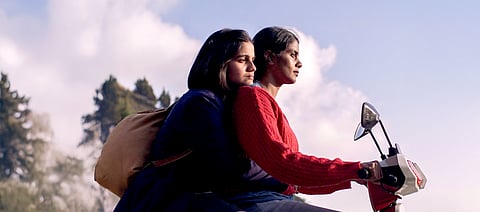


Shuchi Talati’s coming-of-age drama, Girls Will Be Girls weaves a story of dualities: the tender awakening of 18-year-old Mira (Preeti Panigrahi), contrasted against the subtle cruelties of growing up. Set against the backdrop of the Himalayan foothills, Girls Will Be Girls is a poignant exploration of womanhood, rebellion, and the unspoken ties between a mother and daughter.
Full of incredible performances, layered storytelling, and a sharp critique of societal norms, Talati brings to life a tale that refuses to compartmentalise feminism, choosing instead to reflect on its quiet, everyday battles.
The Hollywood Reporter India spoke to the debutant director about her creative vision, the nuances of crafting multidimensional characters, and resisting the urge to simplify emotional complexities.
Edited excerpts:
This is such a phenomenal debut; especially given how much effort it takes to make a film like this. Tell us how it became what it is and how you brought it out into the world.
Creatively, I started writing from a place of anger and rebellion. Many of us went to schools in India where there was constant surveillance — a policing of what we wore, how we behaved. Things like, “Don’t bend over that desk” or “Don’t talk to that boy.”
We grew up with so much shame around desire and sexuality. When I had a boyfriend in grades 10th to 12th, I hid it from everyone, even my best friend. I wanted to tell a story about desire and romance without shame — treating it as normal, as a part of growing up. I wanted the character to have fun.
Initially, the whole film was set in a school. The triangle was between Mira, Sri, and a teacher, exploring two generations of women trying to break free of societal constraints. But the script wasn’t coming together. While writing a separate short about a mother and daughter, I realised it was the same film.
Once the mother entered Girls Will Be Girls, it all came together. The richness and complexity of that relationship added so much.
And, from a production standpoint?
The film was in the co-production market, and I reached out to Richa Chadha, a dear friend from college. She was the only person I knew in the industry — I’d been living in the US for film school. I told her I was applying and wanted to list her as producer. She said, “Put it.”
She didn’t have a production company, so I used her cat’s name, Kamli, and called it Kamli Productions. We got into the market, and I told her she didn’t have to come; I could pitch alone. But she read the script, loved it, and decided to join. Slowly, the rest of the team came together. We finally shot in 2022. Independent filmmaking is a long journey—not for the impatient.
Is it hard to sell a film centered on women’s desire?
Probably. This film is an Indian, French, Norwegian, and American co-production — our funding came from all those places. This is not to make it sound cool, but to give you a sense of how many places had to come together for this. Every country has a different model; countries like France and Norway offer state grants, so they don’t have to worry about recovery, and they prioritise creativity over commercial returns.
In India, we had amazing partners like Blink Digital, and Richa and Ali (Fazal) fought for the film’s integrity. Richa, in particular, protected the film like her child before she had a child. In the US we had Cinema Inutile which is run by Alex C. Lo, they invest in films they really believe in, and they make an effort to support marginalised voices. The rest of the stuff falls in place once you find the right kind of support.
It’s possible we would’ve faced rejection if we’d approached people looking to make more conventional films, but we went to people who aligned with our vision.
Richa told me that with indie films, it’s about staying patient and waiting for the right partners...
We've been working together since 2018 — it’s now 2024. If you’re not aligned, small cracks can turn into big chasms over time.
Tell me about casting. Everyone wants to know — where did you find Preeti Panigrahi, and how did you direct her?
India is a huge country, and I was sure our Mira was out there. But as the production timeline approached, the fear was whether we’d find her in time. Our casting director, Dilip Shankar, used a two-pronged approach: auditioning actors with credits and conducting open calls through colleges and theater groups. Five months in, we saw Preeti’s tape. She stood out because she had this un-self-conscious quality and felt right. Kids these days are very self-aware of their angles and how they look thanks to Instagram, but Preeti had this abandon like a '90s kid — it was perfect for the film’s setting.
Preeti is Mira in many ways. She was the head prefect in school, she came to every rehearsal with a notebook... so she had direct access to Mira’s psychology. Directing her required little work. We did workshops, but her emotional and psychological connection to the role was effortless.
Tell me about creating, holding and releasing tension. Girls Will Be Girls keeps you on the edge of your seat, which is uncommon for a coming-of-age drama...
I love this question, because I always say, “I’m making a drama that feels like a thriller.” (laughs). Because I want that tension, I don’t want film viewing to be an intellectual activity where you’re watching from a distance. I want this full-body experience, where you gasp, and you clutch things because you are so involved. For me, there are two things that are important: you have to deeply care about the character; in this film there’s no immediate danger, no explosions or guns, but there’s emotional danger. A character can get hurt.
Two, I love to keep things unexpected — whether the performance or the writing. Kani (Kusruti) does a phenomenal job at this. I call it the livewire quality, it keeps you on the edge of your seat because you cannot predict what she, Kani the actor, will do next. She lends that to Anila, her character.
The release is instinctive. When we’re editing, we test with trusted audiences to see how it’s landing. Ultimately the final barometer is you — you just have to trust your gut. Fortunately, it worked like I wanted it to. Every glance, every cup of chai not given elicits a reaction from the audience like it’s a big deal. A friend of mine at the screening told me that people were reacting to this film like it was Singham (the 2011 action film). (laughs).
Sorry but that chai scene was a big deal!
I love that you're reacting this way — it means the build-up is working (laughs). What you asked about creating tension is important. The chai itself isn't a big deal, but it comes at a moment when you've had enough, and it's to Kani's credit that she's able to play that silence with such force.
Tell us about casting Kani Kusruti. Because she doesn’t look like Preeti’s mother, but their mother-daughter dynamic feels so authentic that it never feels out of place. Was Anila always envisioned as this character, with Kani naturally fitting the role? Or was Anila's character adjusted to better suit Kani?
That’s a great question and observation. I always believe in modifying characters to fit the actors. Actors come on board with their own gifts, and it would be a shame if you don’t make use of those gifts. When Kani came on board, Anila became Malayali — which opened up more possibilities. She’s a Malayali in North India, so it makes her more isolated like a fish out of water. When she’s angry, she switches to Malayalam which added richness to the role — which is why I think it’s always good to tweak once you lock the actor. As for their looks, many people don’t look like their parents. Do you care that they don’t look like each other?
I absolutely don’t. Because they feel like mother and daughter...
Exactly! When we did their chemistry read, I was so sure it worked because their chemistry felt true. Dilip (the casting director) always said the emotional quality of a relationship matters more than physical resemblance.
Let's talk about Sri and Kesav. His journey is so layered — you’re not sure of how you feel about him till the very end. Tell us about writing Sri and casting Kesav.
Writing Sri was challenging. It’s a tricky character. He needs to be the kind of boy you wouldn’t protect Mira from because the audience already deeply cares about Mira, and Sri can’t be too much of a red flag. He needed vulnerability and a sensitive core. In both writing and casting, Sri had to be boy enough for Mira and man enough for Anila. He had to be charming enough for Mira, but emotionally mature enough for Anila.
Casting Sri was a hard needle to thread. Keshav, from his first audition, had this core niceness and emotional intelligence. He brought a depth that worked beautifully with both Preeti and Kani. His chemistry with Preeti is so special that it made their romance feel real, and that’s crucial for a story like this.
Their chemistry is very crucial for the tension...
Precisely, you have to root for them. Preeti and Kesav became good friends in the process of filming, but they had sparks from the very first audition. You know when they lock their fingers? I stole that from their audition where they improvised this moment.
They are both so special and it was weird for me because they're kids in the film, and it made me introspect about the origin of my general discomfort with these themes. Tell me about normalising these otherwise “bold” or “sensitive” themes?
We don’t often talk about sexuality, and we rarely see it portrayed on screen. When it is absent or avoided, it gets placed in a shameful, hidden box—and that’s not good. It creates this sense that we shouldn’t feel it, shouldn’t discuss it, shouldn’t acknowledge it.
For me, it was really important to depict sexuality on screen in a way that avoids shame and instead normalises it. I wanted the filmmaking to treat it as something mundane and celebrate it, as I mentioned earlier.
But my focus wasn’t on the physical acts — the touching or the kissing. What I wanted to capture was the emotional layer of those moments. To me, the most vulnerable and revealing aspects of sexuality are the emotional exchanges, like when Mira confesses her insecurities about her body, or when she worries that her partner isn’t turned on.
Those moments are what sexuality is truly about. It’s an emotional dialogue between two people. Like any conversation, it can be hurtful, withholding, expressive, or angry. It’s dynamic and complex, just like any other interaction. That’s what I wanted to photograph.
And honestly, I think those are the moments where people feel truly seen — not the touch or the kiss, but the emotions we all recognise. When Mira expresses her insecurities, that’s when the audience might think, 'Oh, that’s so personal, so private. I’ve felt that too, even if I don’t always admit it to myself.'
Seeing those raw, emotional moments on screen is what makes people connect. It’s that deep, vulnerable truth that resonates with all of us.
How did you approach the film’s ending? No one is outright villainised, yet the boy’s ability to manipulate others is made clear. This complexity extends to Anila as well — at first, her actions make us question her as a mother, but later, we see her perspective and motivations. Even Mira’s reactions to her mother leave the audience grappling with mixed feelings. Everyone is given their grey zones, and the film resists simplifying characters into heroes or villains. How did you achieve this nuanced balance?
I want to have deep compassion for all my characters, and understand where they're coming from. That allows me to not completely paint them as black or white, and bring about a recognition that human beings are complicated.
As a mother, Anila has the intention of protecting her daughter, making sure she does well in her board exams, giving her freedom to explore this romance under her watchful eye — because she didn't get to do that. She had to hide and meet her boyfriend on buses. She's also lonely. She also doesn't get care and attention. She's also enjoying the attention and excitement her daughter's boyfriend brings into her life. She has to have all of those things. I'm not trying to simplify them; it's not one or the other.
I want the audience to sit in this soup, which is very similar, hopefully, to their inner emotional world, where you always feel these complicated things. I think it's a thing that people recognise, and I don't have to explain. We are all experts in human behaviour.
I think the idea is just to make all these complicated intentions legible to the audience. Hopefully both of those things together allow you to not hate any character or villainise them. You may not like some of the things they did, and actually, in the film, you're constantly shifting allegiances, but you're still understanding where they come from.
Girls Will be Girls is currently streaming on Amazon Prime Video.