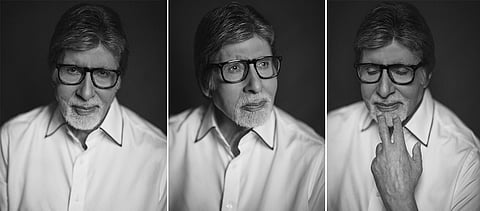


“I shot Mr Bachchan on the sets of Kaun Banega Crorepati (2000) just last week,” says photographer Rohan Shrestha, ecstatic about adding the illustrious actor to his popular White T Series.
A series of back-and-white headshots, Shrestha has been working on this collection for over 13 years. A self-professed introvert, he recalled how he struggled to strike conversations with new people. For the business of photography — in which a connection to the subject proves crucial — he found these simple headshots to be a great way to break the ice and establish rapport before starting a shoot.
“I had been dying to do this shoot with Mr Bachchan,” Shrestha says. From television host and producer Oprah Winfrey to football player Lionel Messi, actors Alia Bhatt, Priyanka Chopra Jonas, Ryan Reynolds, and even Shah Rukh Khan — the portfolio for the White T series is certainly expansive. But he adds, “For me, this (Amitabh Bachchan) is the holy grail. It's definitely the most exciting one so far. The whole series is based around the Indian actor. It has expanded (over the years), but if I go back to its roots — why I started it and why I do what I do — then Mr Bachchan is the ultimate, right?”
His father, the renowned photographer Rakesh Shrestha worked on over 600 films, capturing iconic actors like Sridevi and Madhuri Dixit Nene in the golden years of Indian cinema. “I am a nepo kid!” Shrestha admits with a laugh. The second-generation photographer said that, initially, he didn't want to follow in his father’s footsteps, contrary to what others thought. “And that’s because (Rakesh Shrestha) was a big name to live up to.”.
Shrestha tells The Hollywood Reporter India how the incidental White T series became a window into the celebrities’ most authentic selves — and how he managed to bring the legendary Big B on board.
What is the story behind these portraits?
I had called [actor] Abhishek [Bachchan] and told him that I really wanted to shoot with his dad, and I asked if he could help me with that. I showed him the pictures I’ve clicked of him, Shweta (Bachchan), Navya (Naveli Nanda) and Agastya (Nanda) — all part of a series of actor headshots I’ve been shooting for the last 13 years. I said to him, ‘You have to help me complete it, I've been waiting for years.’ Abhishek replied saying that it was great that I called him on that day because coincidentally, he was going to the sets of KBC to promote his film, I Want To Talk (2024). I reached there at night, and let me tell you, Mr Bachchan can really work. He was filming from seven that morning, and at 10:15 pm, he let me take these pictures of him backstage.
It’s a testament to his professionalism and just the man he is. He didn't have to do that — and it’s so inspiring. I was telling my team on the day too, that we complain about how much we work, while this is how Mr Bachchan works in his 80s. Sometimes he even sleeps in his vanity because he has a call time at 7 am the next day. This is what it takes.
When did you start the White T Series?
13 years ago, (actor) Abhay Deol wanted to go to New York and Los Angeles and asked me to click some headshots. I said to him, ‘Bro, I don't even know what a headshot is!’ I had just started my career in India at the time. I looked it up on Google at a time when everything in the world of the internet was new. I came across old Hollywood photographs of Leonardo DiCaprio and Robert Downey Jr. wearing white ganjis (tank tops) or white t-shirts and it just seemed really cool. I shot Abhay’s headshots and that’s how it started. Since we shoot digital in this era, I take about 60 frames roughly and pick from there.
When did it truly begin to take shape?
Maybe five-six years into my career when Jitesh Pillai (Editor, Filmfare) asked me why I didn't make it into a book. That's when I realised that it had become a series. It was never intentional, I happened to stumble into it and then consistently kept at it. Today, it’s what I'm known for. The simplest, easiest and most beautiful photos to shoot. And in my opinion, more authentic too. A lot of the actors do it without make-up and some I’ve just shot in their houses, with no teams around. It depends on the actor, but that’s the nature of it — it's vulnerable.
How many celebrities have you shot as part of this series?
I don't have a number... I'm still quite naive about the whole thing. Maybe someday I'll see it the way other people do, but for me, it's still a headshot, you know? That's how it all began.
I named it in 2015 and it stuck. Although, now the T-Series (music company) hashtag comes along with it. I didn't intend to do that but I’m screwed! (Laughs)
You’ve inherited your father’s camera gene…
I've grown up in the industry. My dad was friends with a lot of actors so when I was a kid, they all used to come home. That part of (being a celebrity photographer) never phased me, but what did was making a decision about my career when I was 18 years old. My dad worked on over 600 films and shot the iconic posters of Lamhe (1991) and Chandni (1989). He's of that ilk and did it for 30 years, so I knew I’d always be considered Rakesh's son in this industry. I didn't want to do it initially because there was a very big chance that I would fail… after all, photography is an art form. If I wasn't good, I just wasn’t. There's only that many opportunities that you get.