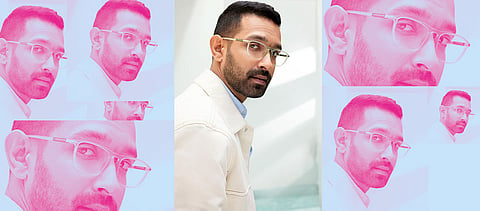


There’s no such thing as overnight success, and actor Vikrant Massey is living proof. He spent two decades quietly working his way up, before people finally took notice. His journey is one of steady determination.
12th Fail was the kind of breakout actors dream of, a turning point that put Massey in a whole new league. But with success comes expectations, and the pressure to follow up a hit can be as intimidating as the struggle to get noticed.
The Hollywood Reporter India caught up with Massey, as he reflected on what it means to have a “big break”, the pressure that follows, and how he stays grounded despite the noise.
How have things changed after the success of 12th Fail?
I'm happier, as an actor, as a person overall, because I've really waited for this. I've just been picking at things since my TV days. The nature of our job is such that you really don't know what the audience’s reaction is going to be. But I've also been fortunate.
When we made this film, Vinod (Chopra) sir wanted to go out there and give it his all. If I may be as candid, all of us wanted the film to do well for him, for Vidhu Vinod Chopra, the director. The amount of time that he put in, the amount of effort that he put in, and the amount of his investment was almost bordering insanity. And, of course, because it is “the India story”. The travesty of our time is such that it continues to be the India story even today, but it is “the India story”, and it inspired a lot of people. People took cognizance of the fact that I could probably shoulder a film. Feels good.
You are definitely going to be compared to a 12th Fail every now and then. I also recognise this very pragmatically, that every film cannot be a 12th Fail, but the resolve still remains to at least match that, if not better that. That was the first time I actually saw the audience take the film home with them.
I read this quote somewhere that Rolls Royce sells you status, Amazon sells you convenience, Disney sells you memories. I want to sell emotions. 12th Fail catapulted me a little closer towards that aspiration.
Do you think it has opened the floodgates?
Yeah, kind of. But that's the nature of life. That's how it's always been.
Is there pressure to keep the momentum going?
There is a sense of anticipation, and I will make sure that people get what they want. But I like to keep things interesting which is why I am doing a Sector 36, as I want to keep doing diverse roles. I have aspired to be an actor who's not bracketed, an actor who can possibly do anything. Sector 36 is a step closer towards that aspiration.
There is pressure sometimes, but I know it for a fact that there's no point in taking pressure. Is there an expectation from the audience, yes. Have I aspired for that expectation? Of course, yes. But the idea is to better myself as an actor. With every film, it might not necessarily be a huge commercial success like 12th Fail, but the idea is to be worth people's time. If I can at least consistently do that, then I think I'm in a decent space.
With films like Blackout (2024) or Phir Aayi Hasseen Dillruba (2024), even though there were mixed reviews, everyone's saying good things about your performance. After 12th Fail, has your approach to your craft changed? Are you looking at a project as a whole? How macro or micro-focussed are you?
I really love this question because this shift has actually happened. Earlier, when I started out with films, the idea was to get people to notice me. ‘I hope people see what I can do in these six scenes,’ which I probably did in Lootera (2013) and in Half Girlfriend (2017). Is that the case today? No. It kind of hurts when the film does not do well, but I do well because I want the film to do well too.
At the cost of sounding pompous or high-headed, I kind of recognise what you've just told me. Most of the reviews talk about me being decent at what I do, but the film not being up to the mark. Now, the idea is for the film to also do well, and all I can do is hope. I certainly can't be handling all the departments in a movie-making business, but I want to continue being consistent. I want to continue being loved for the work I do. But I hope that the films also do equally well because that is where the revenue probably comes in. That is where a little more respect comes in, and that is very important right now.
There's also a recognition of the fact that because of 12th Fail’s massive success, a lot of the other films have found homes because bankability is now a thing. One wants to be a bankable star. If you are headlining a project, does that ever come down to your performance where you feel the need to be more saleable?
Wow, you're asking such lovely questions.
You are asked to contemplate or made to contemplate, but I choose not to. When I say this what I mean is, am I going to do something that is substandard to be saleable? No. Am I going to do something that is saleable, and compromise my work ethic or compromise my standard of job? No, I don't think I will do that. And I hope you know what I'm talking about, right?
Is that possible? Because there are so many other factors at play.
I don't know either. Of course, there are so many peripherals. You really don't know what works. But what I'm trying to say is, to be a bankable actor, am I going to go out there and do something, which, from my prism, is substandard? I will not do that. That is the reason why I am doing Sector 36.
I don't care about the medium either. You know, I am not in a rut that post-12th Fail all my films have to come in cinema halls. No, I have to be worth people's time. For me, the barometer of success is not only box office success; the barometer of success for me is an archival value.
What if a film like 12th Fail or A Death in the Gunj, or even a series like Mirzapur, attain a certain sense of archival value? That, for me, is a much bigger validation as an artist. That is what I am chasing in the long run. But I also want my films to make money. I also want my producers to have a certain sense of profit.
Has there been an immediate shift in how people treat you after 12th Fail?
Yeah, of course! And not just people on sets, I think most places. People are nicer. Especially in the film business because the film has done well and I've picked up a few awards, they've started seeing me in a different light. But it doesn't surprise me. Neither do I take it seriously, nor do I have any disdain towards it.
But do you enjoy it?
I mean, I see it as dark humour, actually. It's funny because I've seen this in life, and now that I'm experiencing it firsthand, I know that such is the nature of life. That's how it's always been even way before I existed. And it'll continue to be so even after I'm gone. But when you're experiencing it yourself you try seeing the humour in all of it.
I go back home and I tell my wife, ‘You know, I bumped into a person who would look through me or probably avoid me four years ago, but now when I walk into the same room, the same person is warmer than expected. They want to stand with you for five more minutes and talk to you, even want to exchange numbers with you.’ But that's dark humour. I see it that way.
You are still playing characters rooted in reality. When your reality no longer resembles that, does it get harder to then tap into it? Or is there a method to it at this point?
There could be a method to it. I don't know. Is it getting harder? Maybe. How will I retain it? I think I have a very robust family system.
So it grounds you?
Yes. And I've been in the business far too long to get swayed away by momentary success or failure. I've been here for 21 years and I say I've just begun. So again, this is crazy dark humour. You have to find humour in life, you really cannot be very serious about everything.
All of it is very transient in nature. I recognise that at some point, all of this is going to come to an end. I might want to put my feet up and do nothing at all and just probably farm or write or read. You know, I still eat the same food, I am borderline introverted. I go back home to the same people, I hang around with the same friends. But post-12th Fail, yes, there are a few more people who want a bit of you, which could sometimes get uncomfortable, but I'm not yet complaining.
Sector 36 is a particularly solid performance. Do you have an affinity for crime thrillers?
I mean, I used to read a lot of it. When I just picked up books they would often be Sidney Sheldon, John Grisham, Jeffrey Archer, and all these guys. But I think a lot of it is beyond my control because it is the audiences who are actually watching crime thrillers. And hence, there are more crime thrillers being made. So somebody has to act in those films. I see it that way. Even the data suggests that most of the stuff that people are watching is crime thrillers.
Then do these decisions come back to the whole saleability, commercial value factor? Are you picking what’s more likely to work?
Nobody knows what works.
If you were to pick purely based on your interest, would you pick a crime thriller over a romance or a drama? What is your natural inclination?
It depends on multiple factors. A choice is an amalgamation of so many things coming together. It's a very insular process.
Is it going to excite me as an actor? I want to go out there and I want to surprise the audiences every now and then with my portrayals of characters. Does it give me an opportunity to achieve that? Is he or she the director I want to work with?
And lastly, and most importantly, what does the film want to say? I want to have a certain archival value. I want people to look back at me once I'm gone and remember me as a storyteller. I want to be the guy who reflected the times that he was living in. If I am able to achieve that, I have achieved my purpose.
My wife is my biggest advisor and my sharpest critic, and she said to me, ‘Your work is going to outlive you. Make it worth it.’
Is there someone you have worked with who has fundamentally shifted how you look at your art?
I think there are a few actors and directors. I remember I was doing this show called Balika Vadhu, and there was an actor called Satyajit Sharma; he was from NSD (National School of Drama) and was highly respected in the theatre circuit. But unfortunately, we couldn't see much of him in cinemas. He was phenomenal in Balika Vadhu. I learned a lot of things from him. The very first thing he told me was, ‘Cut the superfluous.’ I didn't even know what superfluous meant at that time. He would share his knowledge with me. When I saw him act, I was spellbound by what he did. But what also broke my heart was that not a lot of people knew him. Whenever I would see him, I would say, it's so unfair that a man of such tremendous calibre has not got his due.
Since then I have resolved that I don’t want to let this happen to me.
Another person who very recently came into my life and who has really inspired me is Vidhu Vinod Chopra. I call him my home for many reasons. He is not just a director I love working with, but also a mentor I love taking advice from; he's my sounding board. He's my father figure who will always talk to me straight. He made me realise so many things about my own self, which I probably doubt even today, from time to time. But I know he's there. I know Satyajit sir is also always there.
I look up to my parents. I look up to my wife. I have a few friends who've been there with me through thick and thin — it takes a village to raise one. It's taken a village to raise me as well.